Classification of Ecosystems - Environment Notes
An ecosystem is a geographical area in which plants, animals, and other species, as well as weather and topography, collaborate to build a living environment. Abiotic elements, or nonliving parts, coexist in ecosystems. Ecosystems are divided into two types: Natural ecosystems, and Man-made Ecosystems. This article will explain to you what will be helpful in preparing the Environment syllabus for the UPSC Civil service exam.
|
Table of Contents |
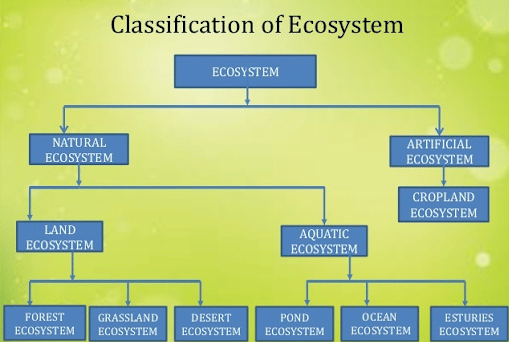
Classification of Ecosystem
Ecosystem - Concept
 Ecosystem |
Classification of Ecosystems
Natural Ecosystem
- A natural ecosystem is an assemblage of plants and animals that works as a unit and is capable of retaining its identities, such as a forest, grassland, or estuary.
- A natural ecosystem may sometimes include human intervention.
- Solar energy is essential to a natural ecosystem's survival.
- Natural Ecosystems are divided into two groups. They are:
- Terrestrial ecosystems include forests, grasslands, deserts, and tundra ecosystems.
- Aquatic ecosystems include plants and animals that live in bodies of water.

Categories of Natural Ecosystem
*To know more about this, click Natural Ecosystem
Terrestrial Ecosystem
- Terrestrial ecosystems are ecosystems that are mostly found on land.
- Terrestrial ecosystems cover roughly 140 to 150 million km2, or about 25 to 30 percent of the total land area on the planet.
- The decreased availability of water in terrestrial ecosystems, as well as the role of water as a limiting factor, distinguishes them from aquatic ecosystems.
- Since the atmosphere is more transparent than water, light is more readily available in terrestrial environments than in aquatic ecosystems.
- Terrestrial ecosystems have more gas availability than aquatic environments.
- Terrestrial ecosystems are further divided into the following.
- Forest Ecosystems
- Grassland Ecosystems
- Desert Ecosystems
- Tundra Biome

Terrestrial Ecosystem
*To know more about this, click Terrestrial Ecosystem
Aquatic Ecosystem
- An aquatic ecosystem is one that is based on water.
- The word 'aquatic' is derived from the Latin word 'aqua', which means water.
- So, in a water-based setting, an aquatic ecosystem is a community of species that live together, interact, and to some extent rely on one another.
- Aquatic ecosystems are divided into the following subcategories based on the concentration of salt content.
- Freshwater Ecosystems: Rivers, lakes and ponds.
- Brackish Water Ecosystems: Mangroves, Estuaries, etc.
- Marine Ecosystems: Oceans, Seas, etc.

Aquatic Ecosystem
*To know more about this, click Aquatic Ecosystem
Man Made (Artificial) Ecosystems
- Artificial or man-made ecosystems are ecosystems that are created and managed by humans.
- Man-made terrestrial ecosystems include gardens, parks, plantations, orchards, villages, and towns.
- Man-made aquatic ecosystems include lakes, canals, aquaria, fisheries tanks, reservoirs, and dams.
- Artificial ecosystems have a limited number of species and plants, whereas natural ecosystems have a diverse number of species and plants.
- Natural ecosystems are self-sustaining and emerge from natural processes, whereas artificial ecosystems require human intervention.
Significance of Ecosystems
- The ecosystem provides a habitat for a variety of wild flora and fauna.
- It encourages the development of numerous food chains and food webs.
- They regulate vital ecological processes and help people live longer.
- The ecosystem participates in nutrient recycling between biotic and abiotic components.
Potential Threat to Ecosystems
Environmental Pollution
- Artificial or man-made ecosystems are ecosystems that are created and managed by humans. Aquariums, gardens, farms, apiaries, poultry, and piggeries are examples of man-made ecosystems. Pollution of the air, land, water, and soil has a direct impact on the health of critical ecosystems.
- Pollution can discharge toxic compounds and damaging chemicals into the environment as a result of natural or artificial causes, endangering the health of living creatures and degrading the nature of non-living objects.
- Water pollution, for example, can disrupt the biological equilibrium in an aquatic system by increasing plant and nutrient development.
- It eventually results in the death of fish due to suffocation caused by dissolved oxygen depletion.
- Pollution has a variety of consequences, including interfering with natural ecosystem cycles such as the oxygen cycle, nitrogen cycle, water cycle, and food chain, resulting in ecosystem destruction.
Over-exploitation of Natural Resources
- The environment has been seriously harmed by the overexploitation of natural resources to the point of diminishing returns.
- Overhunting, overfishing, over mining, and overlogging have resulted in a decrease in community structures, population distributions, and species breeding.
- Excessive fishing, for example, has resulted in the extinction of more than a third of all fish species, and some are now endangered.
Invasive Species
- Foreign species (Invasive Species) that enter an environment through human or natural means can cause substantial harm to the ecosystem's resident species.
- When this happens, native species may be completely wiped out or have a difficult time surviving.
- Invasive species often compete with native species for food, and they can also change the habitat.
- Ecosystems are gradually depleted, and species are completely eradicated as a result.
- The introduction of alien Nile Tilapia into Lake Victoria in the 1970s, according to the WWF (World Wide Fund for Nature), resulted in the loss of more than half of the local cichlid fish family.
Eutrophication
- It is the overabundance of chemical nutrients in water bodies to the point where dense plant growth and algal blooms are encouraged.
- Depletion of oxygen, substantial deterioration of water quality, poisoning of seafood, and loss of recreational opportunities are all results of eutrophication, depending on the degree of eutrophication.
- As a result, it has an impact on fish and other aquatic life forms' survival.
- Toxic algal blooms in water bodies have harmed aquatic life and reduced the availability of clean water, posing a hazard to ecosystems.
Climate Change and Global Warming
- The ecosystems are under threat from climate change and global warming.
- Climate change and global warming have a direct impact on the abiotic factors that keep the biotic elements alive.
- The current rate of global warming is damaging and modifying coral reefs, mountain regions, and water cycles, all of which are essential ecological resources.
- Different species, for example, require different abiotic elements to thrive.
- If global warming and climate change continue, 10% of all species on the planet could go extinct by 2050.
- Thus the changes in the natural ecosystem pose a threat to biodiversity around the world and have ramifications for global food production.
Conclusion
Ecosystems aid in the maintenance of a normal energy flow, which includes the Carbon Cycle, Energy Cycle, Nitrogen Cycle, Oxygen Cycle, and Water Cycle. Aside from these benefits, the ecosystem is significant for weed control, crop rotation, grassland and forest management, biological surveys, soil conservation, and wildlife conservation, among other things
FAQs
Question: What is an ecosystem?
Answer: An ecosystem is a community of living organisms interacting with each other and their non-living environment, such as air, water, and soil.
Question: How are ecosystems classified?
Answer: Ecosystems are classified into terrestrial (land-based) and aquatic (water-based) ecosystems. They can also be further divided into natural and artificial ecosystems.
Question: What is a terrestrial ecosystem?
Answer: A terrestrial ecosystem is one that is found on land, such as forests, deserts, grasslands, and tundras, with plants and animals adapted to these environments.
Question: What is the difference between freshwater and marine ecosystems?
Answer: Freshwater ecosystems include lakes, rivers, and ponds, while marine ecosystems include oceans, seas, and estuaries. Marine ecosystems contain saltwater and support a different range of species compared to freshwater ecosystems.
Question: What is an artificial ecosystem?
Answer: An artificial ecosystem is created or heavily modified by humans, such as agricultural fields, urban parks, or reservoirs, and often requires human intervention to maintain.
MCQs
1. Which of the following is a type of terrestrial ecosystem?
A) Coral reefs
B) Grasslands
C) Oceans
D) Lakes
Answer: (B) See the Explanation
Grasslands are an example of a terrestrial ecosystem, found on land and characterized by vast open areas with grass and herbaceous plants.
2. What type of ecosystem is the Amazon Rainforest?
A) Freshwater ecosystem
B) Marine ecosystem
C) Terrestrial ecosystem
D) Artificial ecosystem
Answer: (C) See the Explanation
The Amazon Rainforest is a type of terrestrial ecosystem, known for its biodiversity and extensive tropical forests.
3. What distinguishes a natural ecosystem from an artificial one?
A) Presence of humans
B) Lack of biodiversity
C) Occurrence without human intervention
D) Located in urban areas
Answer: (C) See the Explanation
A natural ecosystem occurs without significant human intervention and maintains its biodiversity and natural processes, while an artificial ecosystem is created or altered by humans.
4. Which of the following is an example of an aquatic ecosystem?
A) Forest
B) Desert
C) River
D) Grassland
Answer: (C) See the Explanation
A river is an example of a freshwater aquatic ecosystem, supporting a variety of aquatic plants, fish, and other organisms.
5. What is a microecosystem?
A) A small-scale ecosystem like a pond
B) A large ecosystem like a forest
C) An ecosystem created in laboratories
D) A marine ecosystem
Answer: (A) See the Explanation
A microecosystem is a smaller ecosystem, such as a pond, where all the interactions between species and their environment occur on a smaller scale.
GS Mains Questions and Model Answers
Q1: Discuss the importance of classifying ecosystems and its role in environmental conservation.
Answer: Classifying ecosystems is essential for understanding the variety of habitats, species interactions, and environmental processes that occur on Earth. This classification allows for better management and conservation of natural resources. Each type of ecosystem—whether terrestrial, aquatic, or artificial—supports unique biodiversity and provides specific ecosystem services like carbon sequestration, water purification, and climate regulation. By classifying ecosystems, we can prioritize areas for conservation, implement sustainable development policies, and address environmental challenges such as deforestation, habitat destruction, and pollution more effectively.
Q2: Analyze the role of artificial ecosystems in modern human society.
Answer: Artificial ecosystems, such as agricultural fields, urban gardens, and reservoirs, play a crucial role in supporting human life. They provide essential resources such as food, water, and raw materials. In modern society, artificial ecosystems are carefully managed to optimize production and resource use. However, these ecosystems often require significant human intervention and can disrupt natural processes, leading to issues like biodiversity loss and pollution. Balancing artificial ecosystems with the preservation of natural ecosystems is key to achieving sustainability and addressing environmental challenges like climate change and resource depletion.
Q3: Evaluate the challenges in conserving aquatic ecosystems in India.
Answer: Conserving aquatic ecosystems in India presents several challenges due to pollution, over-exploitation of resources, and habitat destruction. Freshwater ecosystems like rivers and lakes face issues such as industrial discharge, agricultural runoff, and urbanization, leading to water pollution and loss of biodiversity. Marine ecosystems are threatened by overfishing, coral bleaching, and oil spills. Additionally, climate change is impacting water temperature and sea levels, further affecting aquatic habitats. Effective conservation strategies require stricter regulations on pollution, sustainable fishing practices, and community involvement in preserving the health of aquatic ecosystems.
Previous Year Questions on Classification of Ecosystems
1. UPSC CSE Mains 2016 (GS Paper 3)
Question: Discuss the significance of wetland ecosystems and the challenges in their conservation in India.
Answer: Wetland ecosystems are vital for biodiversity, water purification, and flood control. They serve as breeding grounds for various species of fish and birds and act as natural filters, removing pollutants from water. In India, wetlands like the Sundarbans and Chilika Lake are crucial for the local economy and environment. However, these ecosystems face challenges such as urbanization, pollution, and agricultural expansion, leading to their degradation. Conservation efforts need to focus on restoring wetland habitats, enforcing pollution control laws, and promoting sustainable land use practices around wetlands.
2. UPSC CSE Mains 2018 (GS Paper 3)
Question: Analyze the impact of human activities on aquatic ecosystems and suggest measures to mitigate these effects.
Answer: Human activities, such as industrial discharge, overfishing, and urban development, have severely impacted aquatic ecosystems. Rivers, lakes, and oceans are polluted with chemicals, plastic waste, and untreated sewage, leading to the loss of aquatic life and ecosystem services. Overfishing has disrupted marine food chains, and habitat destruction has reduced biodiversity. To mitigate these effects, stricter pollution control measures, sustainable fishing practices, and the restoration of degraded aquatic habitats are needed. Public awareness and community involvement in conservation efforts are also crucial for the long-term health of aquatic ecosystems.
Download the PREPP App and attempt FREE IAS Exam Mock Tests and get complete study material!

Live Test : UPSC CSE Prelims CSAT (Paper-II) (Oct 20 - 23)
Full Test - 04: UPSC CSE Prelims CSAT (Paper-II)
Full Test - 03: UPSC CSE Prelims CSAT (Paper-II)
UPSC CSE Prelims 2026 GS Paper 1 Question Paper (24-May-2026)
UPSC CSE Prelims 2026 CSAT Paper 2 Question Paper (24-May-2026)

17 February 2025 | The Hindu Must Read Articles | Current Affairs

16 February 2026 | The Hindu Must Read Articles | Current Affairs

13 February 2026 | The Hindu Must Read Articles | Current Affairs









Comments