Causes of Deforestation - Environment Notes
Deforestation is caused by a variety of causes, both human and natural. Natural processes that induce deforestation include natural forest fires and parasite-caused diseases. Human activities, however, are one of the primary causes of worldwide deforestation. According to the Food and Agriculture Organization (FAO), agriculture accounted for approximately 80% of worldwide deforestation, with infrastructure projects such as roads and dams, as well as mining and urbanisation, accounting for the remaining sources of deforestation. This article will explain to you the Causes of Deforestation which will be helpful in preparing the Environment syllabus for the UPSC Civil service exam.
|
Table of Contents |
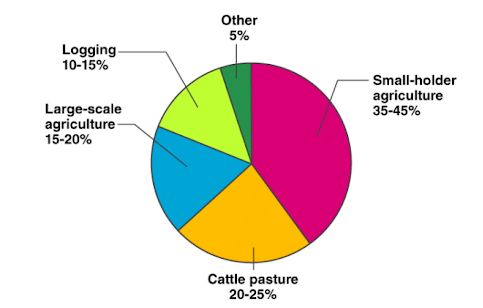
Causes of Tropical Deforestation
What is Deforestation?
- Deforestation, often known as forest clearance, is the process of removing a forest or a stand of trees from land before it is changed to a non-forest usage.
- Forest areas can be converted to farmland, ranches, or urban usage as part of deforestation.
- Tropical rainforests have the highest concentration of deforestation.
- At the moment, forests cover about 31% of the Earth's land surface.
- This is one-third less forest cover that existed prior to the expansion of agriculture, with half of the loss occurring in the last century.
- Every year, between 15 million and 18 million hectares of forest, roughly the size of Bangladesh, are deforested. Every minute, an average of 2,400 trees are felled.
*To know more about this topic, click this link Deforestation
|
|
|
|---|---|
| Importance of Forest | Impact of deforestation |
| Deforestation | Types of Grasslands |
Causes of Deforestation
Shifting Cultivation
- Shifting Cultivation is thought to be responsible for about half of tropical deforestation.
- In shifting agriculture, crops are cleared from the land after two or three years of producing vegetables and grains.
- It is abandoned by the migrants in favour of another site. Slash-and-burn procedures are commonly used to clear land—trees, bushes, and woods are slashed, and the leftover vegetation is burned.
- They are done because the ashes from the burning contribute potash to the soil.
- As a result, detrimental consequences such as localised deforestation, soil erosion, and nutrient loss can be detected.
- As a result of rising demand for food and fodder, shifting agriculture is one of the primary causes of deforestation and land degradation.
Development Project
- Deforestation has also been fueled by the construction of human infrastructure and development projects.
- More specifically, new infrastructures that service the contemporary human lifestyle in four ways: transportation, transformation, and energy generation, account for 10% of deforestation.
- On the one hand, roads, railways, ports, and airports have been created to transport a wide range of items – from grains and fruits to spices, minerals, and fossil fuels – to trading hubs or transformation sites.
- While there were simply fruit trees at first, highways were soon built, allowing products to be transported to other parts of the country.
- While some items were and are manually obtained, others, such as coal, oil, natural gas, biomass, but also meat, dairy, and spirits, required the building of enormous extraction, transportation, and/or storage facilities.
Biofuels
- Sustainable biofuels have the potential to support rural development while also displacing fossil fuels.
- Biofuels were seen as one of many solutions to climate change in the early 2000s.
- However, more recent research suggests that many biofuels may produce more greenhouse gases than fossil fuels.
- Biofuels also contribute to deforestation in addition to competing with feeding a growing global population.
- As most of these products demand a lot of space, forested areas may be cleared or burned to make room for agricultural expansion.
Raw Material Requirements
- Food and raw materials such as cotton, as well as minerals, are in high demand in.
- As a result, forests must be converted to agriculture, pastureland, or mining areas.
- With the advent of digitalization and renewable energy technologies, global demand for raw materials like copper, aluminium, and lithium will skyrocket in the future.
- Thus they have a huge potential in contributing to deforestation.
Other Causes
Land Desertification
- Other causes that contribute to deforestation are partially natural and partly manmade, such as land desertification.
- Land Desertification arises as a result of land exploitation.
- This ultimately renders the area unsuitable for trees development.
- Many petrochemical firms dump trash into rivers, causing soil erosion and making it unsuited for growing plants and trees.
Mining
- Mining for oil and coal necessitates a large area of forest land.
- Aside from that, roads and highways must be constructed to accommodate trucks and other heavy equipment.
- As a result of the necessity for all of these resources, trees and forests are cleared.
- Furthermore, mining waste pollutes the ecosystem and has an impact on surrounding animals.
- Direct mining impacts on forests occur inside the boundaries of extraction sites, and are caused by the development or expansion of extraction sites, waste rock dumps, backwater basins, processing facilities and highways within the mining region. They are, however, only a small part of the larger deforestation problem.
Overpopulation and Urbanization
- Deforestation is being aided by a demographic shift that is causing people to migrate from rural to urban regions (5 percent , according to FAO).
- As a result of this urbanisation, cities are predicted to house 68 percent of the world's population by 2050.
- This estimate will eventually result in a rapid increase in the number of housing and consumption sites.
- And, when cities grow in size to accommodate more people, they push against the natural boundaries that surround them, resulting in deforestation.
- One of the reasons for deforestation is because of this.
Livestock Ranching
- Livestock is considered to be responsible for around 14% of all deforestation on the planet.
- To raise cattle and grow food, farmers frequently clear land by felling trees and burning them.
- They continue to exploit the property until the soil has degraded completely, then repeat the process on new woodland.
- It will eventually reforest, although it will take many years to restore to its previous state.
- Surprisingly, the forest area has decreased by over 40% in the last 40 years, while grassland regions and cow populations have increased dramatically and rapidly.
Forest Fires
- Forest fires are another good example.
- Forest fires kill hundreds of trees each year in different parts of the world.
- It occurs as a result of extremely hot summers and milder winters.
- Whether caused by man or nature, forest fires result in catastrophic forest destruction.
Paper
- The Environment Paper Network estimates that each year, 640 million trees are discarded due to paper waste.
- America, China, Canada, and Japan produce more than half of the world's paper, or 400 million tonnes each year.
- Recycling might prevent the release of 27.5 million tonnes of carbon dioxide into the environment.
- When we utilise recycled paper, we help to ensure that forests remain a healthy ecosystem and wildlife habitat.
Causes of Deforestation in India
- Deforestation in India is mostly caused by agriculture, timber harvesting, mining, and indiscriminate dam construction for hydroelectric power projects.
- Another factor is the increased urbanisation that comes with a growing population.
- Many forests, scrubland, and even agricultural regions have been destroyed by expanding development, which is regrettable.
- In a nutshell, it's a terrible case of habitat destruction in India.
Conclusion
Experts disagree over whether industrial logging contributes significantly to global deforestation. Some claim that poor people are more inclined to clear forests because they have no other options, while others argue that the poor lack the financial means to pay for the supplies and labour required. In only 8% of situations, population growth due to high fertility rates were shown to be the key cause of tropical deforestation, according to one study.
FAQs
Question: What are the primary causes of deforestation?
Answer: Deforestation is the large-scale removal of forests for various human activities. The primary causes of deforestation include:
- Agricultural Expansion: The conversion of forests into agricultural land for farming, especially in tropical regions, is a significant driver of deforestation.
- Urbanization: The growing population leads to urban sprawl, with forests being cleared for the construction of cities, towns, and infrastructure.
- Logging: Commercial logging for timber and paper products contributes significantly to deforestation, particularly in rainforests.
- Mining: The extraction of minerals and fossil fuels from forested areas leads to deforestation and environmental degradation.
- Climate Change: Droughts, increased temperatures, and other impacts of climate change can weaken forests, making them more susceptible to deforestation.
Question: How does agricultural expansion contribute to deforestation?
Answer: Agricultural expansion is one of the largest contributors to deforestation. As demand for food and biofuels increases, forests are cleared to create agricultural land. In many tropical countries, large areas of forest are cut down to plant crops such as palm oil, soybeans, and sugarcane. The shift from subsistence farming to commercial agriculture also accelerates the destruction of forests. This deforestation disrupts ecosystems, contributes to loss of biodiversity, and increases greenhouse gas emissions.
Question: What role does urbanization play in deforestation?
Answer: Urbanization plays a significant role in deforestation, especially as the global population continues to grow. Cities and towns expand to accommodate the increasing demand for housing, roads, and infrastructure. Forests are often cleared to make way for urban development, leading to habitat loss and reduced biodiversity. In addition, urbanization increases pollution and resource consumption, which further pressures forest ecosystems.
Question: How does logging contribute to deforestation?
Answer: Logging, both legal and illegal, contributes significantly to deforestation. Timber is harvested for use in construction, furniture, and paper products. In many cases, forests are cleared for logging without adequate replanting or conservation measures, leading to permanent damage to the ecosystem. In tropical rainforests, where biodiversity is high, logging not only destroys trees but also harms the overall ecological balance.
Question: What is the relationship between deforestation and climate change?
Answer: Deforestation is both a cause and a consequence of climate change. When forests are cut down or burned, carbon stored in trees is released into the atmosphere, contributing to global warming. Additionally, deforestation disrupts the natural carbon cycle, as forests act as carbon sinks, absorbing CO2 from the atmosphere. The loss of forests exacerbates climate change by reducing the Earth's ability to mitigate rising CO2 levels. Conversely, climate change also leads to conditions such as droughts, which make forests more vulnerable to destruction.
MCQs
1. What is the primary cause of deforestation worldwide?
A) Mining
B) Logging
C) Agricultural Expansion
D) Natural Disasters
Answer: (C) See the Explanation
Explanation: Agricultural expansion is the primary cause of deforestation globally. Forests are cleared to make way for crops and livestock farming, which has been a significant driver of forest loss in tropical regions.
2. How does urbanization contribute to deforestation?
A) By increasing forest cover
B) By reducing the need for forest resources
C) By expanding cities into forested areas
D) By promoting forest conservation
Answer: (C) See the Explanation
Explanation: Urbanization contributes to deforestation by expanding cities into forested areas for housing, infrastructure, and commercial activities, leading to the destruction of natural habitats.
3. Which of the following is a consequence of deforestation?
A) Increased biodiversity
B) Enhanced air quality
C) Habitat loss and climate change
D) Improved soil fertility
Answer: (C) See the Explanation
Explanation: Deforestation leads to habitat loss, reduced biodiversity, and contributes to climate change as trees, which store carbon, are removed from the ecosystem.
4. Which of the following practices is a major contributor to deforestation in tropical regions?
A) Overgrazing by livestock
B) Industrialization
C) Illegal logging and agriculture
D) Pollution from industries
Answer: (C) See the Explanation
Explanation: Illegal logging and agricultural expansion, including the conversion of forests into farmland, are major drivers of deforestation in tropical regions, especially in Southeast Asia and the Amazon.
5. Which element of deforestation contributes most to global warming?
A) Forest clearing for mining
B) Forests absorbing CO2
C) Burning of forest biomass
D) Creation of wildlife reserves
Answer: (C) See the Explanation
Explanation: The burning of forest biomass during deforestation releases significant amounts of CO2 into the atmosphere, contributing to global warming by increasing the greenhouse effect.
GS Mains Questions and Model Answers
Q1: Analyze the impact of deforestation on biodiversity. How does the loss of forests affect ecosystems?
Answer: Deforestation leads to the destruction of habitats, causing a significant loss in biodiversity. Forests are home to millions of species, many of which are not found anywhere else on Earth. The loss of forests forces species to migrate or face extinction, disrupting ecosystems and food chains. Additionally, the fragmentation of forests reduces genetic diversity, making species more vulnerable to diseases and environmental changes. The loss of forest ecosystems also affects the services that forests provide, such as clean water, soil fertility, and climate regulation, which further impacts human communities and agricultural productivity.
Q2: Discuss the relationship between deforestation and climate change. How do these two factors interact to exacerbate global warming?
Answer: Deforestation contributes to climate change by releasing large amounts of CO2 into the atmosphere, as trees store carbon during their life cycle. When forests are cleared or burned, this stored carbon is released, contributing to the greenhouse effect and accelerating global warming. Additionally, forests play a crucial role in regulating the Earth's climate by absorbing CO2 from the atmosphere. As forests are lost, the Earth's ability to mitigate climate change diminishes, leading to higher temperatures, altered weather patterns, and more extreme climate events. Thus, deforestation and climate change create a vicious cycle, where deforestation contributes to global warming, which in turn makes it harder for forests to regenerate.
Q3: Evaluate the role of government policies in combating deforestation. What strategies can be implemented to reduce forest loss?
Answer: Government policies play a critical role in combating deforestation by regulating land use, enforcing conservation laws, and promoting sustainable development practices. Strategies to reduce forest loss include:
- Enforcing stricter regulations: Governments can implement and enforce laws to prevent illegal logging, unsustainable farming, and forest encroachment.
- Promoting reforestation: Governments can support reforestation and afforestation programs to restore lost forests and protect existing ones.
- Incentivizing sustainable farming: Policies that promote agroforestry, sustainable agriculture, and organic farming can reduce the need for deforestation.
- International cooperation: Deforestation is a global issue, and international cooperation is essential to address the problem. Governments can work together to share resources, knowledge, and technology for forest conservation.
By combining these strategies, governments can effectively reduce deforestation and promote long-term environmental sustainability.
Previous Year Questions on Deforestation and Environmental Issues
1. UPSC CSE Prelims 2019:
Question: What is the major cause of deforestation in tropical countries?
A) Climate change
B) Agricultural expansion
C) Mining
D) Overpopulation
Answer: (B)
Explanation: Agricultural expansion, particularly for cash crops like palm oil and soy, is the major cause of deforestation in tropical countries.
2. UPSC CSE Mains 2020 (GS Paper 3):
Question: "Examine the relationship between deforestation and climate change. What measures should be taken to mitigate deforestation?"
Answer: Deforestation contributes to climate change by releasing CO2 into the atmosphere, which exacerbates global warming. Measures to mitigate deforestation include enforcing stricter environmental regulations, promoting sustainable agriculture and forestry practices, and supporting international efforts for forest conservation. By addressing both the causes and consequences of deforestation, we can reduce the impact of these practices on the climate.
Download the PREPP App and attempt FREE IAS Exam Mock Tests and get complete study material!

Full Test - 04: UPSC CSE Prelims CSAT (Paper-II)
Full Test - 03: UPSC CSE Prelims CSAT (Paper-II)
UPSC CSE Prelims 2026 GS Paper 1 Question Paper (24-May-2026)
UPSC CSE Prelims 2026 CSAT Paper 2 Question Paper (24-May-2026)

17 February 2025 | The Hindu Must Read Articles | Current Affairs

16 February 2026 | The Hindu Must Read Articles | Current Affairs

13 February 2026 | The Hindu Must Read Articles | Current Affairs









Comments