Causes of Civil Disobedience Movement - Modern India History Notes
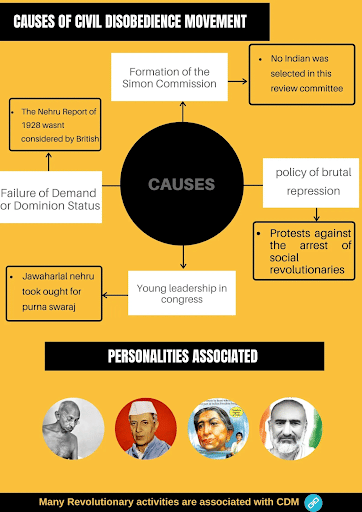
The Civil Disobedience Movement was one of the most important movements launched by Mahatma Gandhi during India's Independence Struggle. Civil Disobedience refers to a citizen's active, professed refusal to obey certain laws, orders, or demands of a government. Establishment of Simon Commission, demand for dominion Status, protests against arrest of social revolutionaries etc were causes of Civil Disobedience Movement. M.K. Gandhi started this movement in India (Dandi) in 1930 by breaking the salt law. In this article, we will discuss the Causes of Civil Disobedience Movement which will be helpful for UPSC exam preparation.
|
Table of Contents |

Civil Disobedience Movement - How it Began?
- Under Mahatma Gandhi's leadership, civil disobedience was born. It was established following the celebration of Independence Day in 1930.
- The civil disobedience movement began with Gandhi's infamous Dandi March on March 12, 1930, when he set out on foot from the Sabarmati Ashram in Ahmedabad with 78 other Ashram members for Dandi.
- Gandhi broke the salt law after arriving in Dandi. Making salt was considered illegal because it was a government monopoly.
- The Salt Satyagraha resulted in widespread support for the civil disobedience movement across the country.
- This event became emblematic of people's opposition to government policies.
Civil Disobedience Movement - Causes
The civil disobedience movement was fueled by three major factors:
Establishment of Simon Commission
- The British government in the United Kingdom established the Indian Statutory Commission, popularly known as the Simon Commission after its Chairman's name, in November 1927 to recommend further constitutional reforms in India.
- However, no Indian was nominated as a member of the commission, which sparked outrage in India because the British government's decision to exclude Indians from the Simon Commission implied that Indians were unfit to decide the next course of constitutional reforms.
- As a result, wherever the commission went in India, there were massive demonstrations and strikes.
Demand for Dominion Status
- In the December 1928 Calcutta session of the Indian National Congress (INC), a demand for dominion status (Swaraj) was raised, and the British Indian government was given a year to accept the Congres' demands.
- If it failed then nothing short of complete independence from foreign rule would become the primary goal of the Congress, and a civil disobedience movement led by Mahatma Gandhi would be launched to achieve this goal.
Protests Against the Arrest of Social Revolutionaries
- Bhagat Singh and Batukeshwar Dutt of the Hindustan Socialist Republican Army (HSRA) were arrested on April 8, 1929, for throwing harmless bombs in the Central Legislative Assembly.
- Members of the HSRA went on a long hunger strike in jail, demanding better treatment for political prisoners, and the death of one of them, Jatin Das, on the 64th day of the strike sparked some of the country's largest demonstrations.
- However, it soon became clear to nationalist leaders that the British government was not sincere in meeting the demand for Dominion Status.
- The INC convened an emergency session in Lahore in December 1929, presided over by Jawaharlal Nehru, and declared Complete Independence or 'Purna Swaraj' as the Congress goal.
- It also authorised Mahatma Gandhi to launch a comprehensive programme of civil disobedience at a time and place of his choosing.
Civil Disobedience Movement - Impact
- More Participants and Prisoners than the Civil Disobedience Movement: The Civil Disobedience Movement had a much larger number of participants than the Non-Cooperation Movement. More than three times as many Satyagrahis were imprisoned.
- Ban And Reduction on Foreign Imports and Revenues from Land: Foreign imports of clothing and cigarettes were cut in half. Government revenue from land revenue and liquor excise were also reduced.
- Involvement of Poor and Illiterates: The movement attracted a large number of poor and illiterate people, many of whom went to jail without hesitation for a just cause.
- Involvement of Women and Students: Women and students participated in large numbers in the movement, which was a liberating experience for Indian women who were entering public space in such large numbers for the first time.
- Involvement of Muslims: Muslims were active participants in the North-West Frontier Province and Bengal. Muslim weavers in Bihar, Delhi, and Lucknow were also effectively mobilised.
- Negotiation with Mahatma Gandhi for the First Time: Most importantly, as previously stated, it was the first time that the government negotiated with Mahatma Gandhi and Congress on an equal footing, which had not occurred previously in the freedom struggle.
Conclusion
Throughout history, civil disobedience has been proven to be effective. It has been used to achieve equality for people who have been discriminated against, to change government and public policy, and to gain acceptance for groups that have been marginalized by society. The civil disobedience movement was the first to be conducted on a national scale, while all others were limited to urban areas. This movement provided people in rural areas with the opportunity to participate. This movement saw a significant number of women participate. Some of the prominent female leaders who led the satyagraha movement included Kasturba Gandhi, Kamladevi Chattopadhyay, Avantikabai Gokhale, Lilavati Munshi, and Hansaben Mehta.
FAQs
Question: What were the main causes of the Civil Disobedience Movement?
Answer: The main causes included dissatisfaction with the Simon Commission, failure of the Round Table Conferences, economic distress due to the Great Depression, repressive salt laws, and inspiration from the Non-Cooperation Movement.
Question: How did the salt laws contribute to the launch of the Civil Disobedience Movement?
Answer: The salt laws, which imposed a British monopoly on salt production and taxation, were seen as a symbol of colonial exploitation. Gandhi used the salt issue as the focal point for the Civil Disobedience Movement, starting with the Dandi March.
Question: Why was the Simon Commission boycotted by Indian leaders?
Answer: The Simon Commission was boycotted because it did not include any Indian representation, which led to widespread protests as Indians felt excluded from decisions regarding their own governance.
Question: What role did the Great Depression play in the Civil Disobedience Movement?
Answer: The Great Depression of 1929 caused severe economic hardship in India, particularly for the agricultural sector, leading to rising discontent and fueling the demand for independence.
Question: How did the failure of the Round Table Conferences impact the Indian freedom movement?
Answer: The failure of the First Round Table Conference to address the core demands of Indian leaders further alienated Indian political leaders from British authorities and strengthened the resolve to launch the Civil Disobedience Movement.
MCQs
- Which event is considered the symbolic start of the Civil Disobedience Movement?
A. Quit India Movement
B. Jallianwala Bagh Massacre
C. Dandi March
D. Simon Commission Protests
Answer: (C) See the Explanation
The Dandi March or Salt March led by Mahatma Gandhi in 1930 marked the symbolic start of the Civil Disobedience Movement against the British salt laws.
- Why was the Simon Commission boycotted in India?
A. It proposed total independence for India
B. It included Indian representation
C. It did not include any Indian members
D. It was organized by Indian leaders
Answer: (C) See the Explanation
The Simon Commission was boycotted because it did not include any Indian representation, leading to widespread protests across India.
- How did the Great Depression of 1929 influence the Civil Disobedience Movement?
A. It led to increased British investments in India
B. It caused severe economic hardship, particularly for Indian farmers
C. It improved trade relations between India and Britain
D. It led to economic prosperity in India
Answer: (B) See the Explanation
The Great Depression caused severe economic distress, especially in the agricultural sector, increasing dissatisfaction with British rule and contributing to the launch of the Civil Disobedience Movement.
- What was the primary demand during the Civil Disobedience Movement?
A. Total independence from British rule
B. Dominion status within the British Empire
C. Reforms in the Indian civil service
D. Abolition of the salt tax
Answer: (A) See the Explanation
The primary demand of the Civil Disobedience Movement was for complete independence from British rule, with the abolition of the salt tax being a symbolic first step.
- The failure of which event led to the intensification of the Civil Disobedience Movement?
A. First Round Table Conference
B. Quit India Movement
C. Second Round Table Conference
D. Cripps Mission
Answer: (A) See the Explanation
The failure of the First Round Table Conference to address Indian demands led to the intensification of the Civil Disobedience Movement, as Indian leaders became more determined to challenge British rule.
GS Mains Questions and Model Answers
Q1: Examine the socio-economic and political causes that led to the launch of the Civil Disobedience Movement in 1930.
Answer: The Civil Disobedience Movement was launched due to a combination of socio-economic and political factors. Politically, the exclusion of Indians from the Simon Commission and the failure of the First Round Table Conference alienated Indian leaders from British authorities. Economically, the Great Depression of 1929 caused widespread distress, particularly in the agricultural sector, leading to rising discontent. The repressive salt laws, which placed a monopoly on the production and sale of salt, became a focal point of resistance. The movement was also inspired by the earlier Non-Cooperation Movement, which had mobilized mass participation.
Q2: Analyze the role of the Dandi March in the Civil Disobedience Movement.
Answer: The Dandi March, also known as the Salt March, was a pivotal event in the Civil Disobedience Movement. Led by Mahatma Gandhi, the march symbolized defiance against the oppressive British salt laws, which had placed a monopoly on salt production and taxation. The 24-day march from Sabarmati to Dandi galvanized widespread participation in the movement and inspired similar acts of civil disobedience across the country. The march drew attention to the unjust nature of British rule and increased pressure on the British government to respond to Indian demands for independence.
Q3: Discuss the impact of the Great Depression on the Indian economy and how it fueled the Civil Disobedience Movement.
Answer: The Great Depression of 1929 had a profound impact on the Indian economy, particularly in the agricultural sector, which was the backbone of India’s economy at the time. Falling agricultural prices and reduced exports led to severe economic hardship for farmers, who faced debt and poverty. The economic distress caused by the Depression intensified existing discontent with British policies, such as heavy taxation and land revenue systems. This economic turmoil played a crucial role in fueling the Civil Disobedience Movement, as Indians demanded relief from colonial exploitation and sought greater control over their economic and political future.
Previous Year Questions on Civil Disobedience Movement
1. UPSC CSE Prelims 2020
Question: Which event in Indian history is associated with the beginning of the Civil Disobedience Movement?
A. Quit India Movement
B. Dandi March
C. Chauri Chaura Incident
D. Simon Commission
Answer: B
Explanation: The Dandi March (1930), led by Mahatma Gandhi, marked the beginning of the Civil Disobedience Movement against the British salt laws.
Download the PREPP App and attempt FREE IAS Exam Mock Tests and get complete study material!

Full Test - 04: UPSC CSE Prelims CSAT (Paper-II)
Full Test - 03: UPSC CSE Prelims CSAT (Paper-II)
UPSC CSE Prelims 2026 GS Paper 1 Question Paper (24-May-2026)
UPSC CSE Prelims 2026 CSAT Paper 2 Question Paper (24-May-2026)

17 February 2025 | The Hindu Must Read Articles | Current Affairs

16 February 2026 | The Hindu Must Read Articles | Current Affairs

13 February 2026 | The Hindu Must Read Articles | Current Affairs









Comments