British conquest of Punjab - Modern India History Notes
British Conquest of Punjab started in 1849 by the British East India Company which lasted until 1949. Punjab was one of the last regions of the Indian subcontinent to fall to the British. In 1858, Punjab along with the rest of the territories controlled by the East India Company came under the direct administration of the British Crown. The Conflicts between the Sikh and the British led to a series of wars like First Anglo-Sikh War (1845–46),Second Anglo-Sikh War (1848–49) .It resulted in the annexation of Punjab in northwestern India. This article will explain to you about the British conquest of Punjab which will be helpful in Modern Indian History preparation for the UPSC Civil service exam.(reframed introduction)
|
Table of Contents |
Consolidation of Punjab
- During the reign of Bahadur Shah, a group of Sikhs led by Banda Bahadur rose against the Mughals after the assassination of Guru Gobind Singh, the last Sikh guru.
- Farrukhsiyar defeated Banda Bahadur in 1715, and he was executed in 1716.
- As a result, the Sikh polity became leaderless once more and was eventually divided into two groups: Bandai (Liberal) and Tat Khalsa (Orthodox).
- Under the influence of Bhai Mani Singh, this schism among the disciples was healed in 1721.
- Later, in 1784, Kapur Singh Faizullapuria organized the Sikhs under the Dal Khalsa, with the goal of politically, culturally, and economically integrating Sikhs.
- Budha Dal, the army of the veterans, and Taruna Dal, the army of the young, were established from the Khalsa's whole body.
- The Mughals' weakening and Ahmad Shah Abdali's assaults caused considerable turmoil and instability in Punjab.
- These political circumstances aided the organized Dal Khalsa in consolidating further.
- The Sikhs banded together in misls, which were military brotherhoods with a democratic structure. Misl is an Arabic word that means "equal" or "similar."
- Misl can also mean "state". Many misls began to control the Punjab area under Sikh chieftains from Saharanpur in the east to Attock in the west, from the mountainous regions of the north to Multan in the south, from 1763 to 1773.
|
|
|
|---|---|
| First Anglo-Sikh War(1845-46) | Second Anglo-Sikh War(1848-49) |
| Battle of Plassey(1757) | Battle of Buxar(1764) |
Ranjit Singh
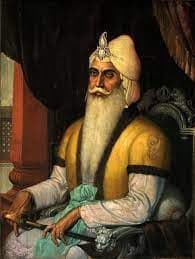
- Maharaja Ranjit Singh, also known as Sher-e-Punjab or "Lion of Punjab," was the first Maharaja of the Sikh Empire, which ruled the northwest Indian subcontinent in the early half of the nineteenth century.
- In Pakistani Punjab, he was born in 1780 to the chief of the Sukerchakia misl of the Sikh confederacies.
- In 1801 he unified 12 Sikh misls and conquered several small kingdoms to become the "Maharaja of Punjab."
- Many Afghan attacks were successfully repelled, and areas including Lahore, Peshawar, and Multan were conquered.
- Lahore became his capital when he captured it in 1799.
- His Sikh Empire stretched north of the Sutlej River and south of the Himalayas in the northwest. Lahore, Multan, Srinagar (Kashmir), Attock, Peshawar, Rawalpindi, Jammu, Sialkot, Amritsar, and Kangra were all part of his empire.
- With the British, he maintained cordial relations.
- Ranjit Singh's rule was marked by reforms, modernization, infrastructure investment, and overall prosperity. Sikhs, Hindus, Muslims, and Europeans served in his Khalsa army and government.
- His legacy encompasses a time of Sikh cultural and artistic rebirth, including the reconstruction of the Harmandir Sahib in Amritsar as well as other significant gurudwaras, including Takht Sri Patna Sahib in Bihar and Hazur Sahib Nanded in Maharashtra.
- In his army, he had troops of many ethnicities and beliefs.
- His army was very efficient in terms of fighting, logistics, and infrastructure.
- There was a fight for succession among his numerous relatives after his death in 1839. This signified the beginning of the Empire's demise.
- Ranjit Singh died in June 1839, and the process of his empire's downfall began with his death.
- Kharak Singh, his eldest legitimate son, succeeded him.
Misl
- There were 12 significant misls during the time of Ranjit Singh's birth (November 2, 1780): Ahluwaliya, Bhangi, Dallewalia, Faizullapuria, Kanhaiya, Krorasinghia, Nakkai, Nishaniya, Phulakiya, Ramgarhiya Sukharchakiya, and Shaheed.
- Gurumatta Sangh, which was primarily a political, social, and economic structure, served as the misl's central administration.
- Ranjit Singh was the son of Sukerchakia misl chieftain Mahan Singh. Ranjit Singh was just 12 years old when Mahan Singh died.
- However, Ranjit Singh showed early political savvy. By the end of the 18th century, all of the great misls (save Sukarchakia) had disintegrated.
Maharaja Ranjit Singh and the English
- The English were concerned about the possibility of a joint Franco-Russian invasion of India via the land route.
- Lord Minto dispatched Charles Metcalfe to Lahore in 1807.
- Ranjit Singh agreed to Metcalfe's proposal for an offensive and defensive alliance on the condition that the English remain neutral in the event of a Sikh-Afghan conflict and recognize Ranjit Singh as the ruler of the whole Punjab, including the Malwa (cis-Sutlej) provinces.
- However, the talks fell through. Ranjit Singh decided to sign the Treaty of Amritsar (April 25, 1809) with the Company amid a new political context in which the Napoleonic threat had diminished and the English had become more dominant.
Treaty of Amritsar (1809)
- The Treaty of Amritsar was noteworthy for both its immediate and potential consequences.
- It thwarted one of Ranjit Singh's most treasured aspirations of extending his control over the whole Sikh people by adopting the Sutlej River as the borderline for his and the Company's dominions.
- He redirected his efforts to the west, capturing Multan (1818), Kashmir (1819), and Peshawar (1834).
- Ranjit Singh was forced by political forces to sign the Tripartite Treaty with the English in June 1838; nevertheless, he refused to allow the British troops access through his lands to invade Dost Mohammad, the Afghan Amir.
- Raja Ranjit Singh's interactions with the Company from 1809 to 1839 plainly demonstrate the former's weak position.
- Despite being aware of his precarious situation, he took no steps to form a coalition of other Indian rulers or to preserve a balance of power.
Punjab After Ranjit Singh
- Kharak Singh, Ranjit Singh's sole legitimate son and heir, was ineffective, and court divisions emerged during his brief rule.
- Kharak Singh's untimely death in 1839, along with the unintentional murder of his son, Prince Nau Nihal Singh, resulted in anarchy throughout Punjab.
- The intentions and counter-plans of numerous organizations to seize the crown of Lahore presented a chance for the English to take decisive action.
- The Lahore administration, following its policy of friendliness with the English firm, allowed British forces to cross through its territory twice: first on their way out of Afghanistan and again on their way back to avenge their defeat.
- These marches caused upheaval and economic disruption in Punjab.
- Sher Singh, another son of Ranjit Singh, succeeded after Nau Nihal Singh died, but he was assassinated in late 1843.
- Soon after, Daleep Singh, Ranjit Singh's minor son, was declared Maharaja, with Rani Jindan as regent and Hira Singh Dogra as wazir.
- Hira Singh himself was assassinated in 1844 as a result of royal intrigue.
- The new wazir, Jawahar Singh, Rani Jindan's brother, quickly enraged the troops and was overthrown and executed in 1845.
- In the same year, Lal Singh, a lover of Rani Jindan, won over the army to his side and was made wazir, while Teja Singh was appointed commander of the soldiers.
First Anglo-Sikh War (1845–46)
- The action of the Sikh army crossing the Sutlej River on December 11, 1845, has been ascribed to the start of the first Anglo-Sikh war.
- This was viewed as an aggressive maneuver that gave the English cause to declare war.
- The turmoil that erupted in the Lahore kingdom upon the death of Maharaja Ranjit Singh, culminated in a power struggle for dominance between the Lahore court and the ever-powerful and more local army
- Mistrust within the Sikh army was a result of the English military efforts to capture Gwalior and Sindh in 1841 and the battle in Afghanistan in 1842.
- An increase in the number of English troops stationed near the Lahore kingdom's border
Course of the war
- The British side had 20,000 to 30,000 troops when the conflict began in December 1845, while the Sikhs had roughly 50,000 men under the general direction of Lal Singh.
- However, the Sikhs were defeated five times in a row due to the treachery of Lal Singh and Teja Singh at Mudki (December 18, 1845), Ferozeshah (December 21–22, 1845), Buddelwal, Aliwal (January 28, 1846), and Sobraon (February 10, 1846).
- Lahore surrendered to British soldiers without a struggle on February 20, 1846.
Result of the war
- Treaty of Lahore - On March 8, 1846, the Sikhs were compelled to accept a humiliating peace at the conclusion of the First Anglo-Sikh War.
- The English were to be given a war indemnity of more than one crore rupees.
- The Jalandhar Doab (between the Beas and the Sutlej) was to be annexed to the Company's dominions.
- A British resident was to be established at Lahore under Henry Lawrence. The strength of the Sikh army was reduced.
- Daleep Singh was recognized as the ruler, with Rani Jindan as regent and Lal Singh as wazir.
- Since the Sikhs were unable to pay the whole war indemnity, Kashmir, including Jammu, was sold to Gulab Singh, who was compelled to pay the Company 75 lakh rupees as the purchase price.
- On March 16, 1846, a second treaty formalized the surrender of Kashmir to Gulab Singh.
- Bhairowal Treaty - the Sikhs were dissatisfied with the Treaty of Lahore on the question of Kashmir, they revolted.
- The Treaty of Bhairowal was signed in December 1846. According to the terms of the treaty, Rani Jindan was deposed as regent, and a council of regency for Punjab was established.
- The council was headed over by the English Resident, Henry Lawrence, and was made up of eight Sikh sardars.
Second Anglo-Sikh War (1848–49)
- The Sikhs were severely humiliated by their defeat in the First Anglo-Sikh War and the conditions of the treaties of Lahore and Bhairowal.
- The inhuman treatment meted out to Rani Jindan, who was transported to Benares as a pensioner, fueled Sikh fury.
- Mulraj, Multan's governor, was replaced by a new Sikh governor due to an increase in annual revenue.
- Mulraj rebelled and assassinated two English officers who were accompanying the new governor.
- Sher Singh was dispatched to put down the rebellion, but he himself joined Mulraj, sparking a general insurrection throughout Multan.
- This might be seen as the direct cause of the conflict.
- Lord Dalhousie, the then-Governor General of India and a staunch expansionist, was given the justification to entirely occupy Punjab.
Course of the war
- Lord Dalhousie traveled to Punjab on his own. Before the eventual conquest of Punjab, three major wars were fought.
- These three fights were as follows:
- The Battle of Ramnagar, conducted by Sir Hugh Gough, the commander-in-chief of the Company, took place in January 1849.
- Battle of Chillianwala, January 1849
- Battle of Gujarat, February 21, 1849, The Sikh army surrendered at Rawalpindi on February 21, 1849, and their Afghan allies were forced out of India.
Result of the war
- The surrender of the Sikh army and Sher Singh in 1849
- Annexation of Punjab; and for his services, the Earl of Dalhousie was given the thanks of the British Parliament and promotion in the peerage, as Marquess
- And the establishment of a three-member board to govern Punjab, consisting of the Lawrence brothers (Henry and John) and Charles Mansel.
- The board was abolished in 1853, and Punjab was given to a chief commissioner.
- John Lawrence was appointed as the first Chief Commissioner.
Lord Dalhousie
- Lord Dalhousie (actual name James Andrew Ramsay) served as Governor-General of India from 1848 until 1856.
- During this time, the Sikhs were crushed once more in the Second Anglo-Sikh War (1849), and Dalhousie was successful in annexing the whole Punjab under British authority.
- He is most known for his Doctrine of Lapse, which many believe was directly responsible for the 1857 Indian Revolt.
- Despite the Doctrine, Lord Dalhousie is often regarded as the "Maker of Modern India."
- In India, Lord Dalhousie established a number of Anglo-vernacular schools. He also instituted social changes, such as the prohibition on female infanticide.
- He was a fervent believer in western administrative changes, believing that they were both essential and preferable to Indian methods.
- He also built engineering institutions to supply resources for each presidency's newly constituted public works department.
- During his term, the first railway line between Bombay and Thane was opened in 1853 and in the same year, Calcutta and Agra were connected by telegraph.
- Other changes he enacted include the establishment of P.W.D. and the passage of the Widow Remarriage Act (1856).
- Dalhousie, a highland station in Himachal Pradesh, was named for him. It began as a summer resort for English civil and military authorities in 1854.
- Lord Dalhousie died on December 19, 1860, at the age of 48.

Conclusion
Punjab, along with the rest of British India, fell under the direct sovereignty of the British crown in 1858, according to Queen Victoria's Queen's Proclamation. Sapta Sindhu, the Vedic country of the seven rivers flowing into the ocean, was the ancient name of the region. The East India Company seized much of the Punjab region in 1849, making it one of the last sections of the Indian subcontinent to fall under British rule. Punjab, along with the rest of British India, was placed under direct British authority in 1858. The Anglo-Sikh battles instilled mutual respect for each other's combat abilities. The Sikhs were to fight on the British side in the Revolt of 1857, as well as in several more operations and wars until Indian independence in 1947.
FAQs
Q1: When did the British conquest of Punjab take place?
Answer: It culminated in 1849 after the Second Anglo-Sikh War.
Q2: What was the significance of Punjab’s annexation?
Answer: Punjab became a strategic region for the British, enhancing their control over India and securing access to Central Asia.
Q3: What led to the First Anglo-Sikh War?
Answer: A power struggle following Maharaja Ranjit Singh’s death and rising tensions between the Sikhs and the British led to the First Anglo-Sikh War in 1845-46.
Q4: What treaty followed the First Anglo-Sikh War?
Answer: The Treaty of Lahore (1846) marked the end of the First Anglo-Sikh War, ceding several territories to the British.
Q5: How did the Second Anglo-Sikh War lead to annexation?
Answer: The British defeated the Sikhs in 1849, and Punjab was formally annexed by Lord Dalhousie.
MCQs
- In which year was Punjab annexed by the British?
a) 1845
b) 1846
c) 1849
d) 1857
Answer: (C) See the Explanation
- Who was the British Governor-General during the annexation of Punjab?
a) Lord Wellesley
b) Lord Dalhousie
c) Lord Canning
d) Lord Hastings
Answer: (B) See the Explanation
- Which treaty ended the First Anglo-Sikh War?
a) Treaty of Amritsar
b) Treaty of Lahore
c) Treaty of Delhi
d) Treaty of Allahabad
Answer: (B) See the Explanation
- What was the key outcome of the Second Anglo-Sikh War?
a) Formation of Sikh Confederacy
b) British annexation of Punjab
c) Anglo-Maratha alliance
d) End of Company rule in India
Answer: (B) See the Explanation
- What was one reason for the British interest in Punjab?
a) Control over sea routes
b) Access to Central Asia
c) Trade monopoly over cotton
d) Mineral resources
Answer: (B) See the Explanation
GS Mains Questions and Model Answers
Q1: Examine the factors leading to the British annexation of Punjab in 1849.
Answer: The British annexation of Punjab was influenced by several factors. The internal instability following Maharaja Ranjit Singh’s death led to weak leadership. The British capitalized on the power vacuum through the First and Second Anglo-Sikh Wars. The Treaty of Lahore weakened the Sikh Empire, and the rebellion in 1848 gave Lord Dalhousie a pretext to annex Punjab. The region's strategic importance for British interests, including trade and access to Central Asia, also made it a valuable acquisition.
Q2: Analyze the consequences of the British annexation of Punjab.
Answer: The annexation of Punjab had significant consequences. It established British dominance in North India and increased their strategic control. The Sikhs, renowned for their martial skills, later became a crucial part of the British Indian Army. Additionally, the annexation paved the way for British economic and political influence in the region, although it also led to resentment among locals. Punjab played a key role in subsequent events, including the 1857 Revolt.
Q3: Discuss how the British annexation of Punjab affected Sikh society and economy.
Answer: The annexation disrupted the traditional power structures of Sikh society. Many nobles lost their influence, and the economy was reoriented to serve British interests. While some infrastructural development took place, such as canals and railways, heavy taxation burdened the peasantry. On the other hand, Sikhs became a prominent part of the colonial military apparatus, which gave them certain advantages but also tied them closely to British rule.
Previous Year Questions on British Conquest of Punjab
1. UPSC CSE 2012
Question: “What were the main causes of the First Anglo-Sikh War?”
Answer: The First Anglo-Sikh War (1845-46) was caused by the power struggle following Maharaja Ranjit Singh’s death and the increasing mistrust between the British and the Sikh leadership. British expansionist policies alarmed the Sikh nobility, and internal instability within the Sikh Empire made conflict inevitable. The war ended with the Treaty of Lahore, weakening the Sikh Empire and increasing British influence in the region.
2. UPSC CSE 2017
Question: “Evaluate the role of Lord Dalhousie in the annexation of Punjab.”
Answer: Lord Dalhousie played a critical role in the annexation of Punjab. He pursued an aggressive policy of expansion, believing in the benefits of direct British rule. After the Sikh uprising in 1848, Dalhousie saw an opportunity to annex Punjab and bring it under the Company’s control. His administration ensured a smooth transition by incorporating Punjab’s military and bureaucracy into the British framework, setting the foundation for the region’s economic and political reorganization. His policy was criticized for being opportunistic but was in line with the broader British imperial strategy.
Download the PREPP App and attempt FREE IAS Exam Mock Tests and get complete study material!

Full Test - 04: UPSC CSE Prelims CSAT (Paper-II)
Full Test - 03: UPSC CSE Prelims CSAT (Paper-II)
UPSC CSE Prelims 2026 GS Paper 1 Question Paper (24-May-2026)
UPSC CSE Prelims 2026 CSAT Paper 2 Question Paper (24-May-2026)

17 February 2025 | The Hindu Must Read Articles | Current Affairs

16 February 2026 | The Hindu Must Read Articles | Current Affairs

13 February 2026 | The Hindu Must Read Articles | Current Affairs









Comments