74th Amendment Act - Indian Polity Notes
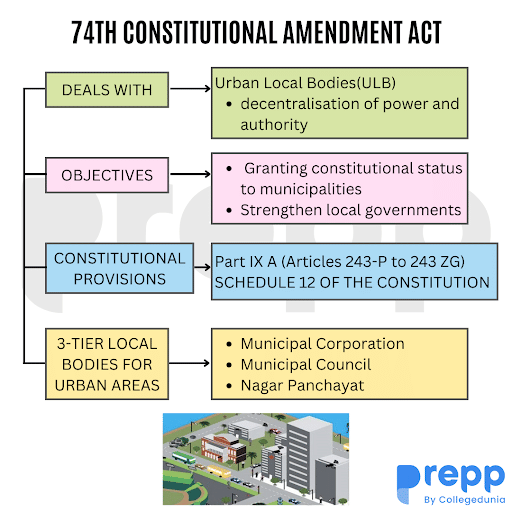
74th Amendment Act is known for giving constitutional status to Urban Local Bodies. It has created an institutional framework to let in grassroots democracy or democratic decentralization through self-governing local bodies in urban areas of the country. It also gave the ULBs, the power to exercise 18 functions listed in the 12th Schedule of the Indian Constitution. The topic “74th Constitutional Amendment Act” is an important part of the UPSC/IAS Exam Polity and Governance syllabus which is discussed in this article in detail. On this topic, in UPSC Prelims and UPSC Mains many times questions have been asked.
|
Table of Contents |

Historical Background
- The village panchayats lost their autonomy and became weak during British rule.
- 1870: The Mayo Resolution (1870) forced the development of local institutions by expanding their powers and responsibilities. Mayo also presented the concept of elected officials in urban municipalities.
- 1882: Following this, Lord Rippon provided the essential democratic framework for these institutions.
- 1907: The appointment of the Royal Commission on Centralization gave a boost to the local self-government institution.
- Post–Independence: After the Constitution came into power, Article 40 mentions the panchayats, and Article 246 enables the state lawmaking body to enact any subject identifying with local self-government.
- 1959: Balwant Rai Mehta Committee proposed three-level PRIs, to be specific, Gram Panchayats at the village level, Panchayat Samiti at the block level, and Zilla Parishad at the district level.
- 1977: The appointment of the Ashok Mehta Committee introduced Panchayat Raj. The Committee suggested a two-level Panchayat Raj institutional design consisting of Zilla Parishad and Mandal Panchayat.
- 1985: The G.V.K. Rao Committee suggested making the "district" the fundamental unit and holding regular elections. However, the L.M.Singhvi Committee suggested giving more financial resources and Constitutional status to the panchayats to reinforce them.
- 1989: The Rajiv Gandhi Government presented the 65th Constitutional Amendment Bill (Nagarpalika bill) in the Lok Sabha. The bill pointed toward strengthening and revamping the municipal bodies by giving Constitutional status to them.
- 1991-93: The Narasimha Rao Government also introduced the Amended Municipalities Bill in Lok Sabha. It eventually became the 74th Constitutional Amendment Act of 1992 and entered into force on June 1, 1993.
Objectives - 74th Constitutional Amendment Act
- The act granted municipalities constitutional status. It has brought them under the purview of the Constitution's justiciable provisions.
- In other words, state governments have a constitutional obligation to implement the new municipal system in accordance with the provisions of the act.
- The act's goal is to revitalize and strengthen municipal governments so that they can function effectively as units of local government.
Constitutional Provisions – 74th Constitutional Amendment Act
- It was passed by Parliament in December 1992 and came into force on 1 June 1993 adding Part IX A (Articles 243-P to 243-ZG) and the 12th schedule in the Constitution.
- The 74th amendment provided a uniform law for all the municipalities in the nation.
| Article | Provisions |
|---|---|
| Article 243 Q |
Article 243-Q mentions the Constitution of Municipalities i.e. Nagar Panchayat, Municipal Council, and Municipal Corporation. |
| Article 243 R |
Article 243R mentions the Composition of Municipalities, it states that all of its members are directly elected by the people of the Municipal area which is divided into territorial constituencies known as wards. |
| Article 243 S |
Article 243 S mentions about constitution and composition of ward committees consisting of wards and members of wards who represent that ward in the Municipality. |
| Article 243 T |
Article 243 T deals with the reservation of seats in every Municipality. |
| Article 243 U |
Article 243 U mentions the duration of Municipalities. |
| Article 243 V |
Article 243 V mentions the grounds for disqualification of members of the Municipality. |
| Article 243 W |
Article 243W deals with the powers, authorities, and responsibilities of municipalities that include urban planning, financial and social development, and so on. |
| Article 243 X |
Article 243X states that the constitution has left it open to the Legislature of a State to specify by law matters relating to the imposition of taxes. |
| Article 243 Y |
Article 243 Y provides for the constitution of the Finance Commission which will give its opinion on the distribution of finances between the State and the municipality and will determine the aid subsidies. |
| Article 243 ZA |
Article 243-ZA provides for the establishment of a State Election Commission, independent of which the Election Commission of India, conducts elections for every Municipal Corporation for a term of 5 years. |
| Article 243 ZC |
Article 243 ZC says that provisions of part IXA are not applicable to Scheduled Areas referred to in article 244. These include Assam, Meghalaya, Tripura, and Mizoram. It is also not applicable to the area under Darjeeling Gorkha Hill Council. |
| Article 243 ZE |
Article 243 ZE says that there will be a Metropolitan Planning Committee in every Metropolitan region to set up a draft improvement plan for the Metropolitan region overall. |
Salient Features - 74th Constitutional Amendment Act
Three Types of Municipalities
-
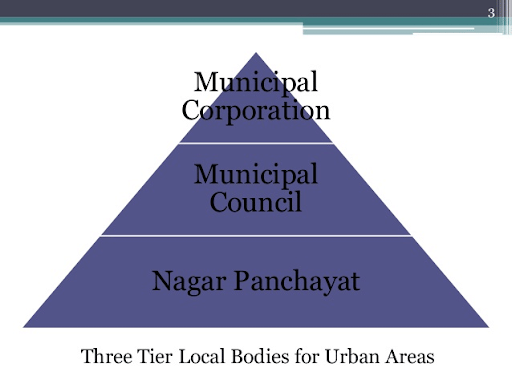
The act provides for the constitution of the following three types of municipalities in every state.
- A Nagar Panchayat (by whatever name called) for a transitional area.
- A municipal council for a smaller urban area.
- A municipal corporation for a larger urban area.
- However, there is one exception, If there is an urban area where municipal services are being provided by an industrial establishment, then the governor may specify that area to be an industrial township. In such a case, a municipality may not be constituted.
Composition
- All the members of a municipality shall be elected directly by the people of the municipal area.
- For this purpose, each municipal area shall be divided into territorial constituencies to be known as wards.
- The state legislature may provide the manner of election of the chairperson of a municipality.
Wards Committees
- A wards committee shall be constituted consisting of one or more wards, within the territorial area of a municipality having a population of three lakh or more.
Other Committees
- In addition to the ward committees, the state legislature is also allowed to make any provision for the constitution of other committees.
- The chairpersons of such committees may be made members of the municipality.
Reservation of Seats
- Reservation of seats for SC and ST is provided in every municipality in proportion to their population.
- Provision for reservation of 1/3rd of the total number of seats is also provided for women.
- The state legislature has been empowered to make any provision for reservation in the municipality at any level in favor of the backward class.
Duration of Municipalities
- Municipalities have been provided with a five-year term of office at every level. It can however be dissolved before the completion of its term.
- A municipality if elected after the dissolution of the municipality shall continue for the remaining period for which the dissolved municipality would have continued had it not been dissolved.
Disqualifications
- A person shall be disqualified on the following grounds:
- if he is disqualified under any law for the time being in force for the purposes of elections to the legislature of the state concerned; or
- if he is disqualified under any law made by the state legislature.
- However, no person shall be disqualified on the ground that he is less than 25 years of age if he has attained the age of 21 years.
State Election Commission
- The State Election Commission has been constituted and has been endowed with various roles like superintendence, direction and control of the preparation of electoral rolls.
- The conduct of elections to the Municipalities shall also be handled by the state election commission.
Powers and Functions
- The powers and functions of the Municipalities are endowed by the state legislature.
- The Municipalities prepare a plan for economic development and social justice for the people of the Municipality.
- It implements the scheme of the Central and State government for the betterment of the people at the ground level.
- Municipalities have the power to enhance employment facilities and undertake development activities in the area.
Finances
The state legislature may-
- authorize a panchayat to levy and collect taxes, duties, duties, and fees;
- assign to the Panchayat taxes, duties, duties, and fees levied and collected by the state government;
- provide grants-in-aid to the Panchayats from the state's consolidated fund, and
- provide for the establishment of funds to credit all money of the Panchayats.
Finance Commission
- The finance commission is constituted by the governor to review the financial position of the Municipalities.
- This commission recommends the governor to decide on the principles that should govern the distribution of taxes between the state and the Municipalities.
- It also determines the taxes, duties, tolls, and fees that may be assigned to Municipalities.
- The provisions with respect to the maintenance of accounts by the Municipalities and the auditing of such accounts are done according to the provisions decided by the state legislature.
Audit of Accounts
- State legislatures can make provisions regarding the maintenance and auditing of municipalities’ accounts.
Application to Union Territories
- The provisions of this Part apply to the territories of the Union. However, the president may specify and direct any exception of modification as required.
Exempted Areas
-
The act does not apply to scheduled areas and tribal areas in the following states.
- At present, ten states of India have scheduled areas - Andhra Pradesh, Telangana, Jharkhand, Chhattisgarh, Gujarat, Himachal Pradesh, Madhya Pradesh, Maharashtra, Orissa, and Rajasthan.
- Presently, there are a total of ten tribal areas (autonomous districts) in the four states of Assam (3), Meghalaya (3), Tripura (1), and Mizoram (3).
- It shall also not affect the functions and powers of the Darjeeling Gorkha Hill Council of West Bengal.
District Planning Committee
- Every state shall constitute at the district level, a district planning committee to consolidate the plans prepared by panchayats and municipalities in the district, and to prepare a draft development plan for the district as a whole.
- The act lays down that four-fifths of the members of a district planning committee should be elected by the elected members of the district panchayat and municipalities in the district from amongst themselves.
Metropolitan Planning Committee
- Every metropolitan area shall have a metropolitan planning committee to prepare a draft development plan.
- A Metropolitan area means an area having a population of 10 lakh or more, in one or more districts, and consisting of two or more municipalities or panchayats or other contiguous areas.
- The act lays down that two-thirds of the members of a metropolitan planning committee should be elected by the elected members of the municipalities and chairpersons of the panchayats in the metropolitan area from amongst themselves.
Continuance of Existing Laws and Panchayats
- All state laws pertaining to municipalities shall remain in effect until one year after the commencement of this act.
- In other words, states must implement the new municipality system based on this act within a year of its enactment on April 24, 1993, the date of the act's enactment.
- However, all municipalities that existed prior to the enactment of the act will continue until the end of their terms, unless dissolved earlier by the state legislature.
Bar to Interference by Courts in Electoral Matters
- The act prohibits courts from interfering in municipality elections.
- It declares that the constitutionality of any law relating to the delimitation of constituencies or the allocation of seats to such constituencies cannot be challenged in any court.
- It also states that no election to a municipality may be challenged unless accompanied by an election petition filed with the appropriate authority and in the manner prescribed by the state legislature.
Twelfth Schedule
The following 18 functional items are placed within the purview of municipalities:
- Urban planning including town planning;
- Regulation of land use and construction of buildings;
- Planning for economic and social development;
- Roads and bridges;
- Water supply for domestic, industrial, and commercial purposes;
- Public health, sanitation, conservancy, and solid waste management;
- Fire services;
- Urban forestry, protection of the environment, and promotion of ecological aspects;
- Safeguarding the interests of weaker sections of society, including the handicapped and mentally retarded;
- Slum improvement and upgradation;
- Urban poverty alleviation;
- Provision of urban amenities and facilities such as parks, gardens, and playgrounds;
- Promotion of cultural, educational, and aesthetic aspects;
- Burials and burial grounds, cremations and cremation grounds, and electric crematoriums;
- Cattle ponds, prevention of cruelty to animals;
- Vital statistics including registration of births and deaths;
- Public amenities including street lighting, parking lots, bus stops, and public conveniences; and
- Regulation of slaughterhouses and tanneries.
Significance of 74th Amendment Act
- Cities and towns make significant contributions to the nation's economic growth.
- The growth of the rural hinterland is significantly aided by these urban centers.
- The people and their representatives must be fully involved in the planning and implementation of the programmes at the local level in order to maintain this economic change in line with requirements and realities at the grassroots level.
- The roots of democracy must extend into the towns, villages, and cities where people live if it is to remain strong and stable in the Parliament and State Legislatures.
Evaluation
- At the point when we take the provisions of the Part IXA of our constitution, we can say with certainty that the 74th amendment act 1992 is perhaps the most significant and fundamental amendment so far concerning urban developments. The Act attempted to make local bodies efficient and transparent.
- The 74th amendment to the Constitution was intended to empower Urban Local government with decision-making abilities, revenue generation, and financial autonomy.
- As far as financial autonomy or independence, Urban Local governments have unquestionably shown improvement over their rural counterparts, nonetheless, no Indian city can in any case coordinate with any of the metros in developed nations even following 25 years of underlying change.
- The implementation of the 74th CAA by the State Governments across the country has not been done enough to implement it with few exceptions like Kerala and West Bengal.
Recent Remarks
- In 2018, NITI Aayog official said that even after the twenty-five years of passing the 74th Constitutional Amendment Act, 1992 that aimed at strengthening democracy at the grass root level through local bodies, only 11 states have managed to devolve municipal functions to Urban Local Bodies.
- Before the hit of the second wave of the Covid pandemic, The 15th Finance Commission had called out the need for decentralized primary healthcare to be handled by local bodies, with the engagement of elected councilors, communities, and resident welfare associations.
Conclusion
- The 74th Amendment to the Constitution marks a watershed moment in India's evolution of local government.
- Municipalities and municipal corporations in urban India have been granted constitutional status for the first time.
- The Nagar Palika Central Legislation, also known as the 74th CAA, has dispersed hundreds of small local governments across India.
- The 74th CAA not only constitutionalized the status of urban local government, but it also improved its life, structure, working, and financial conditions.
FAQs
Question: What is the 74th Constitutional Amendment Act?
Answer: The 74th Constitutional Amendment Act, 1992, provided constitutional status to urban local bodies (ULBs) in India, with the aim of promoting democratic decentralization and ensuring effective governance at the grassroots level in urban areas. It introduced provisions related to the constitution, composition, and powers of municipal institutions.
Question: What are the main objectives of the 74th Amendment?
Answer: The primary objectives of the 74th Amendment include:
- Empowering urban local bodies (ULBs) to function as effective units of self-government.
- Ensuring democratic decentralization by devolving powers, functions, and responsibilities to ULBs.
- Promoting local-level planning and administration through municipalities.
Question: What are the different types of urban local bodies (ULBs) established under the 74th Amendment?
Answer: The 74th Amendment categorizes urban local bodies into three types:
- Nagar Panchayats for transitional areas from rural to urban.
- Municipal Councils for smaller urban areas.
- Municipal Corporations for larger urban areas.
Question: What is the State Election Commission’s role under the 74th Amendment?
Answer: The 74th Amendment mandates the creation of a State Election Commission (SEC) in each state to ensure free and fair elections to the urban local bodies. The SEC is responsible for preparing electoral rolls and conducting regular elections for municipalities.
Question: How does the 74th Amendment impact urban planning and governance?
Answer: The 74th Amendment enhances urban planning and governance by giving municipalities powers to prepare plans for economic development and social justice. It mandates the establishment of Ward Committees and District Planning Committees (DPCs) to promote people's participation in urban governance.
MCQs
- The 74th Constitutional Amendment Act, 1992, provides constitutional status to which of the following?
a) Panchayats
b) Urban local bodies
c) Gram Sabha
d) Zila Parishad
Answer: (B) See the Explanation
The 74th Constitutional Amendment Act grants constitutional status to urban local bodies, empowering them to function as units of self-government.
- Which body is responsible for conducting elections to the urban local bodies under the 74th Amendment?
a) Election Commission of India
b) State Election Commission
c) Municipal Corporation
d) Panchayat Raj Commission
Answer: (B) See the Explanation
The State Election Commission is responsible for conducting elections to the urban local bodies, ensuring transparency and fairness in the election process.
- Which of the following is NOT a type of urban local body mentioned in the 74th Constitutional Amendment Act?
a) Gram Panchayat
b) Nagar Panchayat
c) Municipal Council
d) Municipal Corporation
Answer: (A) See the Explanation
The 74th Amendment deals with urban local bodies such as Nagar Panchayats, Municipal Councils, and Municipal Corporations. Gram Panchayats fall under the jurisdiction of the 73rd Amendment, which focuses on rural governance.
- The 74th Constitutional Amendment mandates the creation of Ward Committees in municipalities with a population of:
a) 100,000 or more
b) 50,000 or more
c) 500,000 or more
d) 1,000,000 or more
Answer: (A) See the Explanation
The 74th Amendment mandates the formation of Ward Committees in municipalities with a population of 100,000 or more to ensure participatory governance at the local level.
- Which of the following institutions is tasked with preparing plans for economic development and social justice under the 74th Amendment?
a) Zila Parishad
b) Gram Sabha
c) District Planning Committee (DPC)
d) State Legislative Assembly
Answer: (C) See the Explanation
The 74th Amendment mandates the formation of District Planning Committees (DPCs) to consolidate local development plans and promote economic development and social justice in urban areas.
GS Mains Questions and Model Answers
Q1: Analyze the impact of the 74th Constitutional Amendment Act on urban governance in India.
Explanation: This question requires an analysis of the 74th Constitutional Amendment Act's impact on urban governance in India. The answer should explore how the amendment empowered urban local bodies by giving them constitutional status, ensuring democratic decentralization, and promoting public participation through Ward Committees. It should also discuss the challenges faced by ULBs, including financial constraints and limited autonomy, and suggest ways to enhance their efficiency and effectiveness in delivering urban services.
Q2: Discuss the role of the State Election Commission in ensuring democratic decentralization under the 74th Constitutional Amendment Act.
Explanation: This question requires a discussion on the role of the State Election Commission (SEC) in promoting democratic decentralization under the 74th Constitutional Amendment Act. The answer should focus on the SEC's responsibilities, such as conducting regular elections for urban local bodies, ensuring free and fair electoral processes, and maintaining the legitimacy of local governance institutions. It should also discuss the challenges faced by the SEC in ensuring regular elections and the importance of electoral transparency in strengthening urban governance.
Q3: “The 74th Constitutional Amendment Act is crucial for promoting inclusive urban development.” Critically evaluate this statement.
Explanation: This question requires a critical evaluation of the role of the 74th Amendment in promoting inclusive urban development. The answer should focus on how the amendment empowers local bodies to address urban planning, social justice, and economic development through public participation. It should also assess whether the structures created under the amendment, such as Ward Committees and District Planning Committees, have succeeded in promoting inclusivity, or if challenges like limited financial autonomy and weak governance have hindered inclusive development.
Previous Year Questions on 74th Constitutional Amendment Act
1. UPSC CSE 2018
Q1: Discuss the significance of the 74th Constitutional Amendment Act in empowering urban local bodies in India.
Answer: The 74th Constitutional Amendment Act, 1992, is significant as it provided constitutional status to urban local bodies (ULBs), thereby empowering them to function as effective units of local self-governance. The amendment devolved powers and responsibilities to ULBs, enabling them to manage urban governance, urban planning, and service delivery. It established provisions for regular elections, financial autonomy, and public participation through Ward Committees. By creating institutions like District Planning Committees (DPCs) and empowering ULBs to prepare local development plans, the amendment strengthened democratic decentralization and enhanced local-level governance in urban areas.
2. UPSC CSE 2019
Q2: Examine the challenges in the implementation of the 74th Constitutional Amendment Act in urban governance.
Answer: Despite its intentions, the implementation of the 74th Constitutional Amendment Act faces several challenges. One major issue is the lack of adequate financial resources for urban local bodies, which limits their ability to provide essential services. In many states, there is a reluctance to devolve sufficient powers and responsibilities to municipalities, leaving them dependent on state governments. Additionally, issues like irregular elections, lack of accountability, and inefficiency in urban governance structures, including the functioning of Ward Committees and District Planning Committees, hinder the effective implementation of the amendment. These challenges undermine the goal of empowering ULBs to function as self-governing institutions.
Download the PREPP App and attempt FREE IAS Exam Mock Tests and get complete study material!
UPSC IAS : CSAT - Mini Live Test

Live Test : UPSC CSE Prelims CSAT (Paper-II) (Oct 20 - 23)
Full Test - 04: UPSC CSE Prelims CSAT (Paper-II)
Full Test - 03: UPSC CSE Prelims CSAT (Paper-II)
UPSC CSE Prelims 2026 GS Paper 1 Question Paper (24-May-2026)
UPSC CSE Prelims 2026 CSAT Paper 2 Question Paper (24-May-2026)

17 February 2025 | The Hindu Must Read Articles | Current Affairs

16 February 2026 | The Hindu Must Read Articles | Current Affairs

13 February 2026 | The Hindu Must Read Articles | Current Affairs









Comments