
Who was the founder of Madras Labour Union ?
B.P. Wadia
Option 3 — B.P. Wadia is correct.
The Madras Labour Union, founded in 1918, is generally recognised as the first organised trade union in India. It was established by B.P. Wadia, a theosophist and associate of Annie Besant, to protect the interests of textile workers at the Buckingham and Carnatic Mills in Madras.
Its formation was a landmark in the Indian labour movement, giving workers a permanent representative body rather than ad-hoc strike committees.
Why the other options are wrong:
| Leader | Associated with |
|---|---|
| N.M. Joshi | Founder of the All India Trade Union Congress (AITUC), 1920 |
| N.M. Lokhande | Pioneer of the early Bombay mill-hands' movement (1880s) |
| V.V. Giri | Trade-union leader and later President of India |
Takeaway: B.P. Wadia and the Madras Labour Union (1918) mark the birth of the modern organised trade-union movement in India.
Similar Questions
Which one of the following theories of labour welfare believes that workers are becoming more and more aware of their rights and welfare measures can appease them ?
Which one of the following is not a characteristic of the ‘Hot - Stove Rule’ of disciplinary action ?
Which one among the following countries does not favour gender equality ?
Which one of the following consists of both vertical sequence of jobs and a series of horizontal opportunities ?
Arrange the following steps of disciplinary actions in correct sequence.
(a) Complaint
(b) Issue of charge sheet
(c) Preliminary fact finding
(d) Consideration of explanation
(e) Suspension pending enquiry
(f) Holding of enquiry
(g) Order of punishment
(h) Appeal
Code :
Which one of the following is not an unfair labour practice ?
Match the items of List I with those of List II.
List - I (Behavioural science) List - II (Contribution) (a) Anthropology (i) Attitude change (b) Psychology (ii) Attitude measurement (c) Social psychology (iii) Conflict (d) Sociology (iv) Organizational culture Codes :
Behaviourally Anchored Rating Scale (BARS) consists of the following steps :
(a) Reallocate incidents
(b) Develop performance dimensions
(c) Generate critical incidents
(d) Develop final statements
The correct chronological order of these steps is :
Assertion (A) : The more differentiated the HR environment, the more uncertain it shall be.
Reason (R) : Organisations are dependent in an environment where human resources are not widely available.
Consider the following statements :
(a) Sensitivity training was developed by Kurt Lewin
(b) In-basket exercise is a simulated training method
(c) Depth interview is also known as Directive Interview
(d) Job evaluation is carried out for promoting job satisfaction
Which of the above statements are true ?
Important Questions from Miscellaneous
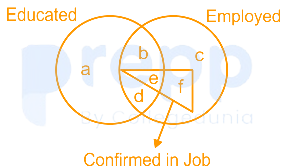
Read the given figure and find the region representing persons who are educated and employed but not confirmed in job.
The magazine in which Mahatma Gandhi mentioned what he wanted the Constitution to do is:
Which gas shields the surface of the earth from ultraviolet radiation from the sun?
Which event is marked as an Intangible Cultural Heritage of Humanity by UNESCO?
Who has been conferred with the rank of the Commander of the Order of the British Empire in 2018?



