
Which one of the following statement with regard to expansion of materials due to heating is not correct?
As ice melts, it expands uniformly up to 4 °C
Understanding Thermal Expansion of Materials
Thermal expansion is the tendency of matter to change its shape, area, and volume in response to a change in temperature. Temperature is a monotonic function of the average molecular kinetic energy of a material. When a material is heated, its molecules begin to vibrate more about their equilibrium positions, which increases the average distance between the molecules. This increased intermolecular distance manifests as an overall expansion of the material.
The question asks to identify the statement that is not correct regarding the expansion of materials due to heating. Let's analyze each statement:
Analyzing Statement 1: Ice Melting and Water Expansion
The statement says: "As ice melts, it expands uniformly up to 4 °C".
- Ice melts at 0 °C to form water.
- When ice melts into water at 0 °C, its volume decreases (water is denser than ice).
- When water is heated from 0 °C to 4 °C, it exhibits anomalous expansion. Unlike most substances, water contracts as its temperature increases in this range. Its density increases, reaching a maximum density at 4 °C.
- Above 4 °C, water expands as its temperature increases, behaving like most other substances.
Therefore, the statement that water expands uniformly up to 4 °C is incorrect. Water actually contracts from 0 °C to 4 °C.
Analyzing Statement 2: Mercury Thermometer
The statement says: "Mercury thermometer works using the principle of expansion due to heating".
- A mercury thermometer consists of a glass bulb connected to a thin capillary tube, containing mercury.
- When the thermometer is exposed to a higher temperature, the mercury inside the bulb absorbs heat and expands.
- Since the volume expansion of the glass is significantly less than that of mercury, the mercury rises up in the capillary tube.
- The height of the mercury column indicates the temperature.
This statement accurately describes the working principle of a mercury thermometer based on the thermal expansion of mercury. This statement is correct.
Analyzing Statement 3: Gaps in Railway Rails
The statement says: "Small gap is kept between two rails to allow for expansion due to heating".
- Railway tracks are made of steel, a material that undergoes thermal expansion.
- In hot weather, the temperature of the rails increases, causing them to expand in length.
- If there were no gaps between the rail segments, the expansion would cause large compressive forces to build up, potentially leading to buckling and deformation of the tracks.
- Leaving small gaps (expansion joints) allows the rails to expand freely without causing damage.
This statement correctly explains the purpose of gaps in railway tracks in the context of thermal expansion. This statement is correct.
Analyzing Statement 4: Length of Metallic Wire
The statement says: "The length of metallic wire increases when its temperature is increased".
- Most materials, including metals, expand when heated.
- This expansion occurs in all dimensions - length, width, and thickness.
- The increase in length of a material due to temperature change is called linear expansion. It is typically proportional to the original length and the temperature change, and dependent on the material's coefficient of linear expansion (\(\alpha\)). The change in length \(\Delta L\) is given by the formula: \(\Delta L = L_0 \alpha \Delta T\).
This statement correctly describes the linear expansion of a metallic wire when its temperature is increased. This statement is correct.
Based on the analysis, the statement that is not correct is the first one, as water contracts, not expands uniformly, when heated from 0 °C to 4 °C.
| Statement | Analysis | Correctness |
|---|---|---|
| As ice melts, it expands uniformly up to 4 °C | Water contracts from 0 °C to 4 °C (anomalous expansion). | Incorrect |
| Mercury thermometer works using the principle of expansion due to heating | Mercury expands significantly with temperature change. | Correct |
| Small gap is kept between two rails to allow for expansion due to heating | Gaps prevent buckling due to thermal expansion of rails. | Correct |
| The length of metallic wire increases when its temperature is increased | Metals undergo linear expansion when heated. | Correct |
Conclusion
The statement that is not correct is the one claiming water expands uniformly up to 4 °C when ice melts. This describes the anomalous expansion of water incorrectly.
Revision Table: Key Thermal Expansion Concepts
| Concept | Description | Equation (for linear expansion) |
|---|---|---|
| Thermal Expansion | Change in size of material with temperature change. | \(-\) |
| Linear Expansion | Change in length (\(\Delta L\)) of a material. | \(\Delta L = L_0 \alpha \Delta T\) |
| Area Expansion | Change in area (\(\Delta A\)) of a material. | \(\Delta A = A_0 \beta \Delta T\), where \(\beta \approx 2\alpha\) |
| Volume Expansion | Change in volume (\(\Delta V\)) of a material. | \(\Delta V = V_0 \gamma \Delta T\), where \(\gamma \approx 3\alpha\) |
| Anomalous Expansion | Unusual expansion behavior, like water between 0 °C and 4 °C. | \(-\) |
Additional Information on Thermal Expansion
Thermal expansion is a crucial concept in physics with many practical applications and considerations in engineering and everyday life.
- Coefficient of Thermal Expansion: This is a material property that indicates how much a material expands per degree Celsius (or Kelvin) change in temperature. Different materials have different coefficients. For isotropic materials (materials with the same properties in all directions), \(\beta \approx 2\alpha\) and \(\gamma \approx 3\alpha\).
- Applications: Thermal expansion is used in bimetallic strips (used in thermostats and circuit breakers), fitting wheels onto axles (shrink fitting), and hot air balloons.
- Engineering Considerations: Engineers must account for thermal expansion when designing bridges, buildings, pipelines, and railway tracks to prevent structural failure. Expansion joints are commonly used.
- Water's Anomaly: The anomalous expansion of water between 0 °C and 4 °C is vital for aquatic life in cold climates. As lakes cool, the denser water at 4 °C sinks to the bottom, while colder water and ice (less dense) remain near the surface. This prevents lakes from freezing solid from the bottom up.
Similar Questions
A Kelvin thermometer and a Fahrenheit thermometer both give the same reading for a certain sample. What would be the corresponding reading in a Celsius thermometer?
A pressure cooker cooks food faster by
The absolute zero temperature is 0 Kelvin. In °C unit, which one of the following is the absolute zero temperature?
The coefficient of areal expansion of a material is 1.6 × 10 -5 K-1 . Which one of the following gives the value of coefficient of volume expansion of this material?
The temperature of a place on one sunny day is 113 in Fahrenheit scale. The Kelvin scale reading of this temperature will be
Radiations coming from the Sun are mostly in the form of
A solid is melted and allowed to cool and solidify again. The temperature is measured at equal interval of time. The graph below shows the change of temperature with time.
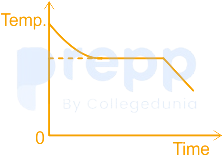
The part of the curve that is practically horizontal is due to
Perspiration cools the body because
In which of the following phenomena do heat waves travel along a straight line with the speed of light?
Which one of the following statement is NOT correct?
Important Questions from Temperature and heat
A Kelvin thermometer and a Fahrenheit thermometer both give the same reading for a certain sample. What would be the corresponding reading in a Celsius thermometer?
Which of the following gases has highest value of critical temperature ?
- For carbon dioxide ($CO_2$), which is commonly used in industrial processes as a supercritical fluid, what is its critical temperature? Above this temperature, $CO_2$ cannot be liquefied regardless of how much pressure is applied, existing only as a supercritical fluid.
- Where does the heat energy go when the solid melts but its temperature remains the same?
A pressure cooker cooks food faster by



