
A pressure cooker cooks food faster by
increasing the boiling point of water
Understanding How a Pressure Cooker Works
A pressure cooker is a cooking pot that uses pressure to cook food faster than conventional methods. It works by trapping steam produced from boiling water inside the sealed pot. This trapping of steam leads to an increase in the pressure inside the cooker.
Pressure and Boiling Point Explained
The boiling point of water is the temperature at which it changes from a liquid to a gas (steam). At standard atmospheric pressure (like at sea level), water boils at \({100}^{\circ}\text{C}\) (\({212}^{\circ}\text{F}\)). However, the boiling point of water is dependent on the surrounding pressure.
- When pressure decreases (like at high altitudes), the boiling point of water decreases.
- When pressure increases (like inside a sealed pressure cooker), the boiling point of water increases.
This relationship between pressure and boiling point is a key principle behind how a pressure cooker functions effectively.
Pressure Cooker and Increased Boiling Point
Inside a pressure cooker, as steam builds up and is trapped, the pressure rises significantly above standard atmospheric pressure. This elevated pressure forces the water to remain in liquid form at temperatures higher than its normal boiling point of \({100}^{\circ}\text{C}\). Water inside a pressure cooker can reach temperatures of around \({120}^{\circ}\text{C}\) to \({121}^{\circ}\text{C}\) (\({248}^{\circ}\text{F}\) to \({250}^{\circ}\text{F}\)).
How Higher Temperature Speeds Up Cooking
Food cooks faster at higher temperatures because chemical reactions involved in cooking occur at a quicker rate when exposed to more heat. Since the water inside the pressure cooker is boiling and cooking the food at a much higher temperature (around \({120}^{\circ}\text{C}\)) compared to boiling in an open pot (\({100}^{\circ}\text{C}\)), heat is transferred to the food more rapidly. This significantly reduces the cooking time for many types of food.
Analyzing the Options
Let's look at the given options in the context of how a pressure cooker cooks food faster:
- Increasing the boiling point of water: As explained, the sealed environment increases pressure, which in turn increases the boiling point of water. Cooking at this higher temperature speeds up the cooking process. This option aligns with the scientific principle.
- Decreasing the boiling point of water: Decreasing the boiling point would mean water turns into steam at a lower temperature (e.g., below \({100}^{\circ}\text{C}\)). Cooking at a lower temperature would take longer, not faster. This option is incorrect.
- Increasing the melting point of water: The melting point of water is \({0}^{\circ}\text{C}\) (\({32}^{\circ}\text{F}\)), which is the temperature at which ice melts. This is not related to the process of cooking food with hot water or steam. This option is irrelevant and incorrect.
- Decreasing the melting point of water: Decreasing the melting point is also related to freezing/melting, not boiling and cooking. This option is irrelevant and incorrect.
Therefore, the primary way a pressure cooker cooks food faster is by increasing the boiling point of water.
| Property | Standard Pressure | Increased Pressure (Pressure Cooker) |
|---|---|---|
| Boiling Point | \({100}^{\circ}\text{C}\) | \(\approx{120}^{\circ}\text{C}\) |
| Melting Point | \({0}^{\circ}\text{C}\) | Slightly decreased, but irrelevant for cooking |
Revision Table: Pressure Cooker Principle
| Key Aspect | Description |
|---|---|
| Mechanism | Seals pot, trapping steam. |
| Effect on Pressure | Increases internal pressure. |
| Effect on Boiling Point | Increases boiling point of water. |
| Effect on Temperature | Water boils at higher temperature (\(\approx{120}^{\circ}\text{C}\)). |
| Effect on Cooking Speed | Faster cooking due to higher temperature. |
Additional Information: Pressure Cooker Benefits and Safety
Besides faster cooking, pressure cookers also offer other benefits:
- Energy Efficiency: Because cooking times are reduced, less energy is consumed.
- Nutrient Retention: Shorter cooking times with less water can help retain more vitamins and minerals.
- Improved Flavor: Intense heat and pressure can help meld flavors effectively.
Safety is also crucial when using a pressure cooker. Modern pressure cookers have multiple safety features, such as pressure release valves and interlocking lids, to prevent accidents from excessive pressure buildup.
Similar Questions
A Kelvin thermometer and a Fahrenheit thermometer both give the same reading for a certain sample. What would be the corresponding reading in a Celsius thermometer?
The absolute zero temperature is 0 Kelvin. In °C unit, which one of the following is the absolute zero temperature?
The coefficient of areal expansion of a material is 1.6 × 10 -5 K-1 . Which one of the following gives the value of coefficient of volume expansion of this material?
The temperature of a place on one sunny day is 113 in Fahrenheit scale. The Kelvin scale reading of this temperature will be
Radiations coming from the Sun are mostly in the form of
A solid is melted and allowed to cool and solidify again. The temperature is measured at equal interval of time. The graph below shows the change of temperature with time.
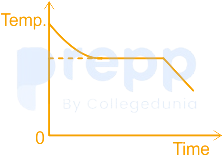
The part of the curve that is practically horizontal is due to
Perspiration cools the body because
In which of the following phenomena do heat waves travel along a straight line with the speed of light?
Which one of the following statement is NOT correct?
Which one of the following statement with regard to expansion of materials due to heating is not correct?
Important Questions from Temperature and heat
A Kelvin thermometer and a Fahrenheit thermometer both give the same reading for a certain sample. What would be the corresponding reading in a Celsius thermometer?
Which of the following gases has highest value of critical temperature ?
- For carbon dioxide ($CO_2$), which is commonly used in industrial processes as a supercritical fluid, what is its critical temperature? Above this temperature, $CO_2$ cannot be liquefied regardless of how much pressure is applied, existing only as a supercritical fluid.
- Where does the heat energy go when the solid melts but its temperature remains the same?
The absolute zero temperature is 0 Kelvin. In °C unit, which one of the following is the absolute zero temperature?



