
Perspiration cools the body because
Evaporation requires latent heat
Understanding How Perspiration Cools the Body
Perspiration, commonly known as sweating, is a vital process for regulating body temperature. When the body heats up, sweat glands release a liquid onto the skin surface. The cooling effect comes from what happens to this liquid.
The Process of Evaporation and Cooling
The primary mechanism by which perspiration cools the body is through evaporation. Evaporation is the process where a liquid turns into a gas or vapor. When sweat evaporates from the skin, it requires energy.
This energy is absorbed from the skin and the underlying blood vessels. The energy absorbed is called the latent heat of vaporization. For water (the main component of sweat) to change state from liquid to gas, it needs a significant amount of energy. This energy is drawn directly from the body's surface, leading to a decrease in skin temperature, and subsequently, cooling the blood flowing near the surface. This cooled blood then circulates, helping to lower the overall body temperature.
Let's consider the options provided in the context of how perspiration cools the body:
- Presence of water on the skin is cooling: While the presence of liquid water is necessary for evaporation, the liquid itself doesn't cause significant cooling just by being there. A wet surface might feel cooler temporarily due to heat conduction, but the sustained and substantial cooling comes from the phase change (evaporation).
- Evaporation requires latent heat: This is the key principle. The energy needed for the liquid water to evaporate into water vapor is taken from the body. This energy removal is what causes cooling.
- Water has a high specific heat: Specific heat is the amount of heat required to raise the temperature of a substance by a certain amount. While water does have a high specific heat, meaning it can absorb a lot of heat before its temperature rises significantly, this property is more relevant to *how much* heat the body or water can hold, not the primary mechanism of cooling during sweating. The cooling effect of sweat is due to the energy *removed* during the change of state (evaporation), not just the capacity of water to store heat.
- Water is a poor conductor of heat: Water's thermal conductivity affects how well it transfers heat. Compared to some metals, water is a relatively poor conductor, but this property doesn't explain the cooling effect of evaporation. In fact, if water were a good conductor, it might even transfer heat *into* the body from warmer surroundings. The cooling is about energy *leaving* the body via the phase change.
Therefore, the fundamental reason why perspiration cools the body is that the process of evaporation requires energy (latent heat), which is absorbed from the body, thereby lowering its temperature.
Summary of Cooling Mechanisms
| Process | Role in Perspiration Cooling | Cooling Mechanism |
|---|---|---|
| Perspiration (Sweating) | Releases liquid (sweat) onto skin surface. | Provides the liquid for evaporation. |
| Evaporation | Sweat changes from liquid to gas. | Requires energy (latent heat). |
| Latent Heat Requirement | Energy for evaporation is absorbed from the body. | Removal of heat energy cools the body. |
Revision Table: Body Temperature Regulation
| Mechanism | Description | How it Transfers Heat |
|---|---|---|
| Radiation | Heat transfer through electromagnetic waves. Body radiates heat, or absorbs it from surroundings. | Heat leaves or enters the body without direct contact. |
| Convection | Heat transfer through the movement of fluids (air or water). | Cool air moving past the skin removes heat. |
| Conduction | Heat transfer through direct contact between surfaces. | Touching a cold surface transfers heat from the body to the surface. |
| Evaporation (Sweating) | Heat transfer through the phase change of liquid sweat to gas. | Body heat is used as latent heat for evaporation, removing heat. |
Evaporation is particularly effective as a cooling mechanism, especially in dry environments, because it directly removes a large amount of heat for each gram of water evaporated. This is why sweating is our primary defense against overheating during exercise or in hot conditions.
Additional Information on Evaporation and Cooling
The efficiency of cooling by perspiration depends on several factors:
- Humidity: High humidity reduces the rate of evaporation because the air is already saturated with water vapor, making it harder for more water to evaporate from the skin.
- Air Movement (Wind): Wind increases the rate of evaporation by moving away the humid air near the skin and replacing it with drier air.
- Surface Area: Spreading sweat over a larger surface area allows for more rapid evaporation.
- Amount of Sweat: The more sweat produced and evaporated, the greater the cooling effect.
The concept of latent heat is fundamental in physics and thermodynamics. The latent heat of vaporization of water is approximately $2260$ kilojoules per kilogram ($2260$ kJ/kg) at $100^\circ\text{C}$, and it is even higher at skin temperature. This large value highlights the significant amount of energy removed from the body during the evaporation of sweat, making it a very effective cooling mechanism.
Similar Questions
A Kelvin thermometer and a Fahrenheit thermometer both give the same reading for a certain sample. What would be the corresponding reading in a Celsius thermometer?
A pressure cooker cooks food faster by
The absolute zero temperature is 0 Kelvin. In °C unit, which one of the following is the absolute zero temperature?
The coefficient of areal expansion of a material is 1.6 × 10 -5 K-1 . Which one of the following gives the value of coefficient of volume expansion of this material?
The temperature of a place on one sunny day is 113 in Fahrenheit scale. The Kelvin scale reading of this temperature will be
Radiations coming from the Sun are mostly in the form of
A solid is melted and allowed to cool and solidify again. The temperature is measured at equal interval of time. The graph below shows the change of temperature with time.
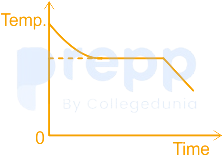
The part of the curve that is practically horizontal is due to
In which of the following phenomena do heat waves travel along a straight line with the speed of light?
Which one of the following statement is NOT correct?
Which one of the following statement with regard to expansion of materials due to heating is not correct?
Important Questions from Temperature and heat
A Kelvin thermometer and a Fahrenheit thermometer both give the same reading for a certain sample. What would be the corresponding reading in a Celsius thermometer?
Which of the following gases has highest value of critical temperature ?
- For carbon dioxide ($CO_2$), which is commonly used in industrial processes as a supercritical fluid, what is its critical temperature? Above this temperature, $CO_2$ cannot be liquefied regardless of how much pressure is applied, existing only as a supercritical fluid.
- Where does the heat energy go when the solid melts but its temperature remains the same?
A pressure cooker cooks food faster by



