
The absolute zero temperature is 0 Kelvin. In °C unit, which one of the following is the absolute zero temperature?
-273.15°C
Understanding Absolute Zero Temperature
The question asks us to find the value of absolute zero temperature in degrees Celsius (°C), given that it is defined as 0 Kelvin (K).
Absolute zero is the theoretical lowest possible temperature where particles have minimal motion. It is the point where the fundamental particles of nature have minimum vibrational motion, retaining only quantum mechanical, zero-point energy-induced particle motion.
On the Kelvin scale, this unique point is set as 0 K. The Kelvin scale is an absolute thermodynamic scale, meaning it starts at absolute zero. Unlike Celsius or Fahrenheit, it does not have negative values.
Converting Kelvin to Celsius
To convert a temperature from Kelvin (K) to Celsius (°C), we use a standard conversion formula. The Celsius scale is related to the Kelvin scale by a simple offset. The size of one degree Celsius is exactly equal to the size of one Kelvin.
The relationship between the two scales is given by the formula:
\( T_{\text{°C}} = T_{\text{K}} - 273.15 \)
Where:
- \( T_{\text{°C}} \) is the temperature in degrees Celsius
- \( T_{\text{K}} \) is the temperature in Kelvin
Calculating Absolute Zero in Celsius
We are given that absolute zero temperature is 0 Kelvin. To find its equivalent value in Celsius, we substitute \( T_{\text{K}} = 0 \) into the conversion formula:
\( T_{\text{°C}} = 0 - 273.15 \)
\( T_{\text{°C}} = -273.15 \)
So, absolute zero temperature, which is 0 Kelvin, is equal to -273.15 degrees Celsius.
Comparing with Options
Let's look at the given options:
- 0°C
- -100°C
- -273.15°C
- -173.15°C
Our calculated value for absolute zero in Celsius is -273.15°C, which matches option 3.
Summary of Temperature Scales
Here is a brief comparison of the absolute zero point on different temperature scales:
| Temperature Scale | Absolute Zero Point |
|---|---|
| Kelvin (K) | 0 K |
| Celsius (°C) | -273.15 °C |
| Fahrenheit (°F) | -459.67 °F |
Revision Table: Key Temperature Conversions
| Conversion | Formula |
|---|---|
| Kelvin to Celsius | \( T_{\text{°C}} = T_{\text{K}} - 27.15 \) |
| Celsius to Kelvin | \( T_{\text{K}} = T_{\text{°C}} + 273.15 \) |
| Celsius to Fahrenheit | \( T_{\text{°F}} = (T_{\text{°C}} \times \frac{9}{5}) + 32 \) |
| Fahrenheit to Celsius | \( T_{\text{°C}} = (T_{\text{°F}} - 32) \times \frac{5}{9} \) |
| Fahrenheit to Kelvin | \( T_{\text{K}} = (T_{\text{°F}} - 32) \times \frac{5}{9} + 273.15 \) |
| Kelvin to Fahrenheit | \( T_{\text{°F}} = (T_{\text{K}} - 273.15) \times \frac{9}{5} + 32 \) |
Additional Information: Significance of Absolute Zero
Absolute zero is a crucial concept in thermodynamics and quantum mechanics.
- It represents the lowest limit of the thermodynamic temperature scale.
- At temperatures approaching absolute zero, many materials exhibit unusual properties like superconductivity and superfluidity.
- It is impossible to reach absolute zero in practice, according to the third law of thermodynamics, though temperatures very close to it have been achieved in laboratories.
- The concept is vital for understanding the behavior of gases (ideal gas law extrapolated to absolute zero) and the principles of quantum mechanics.
Similar Questions
A Kelvin thermometer and a Fahrenheit thermometer both give the same reading for a certain sample. What would be the corresponding reading in a Celsius thermometer?
A pressure cooker cooks food faster by
The coefficient of areal expansion of a material is 1.6 × 10 -5 K-1 . Which one of the following gives the value of coefficient of volume expansion of this material?
The temperature of a place on one sunny day is 113 in Fahrenheit scale. The Kelvin scale reading of this temperature will be
Radiations coming from the Sun are mostly in the form of
A solid is melted and allowed to cool and solidify again. The temperature is measured at equal interval of time. The graph below shows the change of temperature with time.
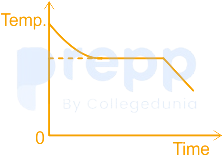
The part of the curve that is practically horizontal is due to
Perspiration cools the body because
In which of the following phenomena do heat waves travel along a straight line with the speed of light?
Which one of the following statement is NOT correct?
Which one of the following statement with regard to expansion of materials due to heating is not correct?
Important Questions from Temperature and heat
A Kelvin thermometer and a Fahrenheit thermometer both give the same reading for a certain sample. What would be the corresponding reading in a Celsius thermometer?
Which of the following gases has highest value of critical temperature ?
- For carbon dioxide ($CO_2$), which is commonly used in industrial processes as a supercritical fluid, what is its critical temperature? Above this temperature, $CO_2$ cannot be liquefied regardless of how much pressure is applied, existing only as a supercritical fluid.
- Where does the heat energy go when the solid melts but its temperature remains the same?
A pressure cooker cooks food faster by



