
The temperature of a place on one sunny day is 113 in Fahrenheit scale. The Kelvin scale reading of this temperature will be
318 K
Understanding Temperature Scales and Conversion
This question asks us to convert a temperature given in the Fahrenheit scale to the Kelvin scale. Temperature scales like Fahrenheit, Celsius, and Kelvin are used to measure the degree of hotness or coldness of a body or environment. To convert a temperature from one scale to another, specific formulas are used.
Converting Temperature from Fahrenheit to Celsius
First, we need to convert the temperature from Fahrenheit (°F) to Celsius (°C). The formula to convert Fahrenheit to Celsius is:
\(\text{C} = \frac{5}{9}(\text{F} - 32)\)
Given the temperature in Fahrenheit is 113°F, we substitute this value into the formula:
\(\text{C} = \frac{5}{9}(113 - 32)\)
\(\text{C} = \frac{5}{9}(81)\)
\(\text{C} = 5 \times \frac{81}{9}\)
\(\text{C} = 5 \times 9\)
\(\text{C} = 45^\circ \text{C}\)
So, 113°F is equivalent to 45°C.
Converting Temperature from Celsius to Kelvin
Next, we convert the temperature from Celsius (°C) to Kelvin (K). The formula to convert Celsius to Kelvin is:
\(\text{K} = \text{C} + 273.15\)
However, in many standard calculations for exams where options are whole numbers, the conversion is often done using 273 instead of 273.15 for simplicity.
Let's use the simpler conversion factor: \(\text{K} = \text{C} + 273\)
Substitute the calculated Celsius temperature (45°C) into this formula:
\(\text{K} = 45 + 273\)
\(\text{K} = 318 \text{ K}\)
Using the more precise value:
\(\text{K} = 45 + 273.15\)
\(\text{K} = 318.15 \text{ K}\)
Given the options are whole numbers, 318 K is the closest value to 318.15 K, and directly obtained using the common approximation of adding 273.
Analyzing the Kelvin Temperature Options
We calculated the temperature in Kelvin to be approximately 318 K.
Let's look at the given options:
- 318 K
- 45 K
- 62·8 K
- 335·8 K
Comparing our calculated value (318 K) with the options, we see that Option 1 matches our result.
Revision Table: Temperature Conversion Formulas
| From | To | Formula |
|---|---|---|
| Celsius (°C) | Fahrenheit (°F) | \(\text{F} = \frac{9}{5}\text{C} + 32\) |
| Fahrenheit (°F) | Celsius (°C) | \(\text{C} = \frac{5}{9}(\text{F} - 32)\) |
| Celsius (°C) | Kelvin (K) | \(\text{K} = \text{C} + 273.15\) (or 273) |
| Kelvin (K) | Celsius (°C) | \(\text{C} = \text{K} - 273.15\) (or 273) |
| Fahrenheit (°F) | Kelvin (K) | First convert °F to °C, then °C to K. |
| Kelvin (K) | Fahrenheit (°F) | First convert K to °C, then °C to °F. |
Additional Information on Temperature Scales
There are three main temperature scales used globally:
- Fahrenheit (°F): Primarily used in the United States. Water freezes at 32°F and boils at 212°F (at standard atmospheric pressure).
- Celsius (°C): Used in most countries worldwide, especially in science. Water freezes at 0°C and boils at 100°C.
- Kelvin (K): The standard unit of temperature in the International System of Units (SI), widely used in science and engineering. It is an absolute scale, meaning that 0 K (absolute zero) is the theoretical point where particles have minimum motion. The Kelvin scale uses the same interval size as the Celsius scale. The freezing point of water is 273.15 K (or approximately 273 K), and the boiling point is 373.15 K (or approximately 373 K).
The difference between using 273 and 273.15 for the Celsius to Kelvin conversion is a matter of precision. For most general calculations or MCQs with whole number options, using 273 is acceptable and often intended to simplify calculations.
Similar Questions
A Kelvin thermometer and a Fahrenheit thermometer both give the same reading for a certain sample. What would be the corresponding reading in a Celsius thermometer?
A pressure cooker cooks food faster by
The absolute zero temperature is 0 Kelvin. In °C unit, which one of the following is the absolute zero temperature?
The coefficient of areal expansion of a material is 1.6 × 10 -5 K-1 . Which one of the following gives the value of coefficient of volume expansion of this material?
Radiations coming from the Sun are mostly in the form of
A solid is melted and allowed to cool and solidify again. The temperature is measured at equal interval of time. The graph below shows the change of temperature with time.
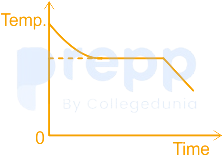
The part of the curve that is practically horizontal is due to
Perspiration cools the body because
In which of the following phenomena do heat waves travel along a straight line with the speed of light?
Which one of the following statement is NOT correct?
Which one of the following statement with regard to expansion of materials due to heating is not correct?
Important Questions from Temperature and heat
A Kelvin thermometer and a Fahrenheit thermometer both give the same reading for a certain sample. What would be the corresponding reading in a Celsius thermometer?
Which of the following gases has highest value of critical temperature ?
- For carbon dioxide ($CO_2$), which is commonly used in industrial processes as a supercritical fluid, what is its critical temperature? Above this temperature, $CO_2$ cannot be liquefied regardless of how much pressure is applied, existing only as a supercritical fluid.
- Where does the heat energy go when the solid melts but its temperature remains the same?
A pressure cooker cooks food faster by



