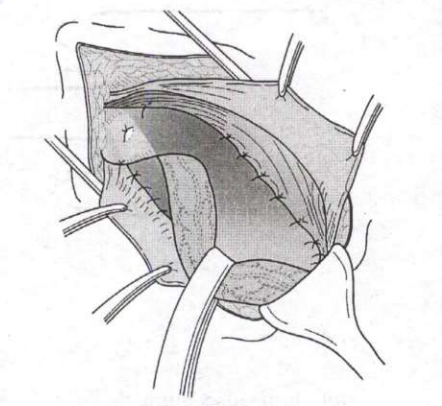
Which one of the following is the most common benign liver lesion?
Hemangioma
The correct answer is haemangioma. Cavernous haemangioma is the commonest benign tumour of the liver, present in about 3-7 percent of the population (up to 20 percent in autopsy series), with a female to male ratio near 5 : 1. It is a congenital vascular malformation of endothelium-lined blood-filled spaces separated by fibrous septa and may enlarge with oestrogen exposure. Most are small, right-lobed and found incidentally. Diagnosis is radiological: peripheral nodular enhancement with progressive centripetal fill-in on CT/MRI, plus a bright T2 light-bulb sign. Biopsy is contraindicated because of bleeding risk; treatment is observation, with resection only for giant symptomatic lesions or Kasabach-Merritt syndrome.
Hepatic adenoma is far rarer, linked to oral contraceptive and anabolic steroid use, and matters because it can bleed and turn malignant, so lesions above 5 cm are resected. Focal nodular hyperplasia is the second commonest benign solid lesion, shows a pathognomonic central stellate scar and has no malignant potential. Simple liver cysts are common but are non-neoplastic developmental cysts, not tumours.
Key point: Central scar equals FNH, OCP use with bleeding risk equals adenoma, centripetal fill-in with no biopsy equals haemangioma, the commonest benign liver lesion.
Similar Questions
Which one of the following statements regarding choledochal cyst is not correct?
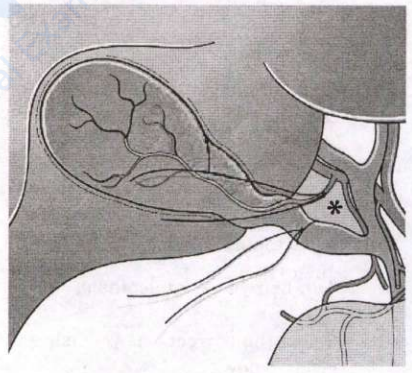
A trainee surgeon is performing his/her first cholecystectomy. The area marked with an asterisk in the diagram represents
A 42-year-old lady underwent a laparoscopic cholecystectomy, which was uneventful other than some spillage of bile and gallstones during dissection. Postoperatively the patient was fine but she started complaining of right shoulder tip pain and developed high grade fever on the 3rd postoperative day. Her pulse was found to be 110/min and RR 20/min. The most likely diagnosis is
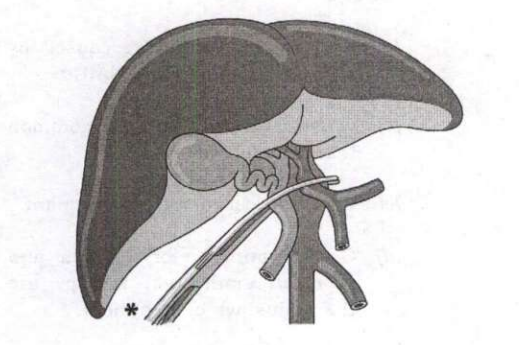
The manoeuvre (marked with an asterisk) shown in the following image is
Important Questions from Hepatobiliary & Pancreatic Surgery
- The Child-Turcotte-Pugh (CTP) score for quantifying the severity of chronic liver disease includes all variables EXCEPT:
'Chain of Lakes' appearance due to sacculation with intervening short strictures of pancreatic duct is seen on:
- Which one of the following statements is NOT correct regarding Pyogenic Liver Abscess?
- Which of the statements regarding Calot's triangle are correct?
1. Common hepatic duct forms the medial boundary of the Calot's triangle
2. Inferior surface of the right lobe of the liver forms the superior boundary of Calot's triangle
3. Right hepatic artery is usually found as a content of the Calot's triangle
4. Cystic duct and medial border of gall bladder forms the lateral border of Calot's triangle
Select the correct answer using the code given below: - CA 19-9 is a tumour marker used for the diagnosis of: