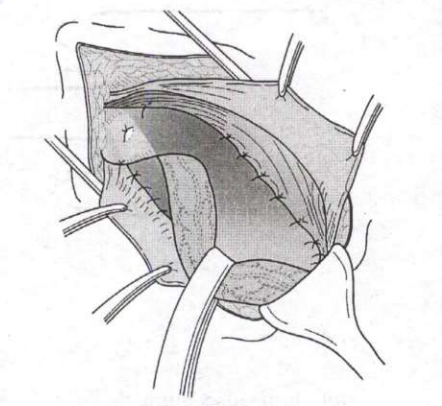
Which one of the following statements regarding choledochal cyst is not correct?
Majority of patients are diagnosed after 10 years of age.
The incorrect statement, and hence the answer, is that most patients are diagnosed after 10 years of age. In fact most choledochal cysts present in infancy and childhood, about 60-80 percent before 10 years, and many are now detected antenatally. The classical triad of pain, jaundice and a right hypochondrial mass is complete in fewer than 20 percent; infants present with obstructive jaundice mimicking biliary atresia, older patients with pain, cholangitis or pancreatitis. There is female preponderance (3-4 : 1) and a higher incidence in East Asians.
The other options are true. Choledochal cysts are congenital dilatations of the intra- and/or extra-hepatic biliary tree, classified by Todani into five types, type I (fusiform CBD dilatation) being commonest at 80-90 percent and type V being Caroli disease; the favoured cause is an anomalous pancreaticobiliary junction with a long common channel. Cholangiocarcinoma risk is about 10-30 percent lifetime, which is exactly why complete excision with Roux-en-Y hepaticojejunostomy is the treatment of choice, internal drainage being obsolete.
Key point: Choledochal cyst is a disease of childhood, usually Todani type I, and must be excised, never merely drained.
Similar Questions
Which one of the following is the most common benign liver lesion?
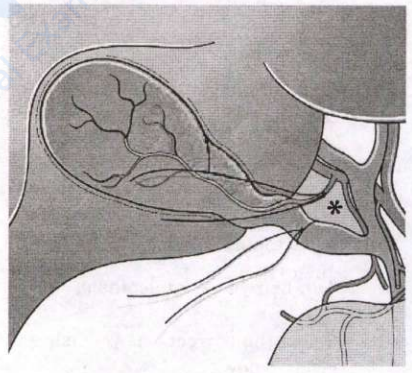
A trainee surgeon is performing his/her first cholecystectomy. The area marked with an asterisk in the diagram represents
A 42-year-old lady underwent a laparoscopic cholecystectomy, which was uneventful other than some spillage of bile and gallstones during dissection. Postoperatively the patient was fine but she started complaining of right shoulder tip pain and developed high grade fever on the 3rd postoperative day. Her pulse was found to be 110/min and RR 20/min. The most likely diagnosis is
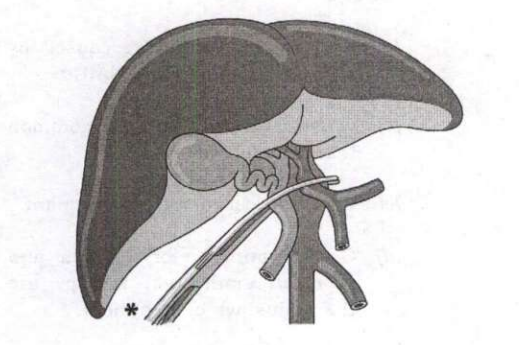
The manoeuvre (marked with an asterisk) shown in the following image is
Important Questions from Hepatobiliary & Pancreatic Surgery
- The Child-Turcotte-Pugh (CTP) score for quantifying the severity of chronic liver disease includes all variables EXCEPT:
'Chain of Lakes' appearance due to sacculation with intervening short strictures of pancreatic duct is seen on:
- Which one of the following statements is NOT correct regarding Pyogenic Liver Abscess?
- Which of the statements regarding Calot's triangle are correct?
1. Common hepatic duct forms the medial boundary of the Calot's triangle
2. Inferior surface of the right lobe of the liver forms the superior boundary of Calot's triangle
3. Right hepatic artery is usually found as a content of the Calot's triangle
4. Cystic duct and medial border of gall bladder forms the lateral border of Calot's triangle
Select the correct answer using the code given below: - CA 19-9 is a tumour marker used for the diagnosis of: