A 42-year-old lady underwent a laparoscopic cholecystectomy, which was uneventful other than some spillage of bile and gallstones during dissection. Postoperatively the patient was fine but she started complaining of right shoulder tip pain and developed high grade fever on the 3rd postoperative day. Her pulse was found to be 110/min and RR 20/min. The most likely diagnosis is
right subdiaphragmatic abscess
The likely diagnosis is a right subdiaphragmatic (subphrenic) abscess. Spilled infected bile and dropped gallstones left in the subhepatic and subphrenic spaces act as an infected nidus. Diaphragmatic irritation, supplied by the phrenic nerve (C3, C4, C5), refers pain to the right shoulder tip through supraclavicular nerves of the same roots. Shoulder tip pain with swinging high-grade fever on the third to fifth postoperative day, pulse 110 per minute and tachypnoea is classic. Confirm on ultrasound or CT; treat with antibiotics and drainage.
Ascending cholangitis would give Charcot's triad including jaundice, absent here, and implies a retained ductal stone. Liver abscess causes tender hepatomegaly with intercostal tenderness rather than isolated shoulder tip pain, and is uncommon after cholecystectomy. DVT with pulmonary embolism causes pleuritic pain, hypoxia and a respiratory rate well above 20 per minute, without high swinging fever.
Key point: Postoperative fever plus shoulder tip pain means a subphrenic collection until proven otherwise - pus somewhere, pus nowhere, means pus under the diaphragm.
Similar Questions
Which one of the following statements regarding choledochal cyst is not correct?
Which one of the following is the most common benign liver lesion?
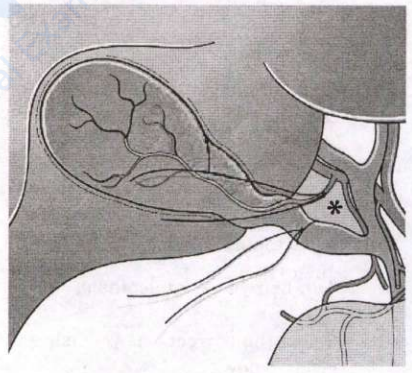
A trainee surgeon is performing his/her first cholecystectomy. The area marked with an asterisk in the diagram represents
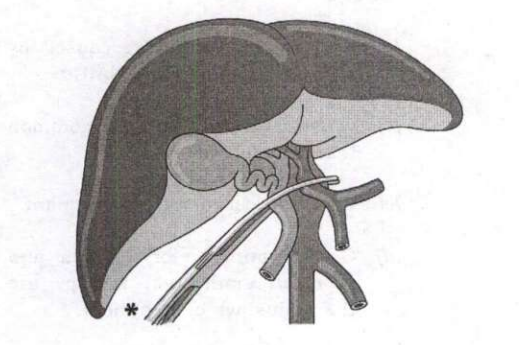
The manoeuvre (marked with an asterisk) shown in the following image is
Important Questions from Hepatobiliary & Pancreatic Surgery
- The Child-Turcotte-Pugh (CTP) score for quantifying the severity of chronic liver disease includes all variables EXCEPT:
'Chain of Lakes' appearance due to sacculation with intervening short strictures of pancreatic duct is seen on:
- Which one of the following statements is NOT correct regarding Pyogenic Liver Abscess?
- Which of the statements regarding Calot's triangle are correct?
1. Common hepatic duct forms the medial boundary of the Calot's triangle
2. Inferior surface of the right lobe of the liver forms the superior boundary of Calot's triangle
3. Right hepatic artery is usually found as a content of the Calot's triangle
4. Cystic duct and medial border of gall bladder forms the lateral border of Calot's triangle
Select the correct answer using the code given below: - CA 19-9 is a tumour marker used for the diagnosis of: