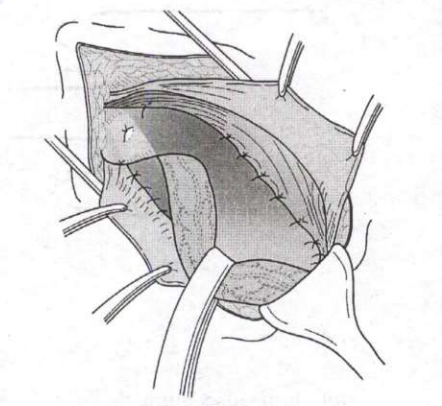
The manoeuvre (marked with an asterisk) shown in the following image is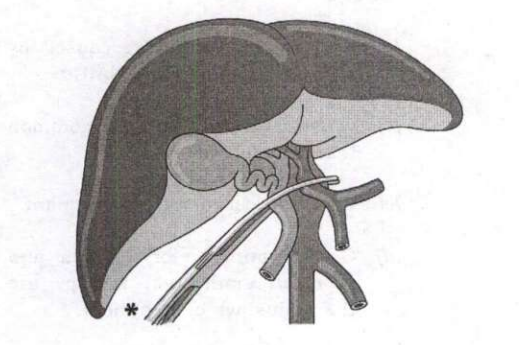
Pringle
The manoeuvre shown is the Pringle manoeuvre: clamping or digitally compressing the hepatoduodenal ligament carrying the portal triad - portal vein, hepatic artery proper and common bile duct - by passing a finger through the foramen of Winslow. This occludes hepatic inflow to control bleeding from a lacerated liver or during hepatectomy. Warm ischaemia is tolerated for about 15 to 20 minutes at a time, so intermittent clamping is preferred. If bleeding persists despite a correct Pringle, the source is the hepatic veins or retrohepatic inferior vena cava, or an aberrant left hepatic artery.
The Mattox manoeuvre is a left medial visceral rotation exposing the suprarenal aorta. The Kocher manoeuvre mobilises the duodenum by incising its lateral peritoneal attachment to expose the pancreatic head, distal bile duct and vena cava. The shoe-shine manoeuvre belongs to antireflux surgery, sliding the wrapped fundus back and forth to confirm a loose, correctly oriented Nissen fundoplication.
Key point: Pringle controls inflow only; persistent bleeding after clamping points to hepatic venous or caval injury.
Similar Questions
Which one of the following statements regarding choledochal cyst is not correct?
Which one of the following is the most common benign liver lesion?
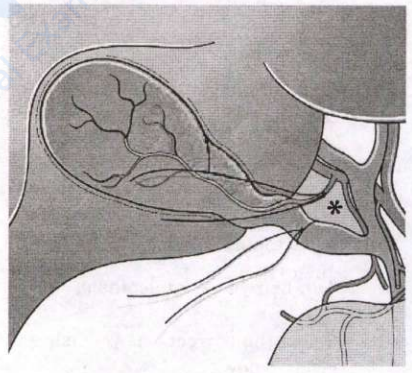
A trainee surgeon is performing his/her first cholecystectomy. The area marked with an asterisk in the diagram represents
A 42-year-old lady underwent a laparoscopic cholecystectomy, which was uneventful other than some spillage of bile and gallstones during dissection. Postoperatively the patient was fine but she started complaining of right shoulder tip pain and developed high grade fever on the 3rd postoperative day. Her pulse was found to be 110/min and RR 20/min. The most likely diagnosis is
Important Questions from Hepatobiliary & Pancreatic Surgery
- The Child-Turcotte-Pugh (CTP) score for quantifying the severity of chronic liver disease includes all variables EXCEPT:
'Chain of Lakes' appearance due to sacculation with intervening short strictures of pancreatic duct is seen on:
- Which one of the following statements is NOT correct regarding Pyogenic Liver Abscess?
- Which of the statements regarding Calot's triangle are correct?
1. Common hepatic duct forms the medial boundary of the Calot's triangle
2. Inferior surface of the right lobe of the liver forms the superior boundary of Calot's triangle
3. Right hepatic artery is usually found as a content of the Calot's triangle
4. Cystic duct and medial border of gall bladder forms the lateral border of Calot's triangle
Select the correct answer using the code given below: - CA 19-9 is a tumour marker used for the diagnosis of: