
A 40-year-old male patient has undergone a surgical procedure for a swelling in his left groin. The image of the procedure is as shown. What procedure has been performed?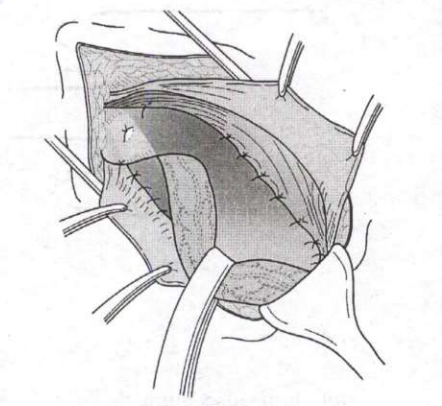
Lichtenstein's repair
The procedure is Lichtenstein's repair, the standard open tension-free mesh repair of inguinal hernia. A flat polypropylene sheet is laid over the posterior wall of the inguinal canal, fixed medially to the pubic tubercle and rectus sheath, inferiorly to the inguinal ligament and superiorly to the conjoint tendon, with a slit in its lateral end forming a new deep ring around the cord. Because it reinforces rather than approximating tissue under tension, recurrence falls to about 1 to 2 per cent.
The others are tissue (non-mesh) repairs. Bassini's repair approximates conjoint tendon to inguinal ligament behind the cord, with higher recurrence. Shouldice repair is a four-layer double-breasted continuous imbrication of transversalis fascia and conjoint tendon to the inguinal ligament - the best pure tissue repair but technically demanding. Desarda's repair uses an undetached strip of external oblique aponeurosis as a mesh-free physiological reinforcement. None uses the prosthetic sheet seen here.
Key point: Mesh over the posterior wall with a lateral slit around the cord equals Lichtenstein, the reference standard open repair.
Important Questions from Abdominal Wall
- ‘Swiss cheese defects' are seen during laparoscopic repair of:
- Structure not forming boundaries of the “Triangle of doom” seen during laparoscopic inguinal hernia surgery dissection is:
- Which of the following is NOT a tissue repair surgery for inguinal hernia repair?
- Which one of the following type of meshes is recommended for intraperitoneal use in abdominal wall hernia?
- A young sports person presented in surgical emergency with the complaints of severe pain in the groin area, extending into the scrotum and upper thigh. The pain is debilitating and he is not able to exercise. On examination there is tenderness in the region of Inguinal canal and pubic tubercle. He is probably suffering from:


