
Weight and mass of an object are defined with Newton’s laws of motion. Which among the following is true ?
Mass is a constant of proportionality.
Understanding Mass and Weight in Physics
In physics, specifically when dealing with Newton's laws of motion, it is important to understand the difference between mass and weight. Both are related to an object, but they represent different physical quantities.
What is Mass?
Mass is an intrinsic property of an object. It is a measure of the amount of matter in an object. Mass is also a measure of an object's inertia – its resistance to acceleration when a net force is applied. Mass is a scalar quantity and is typically measured in kilograms (kg).
According to Newton's second law of motion, the force (\(F\)) acting on an object is directly proportional to its acceleration (\(a\)) and the mass (\(m\)) of the object:
\(F = ma\)
In this equation, mass (\(m\)) acts as the constant of proportionality between the net force (\(F\)) applied to an object and the resulting acceleration (\(a\)). For a given mass, a larger force results in a larger acceleration, and for a given force, a larger mass results in a smaller acceleration.
What is Weight?
Weight, on the other hand, is the force exerted on an object due to gravity. It is a vector quantity, directed towards the center of the gravitational source (like the Earth). Weight is typically measured in Newtons (N).
The weight (\(W\)) of an object is given by the formula:
\(W = mg\)
Here, \(m\) is the mass of the object, and \(g\) is the acceleration due to gravity at the specific location. The value of \(g\) is approximately \(9.8 \, m/s^2\) on the surface of the Earth, but it varies slightly depending on location (altitude, latitude) and is significantly different on other celestial bodies (like the Moon or Mars).
Analyzing the Options
Let's look at each option in the context of our understanding of mass and weight and Newton's laws.
- Option 1: Weight is a constant of proportionality. Weight is a force (\(W=mg\)). In this formula, mass (\(m\)) is the constant for a given object, while \(g\) is a specific value of acceleration. Weight itself is the resulting force, not a constant relating two other variables in a fundamental motion law like \(F=ma\). Therefore, weight is not a constant of proportionality in the way mass is in Newton's second law.
- Option 2: Mass is a constant of proportionality. As discussed earlier, in Newton's second law (\(F=ma\)), mass (\(m\)) serves as the constant of proportionality between the force (\(F\)) and the acceleration (\(a\)). This statement is consistent with the definition of mass and Newton's laws.
- Option 3: Mass is not a constant of proportionality. This contradicts Newton's second law (\(F=ma\)), where mass is explicitly the proportionality constant between force and acceleration.
- Option 4: Weight is a universal constant. Weight (\(W=mg\)) depends on the acceleration due to gravity (\(g\)). Since \(g\) varies depending on location in the universe, weight is not a universal constant. An object's weight on the Moon is about one-sixth its weight on Earth, for example. Mass, however, is a constant property of the object regardless of location (in classical mechanics).
Based on this analysis, the statement that mass is a constant of proportionality is true, specifically in relation to Newton's second law (\(F=ma\)).
Key Distinction: Mass vs. Weight
It is crucial to remember the key differences between mass and weight:
| Feature | Mass | Weight |
|---|---|---|
| Definition | Amount of matter; Measure of inertia | Force due to gravity |
| Nature | Scalar quantity | Vector quantity |
| Unit | Kilograms (kg) | Newtons (N) |
| Location Dependence | Constant (classical) | Varies with gravity (g) |
| Role in \(F=ma\) | Constant of proportionality | Related through \(W=mg\) |
Revision Table: Mass and Weight
Let's quickly review the core concepts related to mass and weight based on Newton's laws:
- Mass is an intrinsic property of an object.
- Mass is the measure of inertia.
- In Newton's second law, \(F=ma\), mass (\(m\)) is the constant linking force (\(F\)) and acceleration (\(a\)).
- Weight is the force exerted by gravity on an object.
- Weight depends on both mass and the local acceleration due to gravity (\(g\)).
- Weight is not constant across different locations.
Additional Information: Newton's Laws and Proportionality
Newton's laws of motion are fundamental to classical mechanics.
- Newton's First Law (Law of Inertia): An object at rest stays at rest and an object in motion stays in motion with the same speed and in the same direction unless acted upon by an unbalanced force. This law highlights the concept of inertia, which is directly related to mass.
- Newton's Second Law (\(F=ma\)): The acceleration of an object is directly proportional to the net force acting on the object, is in the same direction as the net force, and is inversely proportional to the mass of the object. Mathematically, \(F \propto a / m\), which leads to \(F = k \cdot (a/m)\). By defining the unit of force appropriately (e.g., 1 Newton is the force required to accelerate 1 kg by 1 \(m/s^2\)), the constant \(k\) is set to 1, giving \(F=ma\). In this standard form, mass (\(m\)) is the proportionality constant between \(F\) and \(a\).
- Newton's Third Law: For every action, there is an equal and opposite reaction. This law deals with forces acting between two interacting objects.
Understanding the role of mass as the proportionality constant in \(F=ma\) is key to applying Newton's second law correctly.
Similar Questions
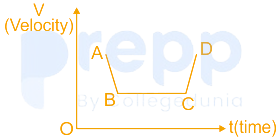
In the given velocity (V) versus time (t) graph, accelerated and decelerated motions are respectively represented by line segments
A rigid body of mass 2 kg is dropped from a stationary balloon kept at a height of 50 m from the ground. The speed of the body when it just touches the ground and the total energy
when it is dropped from the balloon are respectively
(acceleration due to gravity = 9·8 m/s -2 )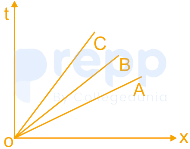
The figure shown above gives the time (t) versus position (x) graphs of three objects A, B and C. Which one of the following is the correct relation between their speeds V A, V Band V C, respectively at any instant (t > 0)?
A ball is released from rest and rolls down an inclined plane, as shown in the following figure, requiring 4 s to cover a distance of 100 cm along the plane:

Which one of the following is the correct value of angle θ that the plane makes with the horizontal? (g = 1000 cm/s 2)
The force acting on a particle of mass m moving along the X-axis is given by F(x) = AX 2- Bx. Which one of the following is the potential energy of the particle?
How long does light take to reach the earth from the Sun?
Consider the following velocity and time graph:
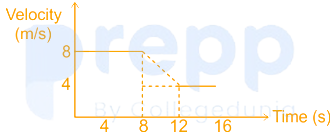
Which one of the following is the value of average acceleration from 8 s to 12 s?
- What is the upward force acting on a skydiver of mass \(60\text{ kg}\) who is falling at a uniform speed of \(2\text{ m/s}\)?
The force-time (\(F-t\)) graph of a 10 kg object initially at rest is shown below.
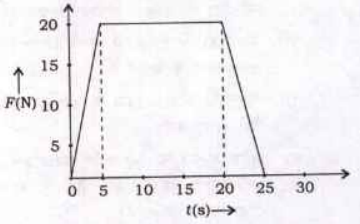
What is the final speed of the object?
- The position vector of a particle is given by \(\vec{r} = \sqrt{3} t^2 \hat{i} + \sqrt{2} t \hat{j} + \sqrt{5} \hat{k}\). Which one of the following statements is correct?
Important Questions from Newton's Laws of Motion
In the given velocity (V) versus time (t) graph, accelerated and decelerated motions are respectively represented by line segments
A balloon is filled with air. The mass of the air in the balloon is 10 gram. A small hole is made to the balloon and released. The balloon moves up with an average speed of 5 cm/s and shrinks completely in 5 seconds. Find the average force acting on the balloon.
A uniform rope is suspended from the roof of a building. The rope breaks if the tension in the rope is greater than 700 N.
A man of mass 50 kg climbs up the rope. Find the maximum acceleration with which he can climb up the rope (g = 10 m/s2)A ball is thrown up with a certain velocity, it attains 50 m and come back to the thrower then the
A string of certain length used to whirl a stone in a vertical circle with certain velocity. The tension developed in the string will be



