
Which one of the following forces is non-central and non-conservative?
Frictional force
Understanding Forces: Central, Conservative, and Non-Conservative
Forces in physics can be categorized based on various properties, including whether they are central or non-central, and whether they are conservative or non-conservative. The question asks us to identify a force that falls into both the non-central and non-conservative categories from the given options.
Defining Key Force Types
- Central Force: A force is called central if it always acts along the line joining the interacting objects. Its magnitude usually depends only on the distance between the objects. Examples include gravitational force between two masses and electrostatic force between two point charges.
- Conservative Force: A force is conservative if the work done by the force in moving an object from one point to another is independent of the path taken. Equivalently, the work done by a conservative force around any closed loop is zero. Examples include gravitational force and electrostatic force. Potential energy can be associated with conservative forces.
- Non-Conservative Force: A force is non-conservative if the work done by the force depends on the path taken. The work done by a non-conservative force around a closed loop is generally not zero. These forces often involve energy dissipation, converting mechanical energy into other forms like heat. Examples include frictional force, air resistance, and viscous force.
- Non-Central Force: A force that does not always act along the line joining the interacting objects, or whose magnitude depends on factors other than just the distance between them in a radial way. Frictional force is an example, as it acts tangent to the surface of contact and opposite to motion.
Analyzing the Given Options
Let's examine each force listed in the options based on these definitions:
-
Frictional force:
- Non-Central: Frictional force acts parallel to the surface of contact, opposing motion. It does not necessarily act along the line connecting the centers of mass of the interacting bodies. Therefore, it is a non-central force.
- Non-Conservative: The work done by friction depends heavily on the path taken. If you slide an object along a longer path, friction does more work (negative work, removing mechanical energy). Work done by friction around a closed loop is generally not zero; mechanical energy is lost due to friction. Therefore, frictional force is a non-conservative force.
-
Electric force:
- Central: For point charges, the electric force acts along the line connecting the two charges. The magnitude depends only on the distance between them and the charges. So, it is a central force.
- Conservative: The electrostatic force is a conservative force. The work done by the electric force in moving a charge between two points depends only on the potential difference between the points, not the path taken.
-
Gravitational force:
- Central: The gravitational force between two point masses acts along the line connecting their centers. The magnitude depends only on the distance between them and their masses. It is a central force.
- Conservative: The gravitational force is a conservative force. The work done by gravity depends only on the change in vertical position, not the path taken.
-
Mechanical force:
- This is a broad term often referring to forces exerted by physical contact or mechanical means. It is not a fundamental force type like gravitational or electric force. A mechanical force could potentially be conservative (like the force exerted by an ideal spring) or non-conservative (like friction). It doesn't inherently possess the properties of being *always* non-central or *always* non-conservative. Frictional force, for instance, is a type of mechanical force, but the term 'mechanical force' itself doesn't specifically mean non-central and non-conservative in all contexts.
Comparing the analyses, frictional force is the only option that is consistently described as both non-central and non-conservative.
| Force Type | Central/Non-Central | Conservative/Non-Conservative |
|---|---|---|
| Frictional force | Non-Central | Non-Conservative |
| Electric force (Electrostatic) | Central | Conservative |
| Gravitational force | Central | Conservative |
| Mechanical force | (Varies) | (Varies) |
Therefore, the force that is both non-central and non-conservative among the given options is frictional force.
Revision Table: Force Properties
| Property | Central Force | Conservative Force |
|---|---|---|
| Direction | Along the line joining interacting bodies | Work done independent of path |
| Magnitude | Often depends only on distance | Potential energy concept applies |
| Work in Closed Loop | N/A (Not a defining property) | Zero |
| Energy | N/A | Conserves mechanical energy |
Additional Information on Non-Conservative Forces
Non-conservative forces play a significant role in real-world systems because they account for energy dissipation. While conservative forces are associated with potential energy, non-conservative forces typically involve conversion of mechanical energy into thermal energy (heat), sound, or deformation.
The work-energy theorem, when including non-conservative forces, states that the total work done by all forces (conservative and non-conservative) equals the change in kinetic energy (\(\Delta KE\)).
\(\Delta KE = W_{conservative} + W_{non-conservative}\)
If we consider the potential energy \(\Delta PE\) associated with conservative forces (\(W_{conservative} = -\Delta PE\)), the equation becomes:
\(\Delta KE = -\Delta PE + W_{non-conservative}\)
Rearranging this gives:
\(\Delta KE + \Delta PE = W_{non-conservative}\)
The sum of kinetic and potential energy is mechanical energy (\(E_{mechanical} = KE + PE\)). Thus, the equation shows that the change in mechanical energy is equal to the work done by non-conservative forces:
\(\Delta E_{mechanical} = W_{non-conservative}\)
This confirms that non-conservative forces cause a change in the total mechanical energy of a system, often a decrease due to work done against the motion (like friction).
Similar Questions
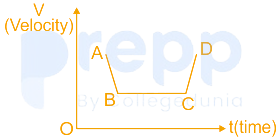
In the given velocity (V) versus time (t) graph, accelerated and decelerated motions are respectively represented by line segments
Consider the following velocity and time graph:
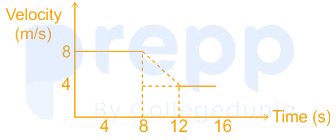
Which one of the following is the value of average acceleration from 8 s to 12 s?
A rigid body of mass 2 kg is dropped from a stationary balloon kept at a height of 50 m from the ground. The speed of the body when it just touches the ground and the total energy
when it is dropped from the balloon are respectively
(acceleration due to gravity = 9·8 m/s -2 )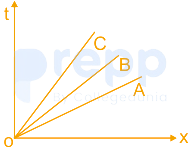
The figure shown above gives the time (t) versus position (x) graphs of three objects A, B and C. Which one of the following is the correct relation between their speeds V A, V Band V C, respectively at any instant (t > 0)?
A ball is released from rest and rolls down an inclined plane, as shown in the following figure, requiring 4 s to cover a distance of 100 cm along the plane:

Which one of the following is the correct value of angle θ that the plane makes with the horizontal? (g = 1000 cm/s 2)
The force acting on a particle of mass m moving along the X-axis is given by F(x) = AX 2- Bx. Which one of the following is the potential energy of the particle?
How long does light take to reach the earth from the Sun?
How is the kinetic energy of a moving object effected If the net work done on it is positive?
The correct sequence of energy transfer that occurs when an apple falls to the ground is
Which one of the following has maximum inertia?
Important Questions from Newton's Laws of Motion
In the given velocity (V) versus time (t) graph, accelerated and decelerated motions are respectively represented by line segments
A balloon is filled with air. The mass of the air in the balloon is 10 gram. A small hole is made to the balloon and released. The balloon moves up with an average speed of 5 cm/s and shrinks completely in 5 seconds. Find the average force acting on the balloon.
A uniform rope is suspended from the roof of a building. The rope breaks if the tension in the rope is greater than 700 N.
A man of mass 50 kg climbs up the rope. Find the maximum acceleration with which he can climb up the rope (g = 10 m/s2)A ball is thrown up with a certain velocity, it attains 50 m and come back to the thrower then the
A string of certain length used to whirl a stone in a vertical circle with certain velocity. The tension developed in the string will be



