
How long does light take to reach the earth from the Sun?
About 8 minutes
Understanding Light Travel Time from the Sun to Earth
The question asks about the time it takes for light emitted by the Sun to reach the Earth. This travel time depends on two main factors: the speed of light and the distance between the Sun and the Earth.
Speed of Light
Light travels at a constant speed in a vacuum, which is the fastest speed known. This speed, denoted by \(c\), is approximately \(299,792,458\) meters per second. For most calculations, we often use a rounded value like \(3 \times 10^8\) meters per second.
Distance Between Sun and Earth
The Earth orbits the Sun in an elliptical path, so the distance is not constant. The average distance between the Sun and the Earth is defined as one Astronomical Unit (AU), which is approximately \(150 \text{ million kilometers}\), or \(1.5 \times 10^{11} \text{ meters}\).
Calculating Light Travel Time
We can calculate the time taken using the basic formula:
\(\text{Time} = \frac{\text{Distance}}{\text{Speed}}\)
Using the approximate values:
\(\text{Distance} \approx 1.5 \times 10^{11} \text{ meters}\)
\(\text{Speed of light} \approx 3 \times 10^8 \text{ meters/second}\)
So, the time taken is:
\(\text{Time} \approx \frac{1.5 \times 10^{11} \text{ m}}{3 \times 10^8 \text{ m/s}}\)
\(\text{Time} \approx \frac{1.5}{3} \times 10^{11-8} \text{ seconds}\)
\(\text{Time} \approx 0.5 \times 10^3 \text{ seconds}\)
\(\text{Time} \approx 500 \text{ seconds}\)
To convert this time into minutes, we divide by 60 (since there are 60 seconds in a minute):
\(\text{Time in minutes} = \frac{500 \text{ seconds}}{60 \text{ seconds/minute}}\)
\(\text{Time in minutes} \approx 8.33 \text{ minutes}\)
This calculation shows that it takes approximately 8.33 minutes for light to travel from the Sun to the Earth. Looking at the options provided, "About 8 minutes" is the closest approximation.
Analyzing the Options
- About 4 minutes: This is too short based on the calculation.
- About 8 minutes: This is very close to our calculated value of 8.33 minutes.
- About 24 minutes: This is too long.
- About 8 hours: This is vastly too long. Light takes minutes, not hours, to cross the distance between the Sun and Earth.
Therefore, the most accurate option describing how long light takes to reach the Earth from the Sun is about 8 minutes.
| Parameter | Approximate Value |
|---|---|
| Distance (Sun to Earth) | 150 million km (\(1.5 \times 10^{11}\) m) |
| Speed of Light (\(c\)) | 300,000 km/s (\(3 \times 10^8\) m/s) |
| Calculated Time | 500 seconds |
| Calculated Time | ~8.33 minutes |
| Closest Option | About 8 minutes |
Revision Table: Key Concepts in Light Travel
| Concept | Description | Relevance to Sun-Earth Light Travel |
|---|---|---|
| Speed of Light | Constant speed of light in a vacuum (\(c\)) | Used as the speed in the time calculation |
| Astronomical Unit (AU) | Average distance between Earth and Sun | Used as the distance in the time calculation |
| Time = Distance/Speed | Fundamental physics formula relating distance, speed, and time | Method used to calculate the travel time |
Additional Information: The Light-Minute
The distance light travels in one minute is sometimes used as a unit of distance in astronomy, called a 'light-minute'. Since light takes about 8 minutes to travel from the Sun to the Earth, the average distance between the Sun and the Earth is approximately 8 light-minutes. This is a very useful way to think about cosmic distances in terms of how long it takes light to cover them. For example, the distance to the nearest star (Proxima Centauri) is about 4.24 light-years, meaning light takes over four years to reach us from that star.
Similar Questions
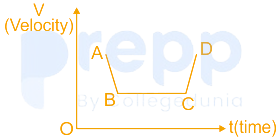
In the given velocity (V) versus time (t) graph, accelerated and decelerated motions are respectively represented by line segments
A rigid body of mass 2 kg is dropped from a stationary balloon kept at a height of 50 m from the ground. The speed of the body when it just touches the ground and the total energy
when it is dropped from the balloon are respectively
(acceleration due to gravity = 9·8 m/s -2 )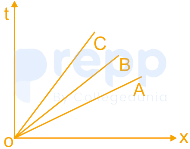
The figure shown above gives the time (t) versus position (x) graphs of three objects A, B and C. Which one of the following is the correct relation between their speeds V A, V Band V C, respectively at any instant (t > 0)?
A ball is released from rest and rolls down an inclined plane, as shown in the following figure, requiring 4 s to cover a distance of 100 cm along the plane:

Which one of the following is the correct value of angle θ that the plane makes with the horizontal? (g = 1000 cm/s 2)
The force acting on a particle of mass m moving along the X-axis is given by F(x) = AX 2- Bx. Which one of the following is the potential energy of the particle?
Consider the following velocity and time graph:
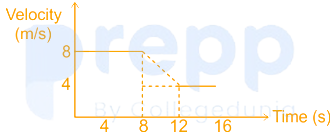
Which one of the following is the value of average acceleration from 8 s to 12 s?
- What is the upward force acting on a skydiver of mass \(60\text{ kg}\) who is falling at a uniform speed of \(2\text{ m/s}\)?
The force-time (\(F-t\)) graph of a 10 kg object initially at rest is shown below.
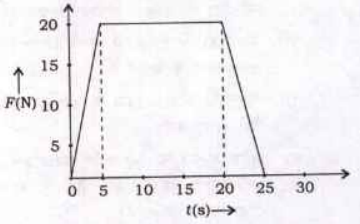
What is the final speed of the object?
- The position vector of a particle is given by \(\vec{r} = \sqrt{3} t^2 \hat{i} + \sqrt{2} t \hat{j} + \sqrt{5} \hat{k}\). Which one of the following statements is correct?
- Which one of the following statements for second law of motion is NOT correct?
Important Questions from Newton's Laws of Motion
In the given velocity (V) versus time (t) graph, accelerated and decelerated motions are respectively represented by line segments
A balloon is filled with air. The mass of the air in the balloon is 10 gram. A small hole is made to the balloon and released. The balloon moves up with an average speed of 5 cm/s and shrinks completely in 5 seconds. Find the average force acting on the balloon.
A uniform rope is suspended from the roof of a building. The rope breaks if the tension in the rope is greater than 700 N.
A man of mass 50 kg climbs up the rope. Find the maximum acceleration with which he can climb up the rope (g = 10 m/s2)A ball is thrown up with a certain velocity, it attains 50 m and come back to the thrower then the
A string of certain length used to whirl a stone in a vertical circle with certain velocity. The tension developed in the string will be



