
When the speed of car is doubled, then what will be the braking force of the car to stop it in the same distance.
Four times
Braking Force and Stopping Distance Relationship
Understanding the relationship between a car's speed, braking force, and stopping distance is fundamental in physics and crucial for vehicle safety. When a car needs to stop, the braking system applies a force that performs work to reduce the car's kinetic energy to zero.
Kinetic Energy and Work Done
The core principle here is the work-energy theorem. The work done by the braking force is equal to the change in the car's kinetic energy. Since the car comes to a stop, its final kinetic energy is zero.
- Initial Kinetic Energy ($KE_i$): This depends on the car's mass (m) and its initial speed (v). \[ KE_i = \frac{1}{2}mv^2 \]
- Final Kinetic Energy ($KE_f$): When the car stops, its speed is 0, so its final kinetic energy is 0. \[ KE_f = 0 \]
- Work Done by Braking Force (W): The braking force (F) acts over a certain stopping distance (d). \[ W = F \times d \]
According to the work-energy theorem:
Work done = Change in Kinetic Energy
\( W = KE_f - KE_i \)
\( F \times d = 0 - \frac{1}{2}mv^2 \)
Considering the magnitude of the braking force (as force and displacement are in opposite directions, the work done by the braking force is negative, indicating energy removal):
\( F \times d = \frac{1}{2}mv^2 \)
From this equation, we can see that the braking force required is directly proportional to the square of the speed and inversely proportional to the stopping distance:
\( F = \frac{mv^2}{2d} \)
This means that if the mass of the car (m) and the stopping distance (d) are kept constant, the braking force (F) is directly proportional to the square of the initial speed (v):
\( F \propto v^2 \)
Braking Force When Speed is Doubled
Let's apply this relationship to the given scenario:
- Initial Scenario:
- Initial speed = \(v_1\)
- Braking force required = \(F_1\)
- Stopping distance = \(d\)
- So, \(F_1 = \frac{mv_1^2}{2d}\)
- New Scenario (Speed Doubled):
- New speed = \(v_2 = 2v_1\)
- New braking force required = \(F_2\)
- Stopping distance remains the same = \(d\)
- So, \(F_2 = \frac{m(2v_1)^2}{2d}\)
- \(F_2 = \frac{m(4v_1^2)}{2d}\)
- \(F_2 = 4 \times \frac{mv_1^2}{2d}\)
By comparing \(F_2\) with \(F_1\), we can see:
\( F_2 = 4 \times F_1 \)
Therefore, when the speed of the car is doubled, to stop it in the same distance, the braking force required will be four times the original braking force.
This principle highlights why higher speeds require significantly more braking effort and longer stopping distances, even with the same braking system, and emphasizes the importance of maintaining safe speeds.
Important Questions from Newton's Laws of Motion
If the resultant force acting on a particle is perpendicular to its velocity then-
1. The speed of the particle changes.
2. The speed of the particle does not change.
3. Kinetic energy of the particle does not change.
Choose the correct code.
Consider the following velocity and time graph:
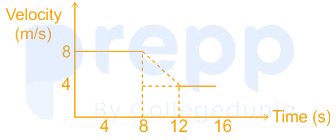
Which one of the following is the value of average acceleration from 8 s to 12 s?
A wire of length L has mass μ per unit length. It is used to pull up a body of mass M upwards with acceleration α. What is the tension at the mid-point of the wire?
(g = acceleration due to gravity)
A rigid body of mass 2 kg is dropped from a stationary balloon kept at a height of 50 m from the ground. The speed of the body when it just touches the ground and the total energy
when it is dropped from the balloon are respectively
(acceleration due to gravity = 9·8 m/s -2 )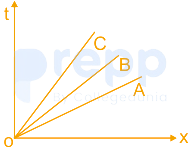
The figure shown above gives the time (t) versus position (x) graphs of three objects A, B and C. Which one of the following is the correct relation between their speeds V A, V Band V C, respectively at any instant (t > 0)?


