
A wire of length L has mass μ per unit length. It is used to pull up a body of mass M upwards with acceleration α. What is the tension at the mid-point of the wire? (g = acceleration due to gravity)
Understanding Tension in a Wire Under Acceleration
This physics problem asks us to find the tension at the mid-point of a wire that is pulling a body upwards with a certain acceleration. The wire itself has mass, distributed uniformly along its length. Understanding how tension changes along a massive wire when it's accelerating is key to solving this. The tension in wire varies because it has to support the weight and provide acceleration to everything below it.
Analyzing the Forces and Masses
Let's break down the components and forces involved:
- Body: Mass $M$.
- Wire: Length $L$, mass per unit length $\mu$.
- Total mass of the wire: $m_{wire} = \mu L$.
- Acceleration: $\alpha$ (upwards).
- Gravity: $g$ (downwards).
We need to find the tension specifically at the mid-point of the wire. Tension in a wire at any point supports the mass below that point and provides the necessary force for its acceleration.
Calculating Tension at the Mid-point
To find the tension at the mid-point, we consider the system consisting of the body of mass $M$ and the lower half of the wire. The tension at the mid-point acts as the upward force on this combined system.
- Length of the lower half of the wire: $L/2$.
- Mass of the lower half of the wire: $m_{lower\_half} = \mu \times (L/2) = \frac{\mu L}{2}$. This demonstrates the importance of considering the mass per unit length.
- Total mass of the system below the mid-point: $M_{system} = M + m_{lower\_half} = M + \frac{\mu L}{2}$.
Now, let's apply Newton's Second Law ($F_{net} = m a$) to this system below the mid-point. The forces acting on this system are:
- Upward force: Tension at the mid-point, $T_{mid}$. This is the tension in wire we are looking for.
- Downward force: The total weight of the system below the mid-point. $W_{system} = M_{system} \times g = \left(M + \frac{\mu L}{2}\right)g$.
The net force is the difference between the upward and downward forces, and this net force causes the upward acceleration $\alpha$ of the system below the mid-point.
According to Newton's Second Law:
\(F_{net} = M_{system} \times \alpha\)
\(T_{mid} - W_{system} = \left(M + \frac{\mu L}{2}\right)\alpha\)
Substitute the expression for $W_{system}$:
\(T_{mid} - \left(M + \frac{\mu L}{2}\right)g = \left(M + \frac{\mu L}{2}\right)\alpha\)
Now, solve for $T_{mid}$:
\(T_{mid} = \left(M + \frac{\mu L}{2}\right)\alpha + \left(M + \frac{\mu L}{2}\right)g\)
Factor out the common term \(\left(M + \frac{\mu L}{2}\right)\):
\(T_{mid} = \left(M + \frac{\mu L}{2}\right)(g + \alpha)\)
This formula gives the Tension in wire at its mid-point when pulling a mass $M$ upwards with acceleration $\alpha$, considering its own mass per unit length. This calculation is a typical physics problem involving varying tension in strings or wires.
Summary of Tension Calculation
The tension at the mid-point of the wire is the force needed to support the body and the lower half of the wire against gravity AND accelerate them upwards. The total mass being lifted by the tension at the mid-point is the sum of the body's mass ($M$) and the mass of the lower half of the wire (\(\frac{\mu L}{2}\)). Both this total mass need to be accelerated upwards with acceleration $\alpha$, and also lifted against gravity $g$. Therefore, the effective acceleration is $(g+\alpha)$. The Tension in wire at the mid-point is the product of this total mass and the effective acceleration.
The final expression for the tension at the mid-point is \(\left(M+\frac{\mu L}{2}\right)(g+\alpha)\).
Important Questions from Newton's Laws of Motion
If the resultant force acting on a particle is perpendicular to its velocity then-
1. The speed of the particle changes.
2. The speed of the particle does not change.
3. Kinetic energy of the particle does not change.
Choose the correct code.
Consider the following velocity and time graph:
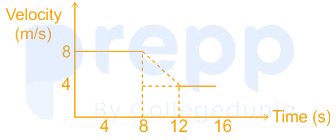
Which one of the following is the value of average acceleration from 8 s to 12 s?
When the speed of car is doubled, then what will be the braking force of the car to stop it in the same distance.
A rigid body of mass 2 kg is dropped from a stationary balloon kept at a height of 50 m from the ground. The speed of the body when it just touches the ground and the total energy
when it is dropped from the balloon are respectively
(acceleration due to gravity = 9·8 m/s -2 )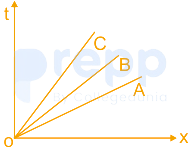
The figure shown above gives the time (t) versus position (x) graphs of three objects A, B and C. Which one of the following is the correct relation between their speeds V A, V Band V C, respectively at any instant (t > 0)?


