
There are 8 lines in a plane, no two of which are parallel. What is the maximum number of points at which they can intersect?
28
Finding Maximum Intersection Points for Lines in a Plane
The question asks for the maximum number of points at which 8 lines in a plane can intersect, given that no two lines are parallel.
When no two lines are parallel, the maximum number of intersection points occurs when every pair of lines intersects at a distinct point. If there were parallel lines, they would not intersect, reducing the total number of intersection points. If more than two lines intersected at the same point, that would also reduce the total number of distinct intersection points.
To find the maximum number of intersection points, we need to determine how many unique pairs of lines can be formed from the given number of lines. Each pair of lines will intersect at exactly one point (since no two are parallel).
The number of ways to choose 2 items from a set of \(n\) items, where the order doesn't matter, is given by the combination formula:
\(C(n, k) = \binom{n}{k} = \frac{n!}{k!(n-k)!}\)
In this problem, we have \(n=8\) lines, and we are choosing \(k=2\) lines at a time to form a pair that intersects. So, the maximum number of intersection points is \(C(8, 2)\).
Calculating the Maximum Intersection Points
Let's calculate \(C(8, 2)\):
\(C(8, 2) = \binom{8}{2} = \frac{8!}{2!(8-2)!}\)
\(C(8, 2) = \frac{8!}{2!6!}\)
\(C(8, 2) = \frac{8 \times 7 \times 6!}{2 \times 1 \times 6!}\)
We can cancel out the \(6!\) from the numerator and the denominator:
\(C(8, 2) = \frac{8 \times 7}{2 \times 1}\)
\(C(8, 2) = \frac{56}{2}\)
\(C(8, 2) = 28\)
So, the maximum number of intersection points for 8 lines in a plane, with no two lines parallel, is 28.
Summary of Calculation
| Number of Lines (\(n\)) | Pairs of Lines (Combination \(C(n, 2)\)) | Maximum Intersection Points |
|---|---|---|
| 8 | \(C(8, 2)\) | 28 |
This calculation shows that with 8 lines, where every pair intersects at a unique point, there will be a total of 28 distinct intersection points.
Revision Table: Line Intersection Concepts
| Concept | Description | Formula |
|---|---|---|
| Intersection Point | A point where two or more lines cross each other. | N/A |
| Parallel Lines | Lines in a plane that do not intersect. | Slopes are equal (for linear equations). |
| Maximum Intersection Points (n lines) | The greatest possible number of distinct points where \(n\) lines in a plane can intersect, assuming no two are parallel and no three are concurrent. | \(C(n, 2) = \frac{n(n-1)}{2}\) |
Additional Information: Understanding Combinations and Geometry
The problem connects concepts from geometry (lines and intersection points) and combinatorics (combinations).
- Lines in a Plane: A line is a straight path extending infinitely in both directions. In a plane, two distinct lines can either be parallel (never intersect) or intersect at exactly one point.
- Maximizing Intersections: To get the maximum number of intersection points, we need to ensure two conditions are met:
- No two lines are parallel. This guarantees that every pair of lines will intersect.
- No three or more lines intersect at the same single point. If multiple lines passed through the same point, they would only contribute one intersection point instead of multiple unique points from separate pairwise intersections. The problem implicitly assumes this scenario by asking for the maximum number of *points*.
- Combinations (\(C(n, k)\)): Combinations are used when we need to select a group of items from a larger set, and the order of selection doesn't matter. In this case, picking line 1 and then line 2 is the same as picking line 2 and then line 1; they form the same pair and create the same intersection point. The formula \(\frac{n(n-1)}{2}\) for \(C(n, 2)\) arises because there are \(n\) choices for the first line and \((n-1)\) choices for the second line, giving \(n(n-1)\) ordered pairs. Since the order doesn't matter, we divide by 2 to get the number of unordered pairs.
Similar Questions
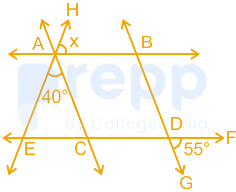
In the given figure AB is parallel to CD and AC is parallel to BD. If ∠EAC = 40°, ∠FDG = 55°, ∠HAB = x°, then what is the value of x?
Three parallel lines x, y and z are cut by two transversals m and n. Transversal m cuts the lines, x, y, z at P, Q, R respectively, and transversal n cuts the lines x, y, z at L, M, N respectively. If PQ = 3 cm, QR = 9 cm and MN = 10.5cm, then what is the length of LM?
If two lines AB and CD intersect at O such that ∠AOC = 5 ∠AOD, then the four angles at O are
The locus of a point equidistant from two intersecting lines is
In the figure given below, p, q, r are parallel lines; l and m are two transversals.
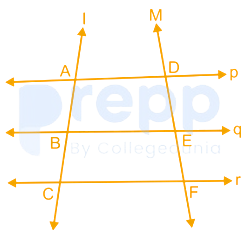
Consider the following:
1. AB : AC = DE : DF
2. AB × EF = BC × DE
Which of the above is/are correct?
The length of a line segment AB is 2 cm. It is divided into two parts at a point C such that AC 2= AB × CB. What is the length of CB?
Consider the following statements in respect of three straight lines A, B and C on a plane:
1. If A and C are parallel and B and C are parallel, then A and B are parallel
2. If A is perpendicular to C and B is perpendicular to C, then A and B are parallel
3. If the acute angle between A and C is equal to the acute angle between B and C; then A and B are parallel
Which of the above statements are correct?A person goes to a market between 4 p.m. and 5 p.m. When he comes back he finds that the hour hand and the minute hand of the clock have interchanged their positions. For how much time (approximately) was he out of his house?
A truck moves along a circular path and describes 100 m when it has traced out 36° at the centre. The radius of the circle is equal to
In a triangle ABC if A − B = \(\frac{\pi}{2}\) , then C + 2B is equal to
Important Questions from Lines and Angles
Two parallel lines are intersected by a transversal, the corresponding angles are:
There are three points P, Q and R on a straight line such that PQ : QR = 3 : 5. If n is the number of possible values of PQ : PR, then what is n equal to ?
Two cars start from a point at the same time and travel on two different roads at right angles to each other. Their speed is 18 km/h and 72 km/h respectively. What will be the distance between them after 6 seconds?
Express 65° in radian :
The measure of an angle for which the measure of the supplement is four times the measure of the complement is:



