
A person goes to a market between 4 p.m. and 5 p.m. When he comes back he finds that the hour hand and the minute hand of the clock have interchanged their positions. For how much time (approximately) was he out of his house?
55.38 minutes
Solving the Clock Hands Interchanged Problem
This is a classic clock problem where the hour hand and minute hand swap their positions between a departure time and a return time. The person leaves between 4 p.m. and 5 p.m. and returns to find the hands interchanged. For the hands to swap positions like this, if the departure is between 4 and 5, the return must be between 5 and 6.
Understanding Clock Hand Angles
To solve this, we need to calculate the angles of the hour and minute hands from the 12 o'clock position (measured clockwise). The speeds of the hands are constant:
- The minute hand moves 360 degrees in 60 minutes, which is \(360/60 = 6\) degrees per minute.
- The hour hand moves 360 degrees in 12 hours (720 minutes), which is \(360/720 = 0.5\) degrees per minute.
The angle of the minute hand \(M\) minutes past the hour is \(6M\) degrees.
The angle of the hour hand \(M\) minutes past hour \(H\) is \(30H + 0.5M\) degrees.
Setting Up Times and Angles
Let the departure time be 4 hours and \(M_1\) minutes past 4 p.m. (i.e., 4:\(M_1\)).
- Hour hand angle at departure: \(A_{H,dep} = 30(4) + 0.5M_1 = 120 + 0.5M_1\) degrees.
- Minute hand angle at departure: \(A_{M,dep} = 6M_1\) degrees.
Let the return time be 5 hours and \(M_2\) minutes past 5 p.m. (i.e., 5:\(M_2\)).
- Hour hand angle at return: \(A_{H,ret} = 30(5) + 0.5M_2 = 150 + 0.5M_2\) degrees.
- Minute hand angle at return: \(A_{M,ret} = 6M_2\) degrees.
Formulating Equations from Swapped Positions
The condition that the hour and minute hands have interchanged their positions means that the hour hand's position at departure is the same as the minute hand's position at return, and the minute hand's position at departure is the same as the hour hand's position at return.
From the first condition (\(A_{H,dep} = A_{M,ret}\)):
\[120 + 0.5M_1 = 6M_2\] Multiply by 2 to eliminate the decimal: \[240 + M_1 = 12M_2 \quad (Eq. 1)\]From the second condition (\(A_{M,dep} = A_{H,ret}\)):
\[6M_1 = 150 + 0.5M_2\] Multiply by 2 to eliminate the decimal: \[12M_1 = 300 + M_2 \quad (Eq. 2)\]Solving for M₁ and M₂
We have a system of two linear equations:
\[ M_1 - 12M_2 = -240 \] \[ 12M_1 - M_2 = 300 \]From Equation 1, we can express \(M_1\) as \(M_1 = 12M_2 - 240\). Substitute this into Equation 2:
\[12(12M_2 - 240) - M_2 = 300\] \[144M_2 - 2880 - M_2 = 300\] \[143M_2 = 3180\] \[M_2 = \frac{3180}{143}\]Now substitute the value of \(M_2\) back into the expression for \(M_1\):
\[M_1 = 12\left(\frac{3180}{143}\right) - 240\] \[M_1 = \frac{38160}{143} - \frac{240 \times 143}{143}\] \[M_1 = \frac{38160 - 34320}{143}\] \[M_1 = \frac{3840}{143}\]So the departure time is 4 hours and \(3840/143\) minutes past 4 p.m., and the return time is 5 hours and \(3180/143\) minutes past 5 p.m.
Calculating the Time Duration
The time the person was out of the house is the difference between the return time and the departure time.
Departure time is at \(4 + \frac{M_1}{60}\) hours past 12 p.m.
Return time is at \(5 + \frac{M_2}{60}\) hours past 12 p.m.
Time out = (Return time) - (Departure time)
Time out = \(\left(5 + \frac{M_2}{60}\right) - \left(4 + \frac{M_1}{60}\right)\) hours
Time out = \(1 + \frac{M_2 - M_1}{60}\) hours
Convert to minutes:
Time out = \(60 \times \left(1 + \frac{M_2 - M_1}{60}\right)\) minutes
Time out = \(60 + (M_2 - M_1)\) minutes
Substitute the calculated values of \(M_1\) and \(M_2\):
\[\text{Time Out} = 60 + \left(\frac{3180}{143} - \frac{3840}{143}\right) \text{ minutes}\] \[\text{Time Out} = 60 + \left(\frac{3180 - 3840}{143}\right) \text{ minutes}\] \[\text{Time Out} = 60 + \left(\frac{-660}{143}\right) \text{ minutes}\] \[\text{Time Out} = \frac{60 \times 143 - 660}{143} \text{ minutes}\] \[\text{Time Out} = \frac{8580 - 660}{143} \text{ minutes}\] \[\text{Time Out} = \frac{7920}{143} \text{ minutes}\]Now, we approximate the numerical value:
\[\frac{7920}{143} \approx 55.384615... \text{ minutes}\]Approximating to two decimal places, the time out is 55.38 minutes.
Conclusion
The person was out of his house for approximately 55.38 minutes.
Revision Table: Clock Problem Key Points
| Concept | Detail | Value |
|---|---|---|
| Minute Hand Speed | Degrees per minute | 6°/min |
| Hour Hand Speed | Degrees per minute | 0.5°/min |
| Departure Time | Minutes past 4 p.m. | \(M_1 = \frac{3840}{143}\) |
| Return Time | Minutes past 5 p.m. | \(M_2 = \frac{3180}{143}\) |
| Time Out Duration | Calculated difference | \(\frac{7920}{143}\) min \(\approx\) 55.38 min |
Additional Information: Solving Swapped Hand Problems
Problems where clock hands swap positions require careful application of the formulas for hand angles at different times. The core idea is that the angular position of the hour hand at the first time equals the angular position of the minute hand at the second time, and vice versa. This typically leads to a system of two linear equations. Solving these equations gives the exact minute values for the departure and return times. The duration is then simply the difference between these two times. These problems are common in quantitative aptitude tests and require a good understanding of the relative speeds and positions of clock hands.
When the departure is between H and H+1, and the return is between H+1 and H+2, there is always one such time pair where hands swap positions. The logic derived here applies generally to such scenarios.
Similar Questions
Three parallel lines x, y and z are cut by two transversals m and n. Transversal m cuts the lines, x, y, z at P, Q, R respectively, and transversal n cuts the lines x, y, z at L, M, N respectively. If PQ = 3 cm, QR = 9 cm and MN = 10.5cm, then what is the length of LM?
If two lines AB and CD intersect at O such that ∠AOC = 5 ∠AOD, then the four angles at O are
The locus of a point equidistant from two intersecting lines is
In the figure given below, p, q, r are parallel lines; l and m are two transversals.
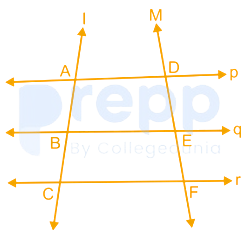
Consider the following:
1. AB : AC = DE : DF
2. AB × EF = BC × DE
Which of the above is/are correct?
The length of a line segment AB is 2 cm. It is divided into two parts at a point C such that AC 2= AB × CB. What is the length of CB?
Consider the following statements in respect of three straight lines A, B and C on a plane:
1. If A and C are parallel and B and C are parallel, then A and B are parallel
2. If A is perpendicular to C and B is perpendicular to C, then A and B are parallel
3. If the acute angle between A and C is equal to the acute angle between B and C; then A and B are parallel
Which of the above statements are correct?There are 8 lines in a plane, no two of which are parallel. What is the maximum number of points at which they can intersect?
A truck moves along a circular path and describes 100 m when it has traced out 36° at the centre. The radius of the circle is equal to
In a triangle ABC if A − B = \(\frac{\pi}{2}\) , then C + 2B is equal to
If a transversal intersects four parallel straight lines, then the number of distinct values of angles formed will be
Important Questions from Lines and Angles
- Two parallel lines L1 and L2 are cut by a transversal. If one of the alternate interior angles is $65^\circ$, what is the measure of the corresponding alternate interior angle?
- Two lines AB and CD are parallel. Let PQ be the transversal intersecting AB at M and CD at N. If $\angle MND = 47^\circ$, find $\angle AMN$.
- The measure of an angle is one half of its supplementary angle. Find its measure.
- The sum of two angles is $155^\circ$ and their difference is $\frac{\pi}{2}$. The value of the greater angle (in radians) is:
- The measure of an angle is three times the measure of its complement. The angles are respectively:



