
A truck moves along a circular path and describes 100 m when it has traced out 36° at the centre. The radius of the circle is equal to
Understanding the Problem: Truck on a Circular Path
This problem involves a truck moving along a circular path. We are given the distance the truck travels along the path (which is an arc length) and the angle traced out at the center of the circle by this movement. We need to find the radius of this circular path.
The relationship between the arc length, the radius of the circle, and the central angle is a fundamental concept in geometry and trigonometry.
Key Concept: Arc Length Formula
The arc length ($\(s\)$) of a circle is the distance along the curved line. It is directly proportional to the radius ($\(r\)$) of the circle and the central angle ($\(\theta\)$) it subtends. The formula relating these quantities is:
\[s = r\theta\]
Important Note: In this formula, the angle $\(\theta\)$ must be measured in radians, not degrees.
Step-by-Step Calculation
We are given the following information:
- Arc length, \(s = 100\) m
- Central angle, \(\theta = 36^\circ\)
Our goal is to find the radius, \(r\).
Step 1: Convert the Central Angle from Degrees to Radians
The given angle is in degrees (\(36^\circ\)). We need to convert it to radians to use the arc length formula. The conversion factor is \(\pi\) radians = \(180^\circ\).
\[\theta_{radians} = \theta_{degrees} \times \frac{\pi}{180^\circ}\]
Substituting the given angle:
\[\theta = 36^\circ \times \frac{\pi}{180^\circ} \text{ radians}\]
Simplify the fraction:
\[\theta = \frac{36}{180}\pi \text{ radians}\]
Since \(180 \div 36 = 5\), the fraction simplifies to \(\frac{1}{5}\).
\[\theta = \frac{\pi}{5} \text{ radians}\]
Step 2: Apply the Arc Length Formula
Now that we have the angle in radians and the arc length, we can use the formula \(s = r\theta\) to solve for the radius \(r\).
Substitute the known values:
\[100 \text{ m} = r \times \frac{\pi}{5} \text{ radians}\]
Step 3: Solve for the Radius \(r\)
To find \(r\), we need to isolate it in the equation. Divide both sides by \(\frac{\pi}{5}\):
\[r = \frac{100}{\frac{\pi}{5}} \text{ m}\]
To divide by a fraction, multiply by its reciprocal:
\[r = 100 \times \frac{5}{\pi} \text{ m}\]
\[r = \frac{500}{\pi} \text{ m}\]
Conclusion: Radius of the Circular Path
The radius of the circular path along which the truck moves is \(\frac{500}{\pi}\) meters.
Revision Table: Circular Path Calculation
| Quantity | Value Given | Unit | Notes |
|---|---|---|---|
| Arc Length (\(s\)) | \(100\) | meters | Distance traveled on the circle's edge |
| Central Angle (\(\theta\)) | \(36^\circ\) | degrees | Angle subtended by the arc at the center |
| Central Angle (\(\theta\)) | \(\frac{\pi}{5}\) | radians | Converted for use in formula |
| Radius (\(r\)) | \(\frac{500}{\pi}\) | meters | Calculated value |
Additional Information: Radians vs. Degrees
It is crucial to understand the difference between degrees and radians when working with angles in formulas involving arc lengths, areas of sectors, or angular velocity. Degrees are a historical unit of angle measurement, where a full circle is divided into \(360^\circ\). Radians, on the other hand, are a more natural unit in many mathematical and physical contexts, defined based on the radius of the circle. One radian is the angle subtended at the center of a circle by an arc that has a length equal to the radius of the circle. A full circle is \(2\pi\) radians, which is equivalent to \(360^\circ\). Therefore, the conversion is \(\pi\) radians = \(180^\circ\).
Similar Questions
Three parallel lines x, y and z are cut by two transversals m and n. Transversal m cuts the lines, x, y, z at P, Q, R respectively, and transversal n cuts the lines x, y, z at L, M, N respectively. If PQ = 3 cm, QR = 9 cm and MN = 10.5cm, then what is the length of LM?
If two lines AB and CD intersect at O such that ∠AOC = 5 ∠AOD, then the four angles at O are
The locus of a point equidistant from two intersecting lines is
In the figure given below, p, q, r are parallel lines; l and m are two transversals.
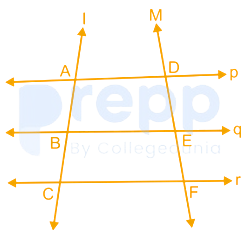
Consider the following:
1. AB : AC = DE : DF
2. AB × EF = BC × DE
Which of the above is/are correct?
The length of a line segment AB is 2 cm. It is divided into two parts at a point C such that AC 2= AB × CB. What is the length of CB?
Consider the following statements in respect of three straight lines A, B and C on a plane:
1. If A and C are parallel and B and C are parallel, then A and B are parallel
2. If A is perpendicular to C and B is perpendicular to C, then A and B are parallel
3. If the acute angle between A and C is equal to the acute angle between B and C; then A and B are parallel
Which of the above statements are correct?There are 8 lines in a plane, no two of which are parallel. What is the maximum number of points at which they can intersect?
A person goes to a market between 4 p.m. and 5 p.m. When he comes back he finds that the hour hand and the minute hand of the clock have interchanged their positions. For how much time (approximately) was he out of his house?
In a triangle ABC if A − B = \(\frac{\pi}{2}\) , then C + 2B is equal to
If a transversal intersects four parallel straight lines, then the number of distinct values of angles formed will be
Important Questions from Lines and Angles
- Two parallel lines L1 and L2 are cut by a transversal. If one of the alternate interior angles is $65^\circ$, what is the measure of the corresponding alternate interior angle?
- Two lines AB and CD are parallel. Let PQ be the transversal intersecting AB at M and CD at N. If $\angle MND = 47^\circ$, find $\angle AMN$.
- The measure of an angle is one half of its supplementary angle. Find its measure.
- The sum of two angles is $155^\circ$ and their difference is $\frac{\pi}{2}$. The value of the greater angle (in radians) is:
- The measure of an angle is three times the measure of its complement. The angles are respectively:



