
The length of a line segment AB is 2 cm. It is divided into two parts at a point C such that AC 2= AB × CB. What is the length of CB?
3 – √5 cm
Understanding the Line Segment Division Problem
The question asks us to find the length of a segment CB, where a point C divides a line segment AB of a known length. We are given the total length of the line segment AB and a specific relationship between the lengths of the segments AC and CB, involving the total length AB.
Key Information Provided:
- The total length of the line segment AB is 2 cm.
- Point C lies on the line segment AB, dividing it into two parts: AC and CB.
- The relationship given is
AC2 = AB × CB.
We need to determine the length of CB based on this information.
Setting Up the Equation for CB Length
Let's denote the length of the line segment CB as \(x\) cm.
Since C is a point on the line segment AB, the length of AB is the sum of the lengths of AC and CB:
AB = AC + CB
We know AB = 2 cm and we've defined CB = \(x\) cm. So, we can find the length of AC:
\(2 = AC + x\)
\(AC = 2 - x\) cm.
Now, let's use the given condition: \(AC^2 = AB \times CB\).
Substitute the expressions for AC, AB, and CB into this equation:
\((2 - x)^2 = 2 \times x\)
Solving the Quadratic Equation for CB
We need to solve the equation \((2 - x)^2 = 2x\) for \(x\). Let's expand and rearrange the equation to form a standard quadratic equation (\(ax^2 + bx + c = 0\)).
- Expand the squared term:
\((2 - x)^2 = 2^2 - 2(2)(x) + x^2 = 4 - 4x + x^2\) - Set the expanded term equal to \(2x\):
\(4 - 4x + x^2 = 2x\) - Rearrange the equation to the standard quadratic form: Subtract \(2x\) from both sides.
\(x^2 - 4x - 2x + 4 = 0\)\(x^2 - 6x + 4 = 0\) - Solve the quadratic equation using the quadratic formula:
The formula is \(x = \frac{-b \pm \sqrt{b^2 - 4ac}}{2a}\).
In our equation, \(a=1\), \(b=-6\), and \(c=4\).
\(x = \frac{-(-6) \pm \sqrt{(-6)^2 - 4(1)(4)}}{2(1)}\)\(x = \frac{6 \pm \sqrt{36 - 16}}{2}\)\(x = \frac{6 \pm \sqrt{20}}{2}\) - Simplify the square root: \(\sqrt{20} = \sqrt{4 \times 5} = 2\sqrt{5}\).
\(x = \frac{6 \pm 2\sqrt{5}}{2}\) - Simplify the expression for x: Divide both terms in the numerator by 2.
\(x = \frac{2(3 \pm \sqrt{5})}{2}\)\(x = 3 \pm \sqrt{5}\)
This gives us two possible values for the length of CB (\(x\)):
- \(x_1 = 3 + \sqrt{5}\)
- \(x_2 = 3 - \sqrt{5}\)
Validating the Solution for CB
We need to determine which of the two possible values for \(x\) is the correct length for the segment CB.
Remember that CB (\(x\)) is a part of the line segment AB, which has a total length of 2 cm. Therefore, the length of CB must be less than 2 cm.
Let's evaluate the two possible solutions:
- Consider \(x_1 = 3 + \sqrt{5}\): We know that \(\sqrt{5}\) is approximately 2.236. So, \(x_1 \approx 3 + 2.236 = 5.236\) cm. Since 5.236 cm is greater than the total length of AB (2 cm), this solution is not physically possible for the length of CB.
- Consider \(x_2 = 3 - \sqrt{5}\): Using \(\sqrt{5} \approx 2.236\), we get \(x_2 \approx 3 - 2.236 = 0.764\) cm. This value is positive and less than 2 cm, which is a valid length for the segment CB.
We should also check if the corresponding length of AC is positive.
If \(x = 3 - \sqrt{5}\), then \(AC = 2 - x = 2 - (3 - \sqrt{5}) = 2 - 3 + \sqrt{5} = \sqrt{5} - 1\). Since \(\sqrt{5} \approx 2.236\), \(AC \approx 2.236 - 1 = 1.236\) cm, which is positive.
Thus, the only valid length for CB is \(3 - \sqrt{5}\) cm.
Final Answer Calculation Check
Let's verify the condition \(AC^2 = AB \times CB\) using the valid lengths:
- \(AB = 2\) cm
- \(CB = 3 - \sqrt{5}\) cm
- \(AC = \sqrt{5} - 1\) cm
Calculate \(AC^2\):
\(AC^2 = (\sqrt{5} - 1)^2 = (\sqrt{5})^2 - 2(\sqrt{5})(1) + 1^2 = 5 - 2\sqrt{5} + 1 = 6 - 2\sqrt{5}\)
Calculate \(AB \times CB\):
\(AB \times CB = 2 \times (3 - \sqrt{5}) = 6 - 2\sqrt{5}\)
Since \(AC^2 = 6 - 2\sqrt{5}\) and \(AB \times CB = 6 - 2\sqrt{5}\), the condition is satisfied.
Therefore, the length of CB is \(3 - \sqrt{5}\) cm.
Similar Questions
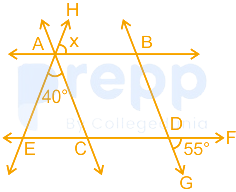
In the given figure AB is parallel to CD and AC is parallel to BD. If ∠EAC = 40°, ∠FDG = 55°, ∠HAB = x°, then what is the value of x?
Three parallel lines x, y and z are cut by two transversals m and n. Transversal m cuts the lines, x, y, z at P, Q, R respectively, and transversal n cuts the lines x, y, z at L, M, N respectively. If PQ = 3 cm, QR = 9 cm and MN = 10.5cm, then what is the length of LM?
If two lines AB and CD intersect at O such that ∠AOC = 5 ∠AOD, then the four angles at O are
The locus of a point equidistant from two intersecting lines is
In the figure given below, p, q, r are parallel lines; l and m are two transversals.
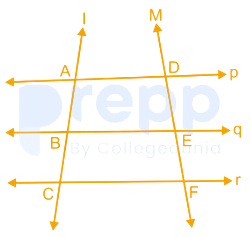
Consider the following:
1. AB : AC = DE : DF
2. AB × EF = BC × DE
Which of the above is/are correct?
Consider the following statements in respect of three straight lines A, B and C on a plane:
1. If A and C are parallel and B and C are parallel, then A and B are parallel
2. If A is perpendicular to C and B is perpendicular to C, then A and B are parallel
3. If the acute angle between A and C is equal to the acute angle between B and C; then A and B are parallel
Which of the above statements are correct?There are 8 lines in a plane, no two of which are parallel. What is the maximum number of points at which they can intersect?
A person goes to a market between 4 p.m. and 5 p.m. When he comes back he finds that the hour hand and the minute hand of the clock have interchanged their positions. For how much time (approximately) was he out of his house?
A truck moves along a circular path and describes 100 m when it has traced out 36° at the centre. The radius of the circle is equal to
In a triangle ABC if A − B = \(\frac{\pi}{2}\) , then C + 2B is equal to
Important Questions from Lines and Angles
Two parallel lines are intersected by a transversal, the corresponding angles are:
There are three points P, Q and R on a straight line such that PQ : QR = 3 : 5. If n is the number of possible values of PQ : PR, then what is n equal to ?
Two cars start from a point at the same time and travel on two different roads at right angles to each other. Their speed is 18 km/h and 72 km/h respectively. What will be the distance between them after 6 seconds?
Express 65° in radian :
The measure of an angle for which the measure of the supplement is four times the measure of the complement is:



