
The locus of a point equidistant from two intersecting lines is
A pair of straight lines
Understanding the Locus of Points Equidistant from Intersecting Lines
The question asks us to find the locus of a point that is equidistant from two intersecting lines. The term 'locus' refers to the set of all points that satisfy a given condition.
In this specific case, the condition is that the distance from a point to the first line is equal to the distance from the same point to the second line.
Analyzing the Geometry
Consider two lines, let's call them \(L_1\) and \(L_2\), that intersect at a point, say O.
These two lines divide the plane into four angles (two pairs of vertically opposite angles).
A point P is equidistant from \(L_1\) and \(L_2\) if the perpendicular distance from P to \(L_1\) is equal to the perpendicular distance from P to \(L_2\).
The Angle Bisectors
Geometrically, the set of points equidistant from two intersecting lines forms two straight lines. These lines are the bisectors of the angles formed by the two intersecting lines.
Let's visualize this:
- The angle bisector of an angle is the locus of points equidistant from the two sides (lines) forming the angle.
- Since two intersecting lines form two pairs of vertically opposite angles, there are two such angle bisectors.
- One bisector line bisects one pair of vertically opposite angles.
- The other bisector line bisects the other pair of vertically opposite angles.
These two angle bisector lines are perpendicular to each other and pass through the intersection point O of the original lines.
| Concept | Description |
|---|---|
| Locus | Set of points satisfying a condition. |
| Equidistant | Same distance from two or more objects. |
| Intersecting Lines | Lines that cross at a single point. |
| Angle Bisector | Locus of points equidistant from two rays forming an angle. |
Identifying the Locus
Since the locus consists of two distinct straight lines (the angle bisectors), the correct description of this locus is "a pair of straight lines".
Let the equations of the two intersecting lines be \(a_1x + b_1y + c_1 = 0\) and \(a_2x + b_2y + c_2 = 0\). The equations of the angle bisectors (the locus of points equidistant from these lines) are given by:
\( \frac{a_1x + b_1y + c_1}{\sqrt{a_1^2 + b_1^2}} = \pm \frac{a_2x + b_2y + c_2}{\sqrt{a_2^2 + b_2^2}} \)
The \(\pm\) sign gives the equations of the two distinct angle bisectors, which form a pair of straight lines.
Conclusion
Based on the geometric properties and the algebraic representation, the locus of a point equidistant from two intersecting lines is a pair of straight lines.
Revision Table: Locus Concepts
| Locus Condition | Description of Locus |
|---|---|
| Equidistant from a fixed point | A circle (with the fixed point as center). |
| Equidistant from a fixed line | A pair of parallel lines (one on each side of the fixed line). If restricted to one side, it's a single parallel line. |
| Equidistant from two fixed points | The perpendicular bisector of the segment joining the two points. (A single straight line). |
| Equidistant from a fixed point and a fixed line (not passing through the point) | A parabola. |
| Equidistant from two intersecting lines | A pair of straight lines (the angle bisectors). |
Additional Information: Angle Bisectors
The two angle bisectors of two intersecting lines are always perpendicular to each other. This is because they bisect angles that are supplementary. If the angles are \( \theta \) and \( 180^\circ - \theta \), the bisectors make angles of \( \theta/2 \) and \( (180^\circ - \theta)/2 = 90^\circ - \theta/2 \) with one of the original lines. The angle between the bisectors is the sum of these angles, \( \theta/2 + (90^\circ - \theta/2) = 90^\circ \).
The angle bisectors pass through the point of intersection of the original lines.
Similar Questions
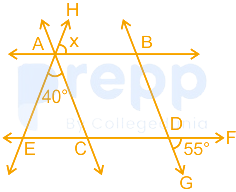
In the given figure AB is parallel to CD and AC is parallel to BD. If ∠EAC = 40°, ∠FDG = 55°, ∠HAB = x°, then what is the value of x?
Three parallel lines x, y and z are cut by two transversals m and n. Transversal m cuts the lines, x, y, z at P, Q, R respectively, and transversal n cuts the lines x, y, z at L, M, N respectively. If PQ = 3 cm, QR = 9 cm and MN = 10.5cm, then what is the length of LM?
If two lines AB and CD intersect at O such that ∠AOC = 5 ∠AOD, then the four angles at O are
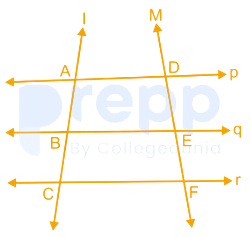
In the figure given below, p, q, r are parallel lines; l and m are two transversals.
Consider the following:
1. AB : AC = DE : DF
2. AB × EF = BC × DE
Which of the above is/are correct?
The length of a line segment AB is 2 cm. It is divided into two parts at a point C such that AC 2= AB × CB. What is the length of CB?
Consider the following statements in respect of three straight lines A, B and C on a plane:
1. If A and C are parallel and B and C are parallel, then A and B are parallel
2. If A is perpendicular to C and B is perpendicular to C, then A and B are parallel
3. If the acute angle between A and C is equal to the acute angle between B and C; then A and B are parallel
Which of the above statements are correct?There are 8 lines in a plane, no two of which are parallel. What is the maximum number of points at which they can intersect?
A person goes to a market between 4 p.m. and 5 p.m. When he comes back he finds that the hour hand and the minute hand of the clock have interchanged their positions. For how much time (approximately) was he out of his house?
A truck moves along a circular path and describes 100 m when it has traced out 36° at the centre. The radius of the circle is equal to
In a triangle ABC if A − B = \(\frac{\pi}{2}\) , then C + 2B is equal to
Important Questions from Lines and Angles
Two parallel lines are intersected by a transversal, the corresponding angles are:
There are three points P, Q and R on a straight line such that PQ : QR = 3 : 5. If n is the number of possible values of PQ : PR, then what is n equal to ?
Two cars start from a point at the same time and travel on two different roads at right angles to each other. Their speed is 18 km/h and 72 km/h respectively. What will be the distance between them after 6 seconds?
Express 65° in radian :
The measure of an angle for which the measure of the supplement is four times the measure of the complement is:



