
Three parallel lines x, y and z are cut by two transversals m and n. Transversal m cuts the lines, x, y, z at P, Q, R respectively, and transversal n cuts the lines x, y, z at L, M, N respectively. If PQ = 3 cm, QR = 9 cm and MN = 10.5cm, then what is the length of LM?
3.5 cm
Understanding the Problem: Parallel Lines and Transversals
The question describes a geometric setup involving three parallel lines, labelled x, y, and z. These lines are intersected by two other lines, called transversals, labelled m and n. Transversal m cuts the parallel lines at points P (on x), Q (on y), and R (on z). Transversal n cuts the same parallel lines at points L (on x), M (on y), and N (on z).
We are given the lengths of certain segments formed on these transversals by the parallel lines:
- On transversal m: PQ = 3 cm and QR = 9 cm.
- On transversal n: MN = 10.5 cm.
We need to find the length of the segment LM on transversal n.
Applying the Intercept Theorem (Property of Parallel Lines and Transversals)
This problem can be solved using a fundamental theorem in geometry related to parallel lines and transversals. The theorem states that if three or more parallel lines cut off segments on a transversal, then they cut off proportional segments on any other transversal.
In our case, the three parallel lines x, y, and z are cut by transversals m and n. According to the theorem, the ratio of the segments on transversal m must be equal to the ratio of the corresponding segments on transversal n.
The segments on transversal m are PQ and QR. The corresponding segments on transversal n are LM and MN. Therefore, we can set up the following proportion:
\[ \frac{\text{Length of segment on m between x and y}}{\text{Length of segment on m between y and z}} = \frac{\text{Length of segment on n between x and y}}{\text{Length of segment on n between y and z}} \]
Substituting the segment names:
\[ \frac{PQ}{QR} = \frac{LM}{MN} \]
Solving for the Unknown Length LM
We are given the values for PQ, QR, and MN. Let's substitute these values into the proportion:
| Segment | Transversal | Given Length |
|---|---|---|
| PQ | m | 3 cm |
| QR | m | 9 cm |
| MN | n | 10.5 cm |
| LM | n | ? (To find) |
The equation becomes:
\[ \frac{3 \text{ cm}}{9 \text{ cm}} = \frac{LM}{10.5 \text{ cm}} \]
Now, we can solve for LM. First, simplify the fraction on the left side:
\[ \frac{3}{9} = \frac{1}{3} \]
So the equation is:
\[ \frac{1}{3} = \frac{LM}{10.5} \]
To find LM, we can multiply both sides of the equation by 10.5:
\[ LM = \frac{1}{3} \times 10.5 \]
\[ LM = \frac{10.5}{3} \]
Performing the division:
\[ LM = 3.5 \]
So, the length of LM is 3.5 cm.
Summary of Calculation Steps
- Identify the parallel lines and transversals.
- Recognize the segments formed on each transversal.
- Apply the Intercept Theorem, stating that the ratio of corresponding segments on the transversals is equal: \( \frac{PQ}{QR} = \frac{LM}{MN} \).
- Substitute the given values: \( \frac{3}{9} = \frac{LM}{10.5} \).
- Simplify the equation: \( \frac{1}{3} = \frac{LM}{10.5} \).
- Solve for LM: \( LM = \frac{1}{3} \times 10.5 = 3.5 \).
The length of LM is 3.5 cm.
Revision Table: Key Concepts
| Concept | Description | Relevance to Problem |
|---|---|---|
| Parallel Lines | Lines in a plane that never meet. | x, y, and z are parallel lines, crucial for the theorem. |
| Transversal | A line that intersects two or more other lines. | m and n are transversals, forming segments. |
| Intercept Theorem | Parallel lines cut proportional segments on any transversal. | Used to set up the equation \( \frac{PQ}{QR} = \frac{LM}{MN} \). |
| Proportion | An equation stating that two ratios are equal. | The theorem leads to a proportion, which is solved. |
Additional Information: Extensions of the Intercept Theorem
The Intercept Theorem is a powerful result. Here are some related ideas:
- Basic Proportionality Theorem (BPT): Also known as Thales's Theorem, BPT is a special case of the Intercept Theorem involving a triangle and a line parallel to one of its sides. If a line is drawn parallel to one side of a triangle intersecting the other two sides, then it divides the two sides proportionally. You can visualize the parallel lines x, y, z as part of a figure where transversals m and n might converge to form a triangle (or extend beyond to form similar triangles).
- Midpoint Theorem: This is a specific application where the parallel lines cut off equal segments on one transversal. If a line segment joins the midpoints of two sides of a triangle, then it is parallel to the third side and is half the length of the third side. This implies that if the parallel lines cut equal intercepts on one transversal, they cut equal intercepts on any other transversal as well.
- Applications: The Intercept Theorem is used in various geometric constructions and proofs, and it's fundamental for understanding similarity in triangles.
Understanding how parallel lines divide transversals proportionally is key to solving this type of geometry problem.
Similar Questions
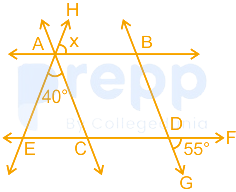
In the given figure AB is parallel to CD and AC is parallel to BD. If ∠EAC = 40°, ∠FDG = 55°, ∠HAB = x°, then what is the value of x?
If two lines AB and CD intersect at O such that ∠AOC = 5 ∠AOD, then the four angles at O are
The locus of a point equidistant from two intersecting lines is
In the figure given below, p, q, r are parallel lines; l and m are two transversals.
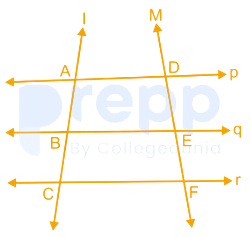
Consider the following:
1. AB : AC = DE : DF
2. AB × EF = BC × DE
Which of the above is/are correct?
The length of a line segment AB is 2 cm. It is divided into two parts at a point C such that AC 2= AB × CB. What is the length of CB?
Consider the following statements in respect of three straight lines A, B and C on a plane:
1. If A and C are parallel and B and C are parallel, then A and B are parallel
2. If A is perpendicular to C and B is perpendicular to C, then A and B are parallel
3. If the acute angle between A and C is equal to the acute angle between B and C; then A and B are parallel
Which of the above statements are correct?There are 8 lines in a plane, no two of which are parallel. What is the maximum number of points at which they can intersect?
A person goes to a market between 4 p.m. and 5 p.m. When he comes back he finds that the hour hand and the minute hand of the clock have interchanged their positions. For how much time (approximately) was he out of his house?
A truck moves along a circular path and describes 100 m when it has traced out 36° at the centre. The radius of the circle is equal to
In a triangle ABC if A − B = \(\frac{\pi}{2}\) , then C + 2B is equal to
Important Questions from Lines and Angles
Two parallel lines are intersected by a transversal, the corresponding angles are:
There are three points P, Q and R on a straight line such that PQ : QR = 3 : 5. If n is the number of possible values of PQ : PR, then what is n equal to ?
Two cars start from a point at the same time and travel on two different roads at right angles to each other. Their speed is 18 km/h and 72 km/h respectively. What will be the distance between them after 6 seconds?
Express 65° in radian :
The measure of an angle for which the measure of the supplement is four times the measure of the complement is:



