
The two port network mentioned below can be characterized by four variables V1, V2, I1 and I2, in which only two can be independent. The h-parameters of the two port network possesses the following : (a) Linear network should contain no independent sources. Options :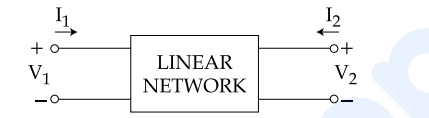
(b) V1 and V2 are taken as independent variables.
(c) V1 and I2 are taken as independent variables.
(d) I1 and V2 are taken as independent variables.
(c) and (d) only are correct
This question was cancelled by UGC. The official answer key records code 9 against it, meaning every option was credited and all candidates were awarded the two marks whatever they marked. The discussion below therefore gives the best-supported reading of the item rather than a uniquely correct option.
The h-parameter equations settle which variables are independent. The hybrid description is
\(V_{1}=h_{11}I_{1}+h_{12}V_{2}\)
\(I_{2}=h_{21}I_{1}+h_{22}V_{2}\)
The quantities on the right are the independent ones, so the independent pair is I1 and V2 — statement (d). The dependent pair is V1 and I2, which makes statement (c) the exact reverse of the truth: those are the variables the model produces, not the ones it is driven by. (A description driven by V1 and I2 exists — it is the inverse-hybrid or g-parameter set.) Statement (b), driving with both voltages, is the y-parameter set.
Statement (a) is true as well. Every two-port parameter set assumes the network contains no independent sources; if it did, the port equations would need a constant term and the network would no longer be describable by a plain 2 × 2 matrix. Dependent (controlled) sources are perfectly acceptable and merely make the network non-reciprocal.
So the strictly correct combination is (a) and (d), and that pair is not among the four options. The question as printed is defective. Of what is offered, option 3 — (c) and (d) — is the only code that includes the genuinely correct statement (d), and it is taken as the intended answer; the choice is flagged for checking against the official key.
| Set | Independent | Dependent | Equations |
|---|---|---|---|
| z | I1, I2 | V1, V2 | V = zI |
| y | V1, V2 | I1, I2 | I = yV |
| h | I1, V2 | V1, I2 | hybrid |
| g | V1, I2 | I1, V2 | inverse hybrid |
Why the hybrid set is the one used for transistors. Its four parameters are each easy to measure and each physically meaningful:
\(h_{11}=\left.\dfrac{V_{1}}{I_{1}}\right|_{V_{2}=0}\) input impedance with the output shorted; \(h_{21}=\left.\dfrac{I_{2}}{I_{1}}\right|_{V_{2}=0}\) forward current gain (the familiar \(h_{fe}=\beta\)); \(h_{12}\) reverse voltage gain and \(h_{22}\) output admittance, both with the input open. A transistor has a low input impedance and a high output impedance, so a short-circuit measurement at the input and an open-circuit one at the output are exactly the convenient tests — whereas pure z or y parameters would demand an open or a short at both ports and are much harder to realise at the transistor's terminals. The "hybrid" name simply records that the four parameters have mixed units: ohms, siemens and two dimensionless ratios.
Hence, per the option set the answer is (c) and (d) only, the strictly correct pair being (a) and (d).
Similar Questions
Read the following statements :
ST 1 : y-parameters can be obtained from Z parameters.
ST 2 : It is not necessary to define y-parameters separately.Match the given lists :
List – I List – II a. Condition of reciprocity i. \(\dfrac{Z_{12}}{Z_{22}}\) b. h12 ii. Z12 = Z21 c. 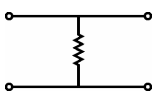 \(\begin{bmatrix}R&R\\R&R\end{bmatrix}\)
iii. Z d. Condition of symmetry iv. Z11 = Z22 Codes :
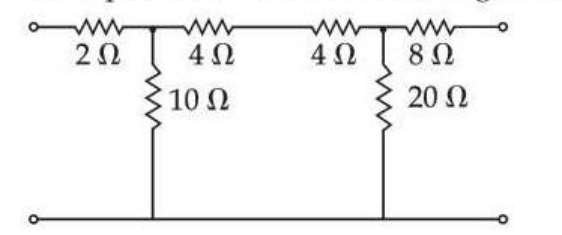
The T-parameters for the following cascaded network is :
For the two-port network shown in figure, the z-parameter matrix is given by
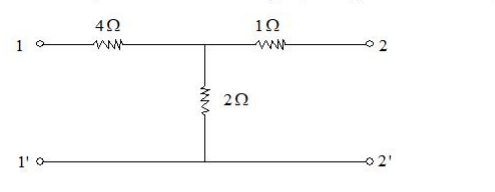
The z parameters z11 and z21 for the 2-port network shown in the given figure respectively are :
Assertion (A) : In a two port network, with 4 terminals four types of parameters like impedance, admittance, hybrid and transmission are considered and they are related to each other.
Reason (R) : The assumption made for the above statement is that there are no independent sources and non-zero initial conditions within the linear port network.
Select your answer using the codes given below :
The [Y] parameters of the network shown below are given as :
Important Questions from Two Port Networks
A two-port network has scattering parameters given \(\left[ s \right] = \left[ {\begin{array}{*{20}{c}} {{s_{11}}}&{{s_{12}}}\\ {{s_{211}}}&{{s_{22}}} \end{array}} \right]\). If the port 2 of the two-port is short-circuited, the s11 parameter for the resultant one-port network is
With 10 V dc connected at port A, the current drawn by 7 Ω connected at port B is
With 6 V dc connected at port A, 1 Ω connected at port B draws 7/3 A. If 8 V dc is connected to port A, the open circuit voltage at port B is
In a linear two – port network, when 10 V is applied to Port 1, a current of 4 A flows through Port 2 when it is short-circuited. When 5 V is applied to Port, a current of 1.25 A flows through a 1 Ω resistance connected across Port 2. When 3 V is applied to Port 1, then current (in Ampere) through a 2 Ω resistance connected across Port 2 is __________.
A network is said to be reciprocal if



