
Read the following statements : ST 1 : y-parameters can be obtained from Z parameters.
ST 2 : It is not necessary to define y-parameters separately.
ST 1 and ST 2 are correct.
ST 1 and ST 2 are correct — option (D), as recorded in the supplied key.
Statement 1 is certainly true. The admittance and impedance matrices of a two-port are inverses of one another :
\([Y]=[Z]^{-1}\)
and the conversion is explicit. Writing \(\Delta Z=Z_{11}Z_{22}-Z_{12}Z_{21}\),
\(Y_{11}=\dfrac{Z_{22}}{\Delta Z},\quad Y_{12}=\dfrac{-Z_{12}}{\Delta Z},\quad Y_{21}=\dfrac{-Z_{21}}{\Delta Z},\quad Y_{22}=\dfrac{Z_{11}}{\Delta Z}\)
So whenever the Z-parameters of a network are known and the matrix is non-singular, the Y-parameters follow by arithmetic alone with no further measurement.
Statement 2 follows from statement 1 on the key’s reading. If every Y-parameter can be computed from the Z-parameters, then a separate defining experiment for the Y set is not necessary — the same information is already present in the Z description, merely expressed in another basis. The two parameter sets describe one network, not two.
The qualification worth carrying, because it is the reason a careful candidate hesitates over ST 2. The conversion requires \(\Delta Z\neq 0\), and for some networks it is exactly zero — a series impedance in the through path has no finite Y description, and a shunt element has no finite Z description. Those cases are why all six parameter sets exist :
| Set | Independent variables | Natural use |
|---|---|---|
| Z (open-circuit impedance) | \(I_{1},I_{2}\) | Series-connected two-ports |
| Y (short-circuit admittance) | \(V_{1},V_{2}\) | Parallel-connected two-ports |
| h (hybrid) | \(I_{1},V_{2}\) | Transistor small-signal models |
| ABCD (transmission) | \(V_{2},I_{2}\) | Cascaded networks — matrices simply multiply |
The practical reason for defining Y separately is convenience rather than necessity: measuring Y requires short-circuit terminations while Z requires open-circuit ones, and at high frequency a good short is far easier to realise than a good open, which is why Y and S parameters dominate RF work.
Note. Read strictly — as a claim that the Y set never needs independent definition — ST 2 fails for the singular cases above, which would give option (A). The answer stored here follows the supplied key.
Similar Questions
Match the given lists :
List – I List – II a. Condition of reciprocity i. \(\dfrac{Z_{12}}{Z_{22}}\) b. h12 ii. Z12 = Z21 c. 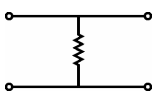 \(\begin{bmatrix}R&R\\R&R\end{bmatrix}\)
iii. Z d. Condition of symmetry iv. Z11 = Z22 Codes :
The T-parameters for the following cascaded network is :
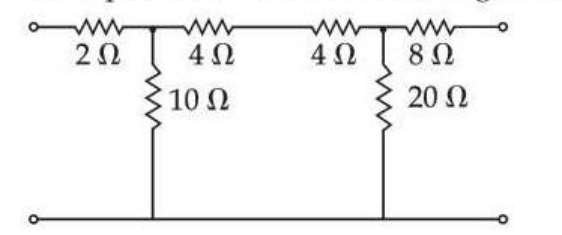
For the two-port network shown in figure, the z-parameter matrix is given by
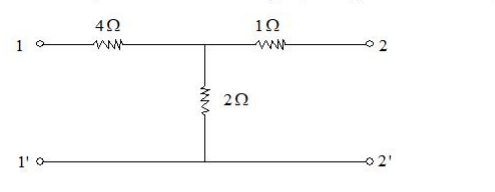
The z parameters z11 and z21 for the 2-port network shown in the given figure respectively are :
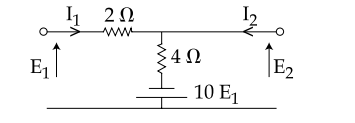
The two port network mentioned below can be characterized by four variables V1, V2, I1 and I2, in which only two can be independent.
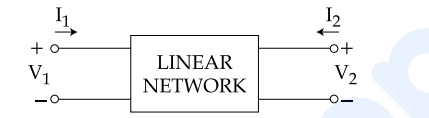
The h-parameters of the two port network possesses the following :
(a) Linear network should contain no independent sources.
(b) V1 and V2 are taken as independent variables.
(c) V1 and I2 are taken as independent variables.
(d) I1 and V2 are taken as independent variables.Options :
Assertion (A) : In a two port network, with 4 terminals four types of parameters like impedance, admittance, hybrid and transmission are considered and they are related to each other.
Reason (R) : The assumption made for the above statement is that there are no independent sources and non-zero initial conditions within the linear port network.
Select your answer using the codes given below :
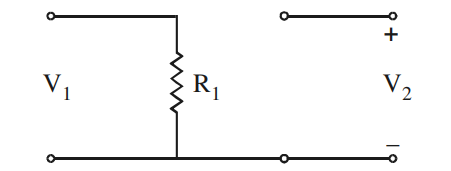
The [Y] parameters of the network shown below are given as :
Important Questions from Two Port Networks
A two-port network has scattering parameters given \(\left[ s \right] = \left[ {\begin{array}{*{20}{c}} {{s_{11}}}&{{s_{12}}}\\ {{s_{211}}}&{{s_{22}}} \end{array}} \right]\). If the port 2 of the two-port is short-circuited, the s11 parameter for the resultant one-port network is
With 10 V dc connected at port A, the current drawn by 7 Ω connected at port B is
With 6 V dc connected at port A, 1 Ω connected at port B draws 7/3 A. If 8 V dc is connected to port A, the open circuit voltage at port B is
In a linear two – port network, when 10 V is applied to Port 1, a current of 4 A flows through Port 2 when it is short-circuited. When 5 V is applied to Port, a current of 1.25 A flows through a 1 Ω resistance connected across Port 2. When 3 V is applied to Port 1, then current (in Ampere) through a 2 Ω resistance connected across Port 2 is __________.
A network is said to be reciprocal if



