
Match the given lists : Codes :List – I List – II a. Condition of reciprocity i. \(\dfrac{Z_{12}}{Z_{22}}\) b. h12 ii. Z12 = Z21 c. 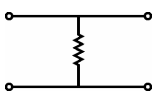 \(\begin{bmatrix}R&R\\R&R\end{bmatrix}\)
iii. Z d. Condition of symmetry iv. Z11 = Z22
a-ii, b-i, c-iii, d-iv
Two of the pairings are definitions and carry the rest: a-ii, b-i, c-iii, d-iv — option 2.
| Item | Match |
|---|---|
| a. Reciprocity | ii. Z12 = Z21 |
| b. h12 | i. Z12/Z22 |
| c. Matrix of resistances in ohms | iii. Z |
| d. Symmetry | iv. Z11 = Z22 |
Reciprocity against symmetry — the distinction the question tests. They are different conditions and are easily confused.
Reciprocity, \(Z_{12}=Z_{21}\), says the transfer works equally in both directions: a source at port 1 producing a given response at port 2 would produce the same response at port 1 if source and measurement were interchanged. Every network built only from R, L, C and transformers is reciprocal; devices containing dependent sources — transistors, gyrators, circulators — are not.
Symmetry, \(Z_{11}=Z_{22}\), says the two ports look alike from outside: the network is electrically identical whichever end it is entered from. A T-network with equal series arms is symmetric; one with unequal arms is still reciprocal but not symmetric. So symmetry implies reciprocity, but not the reverse.
b — where the h12 expression comes from. The hybrid parameter \(h_{12}\) is the reverse voltage ratio measured with port 1 open:
\(h_{12}=\dfrac{V_{1}}{V_{2}}\bigg|_{I_{1}=0}\)
Setting \(I_{1}=0\) in the Z equations gives \(V_{1}=Z_{12}I_{2}\) and \(V_{2}=Z_{22}I_{2}\), so the current cancels and
\(h_{12}=\dfrac{Z_{12}}{Z_{22}}\)
c — identifying the parameter set by its units. A matrix whose entries are all resistances in ohms can only be an impedance matrix, since
\([V]=[Z][I]\)
requires the coefficients to carry the dimensions of ohms. A Y matrix would hold siemens, and an h matrix is hybrid precisely because its four entries have four different dimensions — ohms, dimensionless, dimensionless, siemens — so a uniform matrix cannot be one.
The particular matrix shown, with all four entries equal, describes a network satisfying both conditions at once: \(Z_{12}=Z_{21}\) and \(Z_{11}=Z_{22}\), so it is reciprocal and symmetric — a single shunt resistance R between the two ports.
Hence, the correct code is a-ii, b-i, c-iii, d-iv.
Similar Questions
Read the following statements :
ST 1 : y-parameters can be obtained from Z parameters.
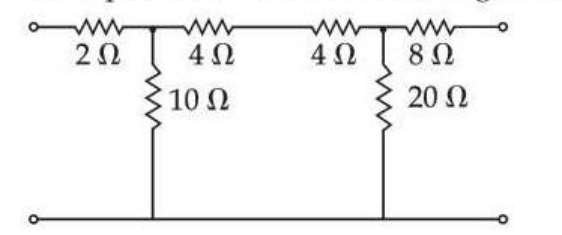
ST 2 : It is not necessary to define y-parameters separately.The T-parameters for the following cascaded network is :
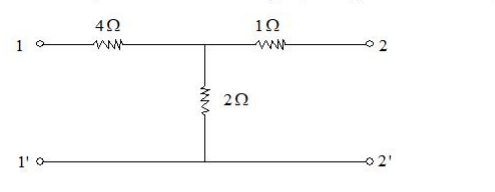
For the two-port network shown in figure, the z-parameter matrix is given by
The z parameters z11 and z21 for the 2-port network shown in the given figure respectively are :
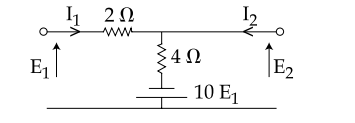
The two port network mentioned below can be characterized by four variables V1, V2, I1 and I2, in which only two can be independent.
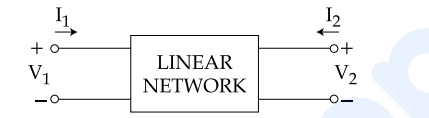
The h-parameters of the two port network possesses the following :
(a) Linear network should contain no independent sources.
(b) V1 and V2 are taken as independent variables.
(c) V1 and I2 are taken as independent variables.
(d) I1 and V2 are taken as independent variables.Options :
Assertion (A) : In a two port network, with 4 terminals four types of parameters like impedance, admittance, hybrid and transmission are considered and they are related to each other.
Reason (R) : The assumption made for the above statement is that there are no independent sources and non-zero initial conditions within the linear port network.
Select your answer using the codes given below :
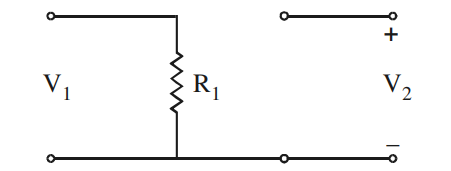
The [Y] parameters of the network shown below are given as :
Important Questions from Two Port Networks
A two-port network has scattering parameters given \(\left[ s \right] = \left[ {\begin{array}{*{20}{c}} {{s_{11}}}&{{s_{12}}}\\ {{s_{211}}}&{{s_{22}}} \end{array}} \right]\). If the port 2 of the two-port is short-circuited, the s11 parameter for the resultant one-port network is
With 10 V dc connected at port A, the current drawn by 7 Ω connected at port B is
With 6 V dc connected at port A, 1 Ω connected at port B draws 7/3 A. If 8 V dc is connected to port A, the open circuit voltage at port B is
In a linear two – port network, when 10 V is applied to Port 1, a current of 4 A flows through Port 2 when it is short-circuited. When 5 V is applied to Port, a current of 1.25 A flows through a 1 Ω resistance connected across Port 2. When 3 V is applied to Port 1, then current (in Ampere) through a 2 Ω resistance connected across Port 2 is __________.
A network is said to be reciprocal if



