
Assertion (A) : In a two port network, with 4 terminals four types of parameters like impedance, admittance, hybrid and transmission are considered and they are related to each other. Reason (R) : The assumption made for the above statement is that there are no independent sources and non-zero initial conditions within the linear port network. Select your answer using the codes given below :
Both (A) and (R) are true and (R) is the correct explanation of (A).
Both statements are true, and the reason states the very condition that makes the assertion possible.
Why there are four parameter sets. A two-port has four terminal variables — V1, I1, V2, I2 — of which any two may be chosen as independent and the other two expressed in terms of them. Each choice gives a different description:
| Set | Independent | Equations | Where used |
|---|---|---|---|
| z | I1, I2 | V = zI | Series-connected networks |
| y | V1, V2 | I = yV | Parallel-connected networks |
| h | I1, V2 | Hybrid | Transistor models |
| ABCD | V2, −I2 | Transmission | Cascaded networks, lines |
Since all four describe the same network, they must be interconvertible, and the standard conversion tables express any set in terms of any other — for example \(h_{11}=\dfrac{\Delta z}{z_{22}}\) and \(y=z^{-1}\).
Now the reason, which is the precondition for all of it. Each description takes the form of a homogeneous linear relation — a 2 × 2 matrix with no constant term. Two things would destroy that:
• an independent source inside the network would add a constant, so V1 would not be zero when both currents were zero, and the matrix form could not hold;
• a non-zero initial condition — charge on a capacitor, current in an inductor — would add a similar constant term in the s domain.
Excluding both is exactly what allows the network to be characterised by four numbers, and hence what allows the four sets to be related to one another. So (R) explains (A) and the code is 1.
What is not excluded : dependent (controlled) sources are perfectly permissible, because their value is proportional to a terminal variable and so contributes to the matrix rather than to a constant term. Their presence simply makes the network non-reciprocal, so \(z_{12}\ne z_{21}\) and the matrix loses its symmetry. That is precisely how a transistor is modelled.
A caution on existence : the four sets are interconvertible but not all of them always exist. A network whose z matrix is singular has no y parameters, and an ideal transformer has neither z nor y but perfectly good ABCD parameters — which is a further reason for keeping all four in the toolkit.
Hence, both (A) and (R) are true and (R) is the correct explanation of (A).
Similar Questions
Read the following statements :
ST 1 : y-parameters can be obtained from Z parameters.
ST 2 : It is not necessary to define y-parameters separately.Match the given lists :
List – I List – II a. Condition of reciprocity i. \(\dfrac{Z_{12}}{Z_{22}}\) b. h12 ii. Z12 = Z21 c. 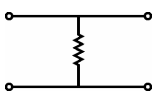 \(\begin{bmatrix}R&R\\R&R\end{bmatrix}\)
iii. Z d. Condition of symmetry iv. Z11 = Z22 Codes :
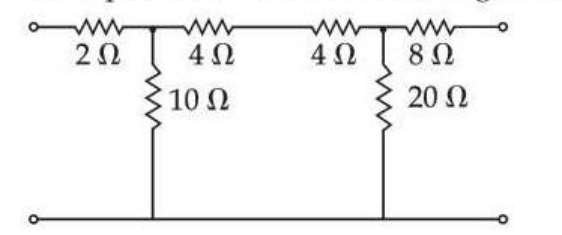
The T-parameters for the following cascaded network is :
For the two-port network shown in figure, the z-parameter matrix is given by
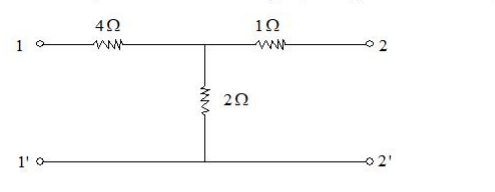
The z parameters z11 and z21 for the 2-port network shown in the given figure respectively are :
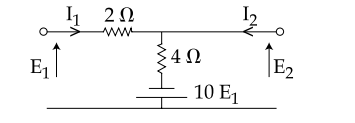
The two port network mentioned below can be characterized by four variables V1, V2, I1 and I2, in which only two can be independent.
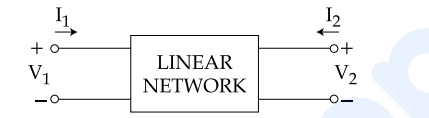
The h-parameters of the two port network possesses the following :
(a) Linear network should contain no independent sources.
(b) V1 and V2 are taken as independent variables.
(c) V1 and I2 are taken as independent variables.
(d) I1 and V2 are taken as independent variables.Options :
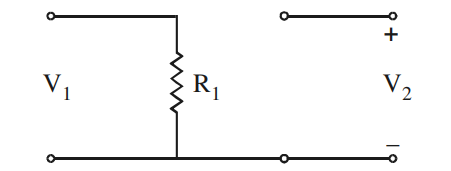
The [Y] parameters of the network shown below are given as :
Important Questions from Two Port Networks
A two-port network has scattering parameters given \(\left[ s \right] = \left[ {\begin{array}{*{20}{c}} {{s_{11}}}&{{s_{12}}}\\ {{s_{211}}}&{{s_{22}}} \end{array}} \right]\). If the port 2 of the two-port is short-circuited, the s11 parameter for the resultant one-port network is
With 10 V dc connected at port A, the current drawn by 7 Ω connected at port B is
With 6 V dc connected at port A, 1 Ω connected at port B draws 7/3 A. If 8 V dc is connected to port A, the open circuit voltage at port B is
In a linear two – port network, when 10 V is applied to Port 1, a current of 4 A flows through Port 2 when it is short-circuited. When 5 V is applied to Port, a current of 1.25 A flows through a 1 Ω resistance connected across Port 2. When 3 V is applied to Port 1, then current (in Ampere) through a 2 Ω resistance connected across Port 2 is __________.
A network is said to be reciprocal if



