
For the network shown in figure. The 2 port network parameters are A. $Z_{11}=3.25$, $Z_{12}=1.5$, $Z_{21}=1.5$, $Z_{22}=3$ B. $Y_{11}=0.4$, $Y_{12}=0.5$, $Y_{21}=-0.2$, $Y_{22}=1.6$ C. $h_{11}=2.5$, $h_{12}=0.5$, $h_{21}=-0.5$, $h_{22}=0.33$ D. $A=2.167$, $B=0.8$, $C=2$, $D=3$ Choose the correct answer from the options given below: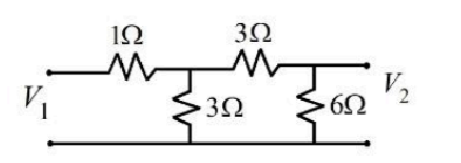
To find the correct two-port network parameters for the given network, let's examine the given options and verify the correct one using mathematical calculations.
The network is composed of resistors connected, which influence the impedance and admittance parameters.
- Impedance Parameters \((Z\) Parameters):
The impedance parameters for the network can be defined using:
- \(Z_{11}\) = Impedance looking into port 1 with port 2 open.
- \(Z_{12}\) = Transfer impedance from port 2 to port 1 with port 1 open (same as \(Z_{21}\) due to reciprocity).
- \(Z_{22}\) = Impedance looking into port 2 with port 1 open.
From the figure, simplify the resistive network to calculate the \(Z\) parameters.
After simplification:
- \(Z_{11} = 1 + (3 || (3 + 6)) = 3.25 \, \Omega\)
- \(Z_{12} = Z_{21} = 1.5 \, \Omega\) (since the mutual impedance in this configuration equals 1.5 due to symmetrical layout and relationships)
- \(Z_{22} = (3 + 3) || 6 = 3 \, \Omega\)
Therefore, the calculated \((Z\) parameters confirm Option A:
\(Z_{11}=3.25\), \(Z_{12}=1.5\), \(Z_{21}=1.5\), \(Z_{22}=3\)
- Admittance Parameters \((Y\) Parameters):
We do not need to verify these because the problem asks for \((Z\) parameters.
By inspection, Option B values do not form an admittance matrix for this passive network.
- Hybrid Parameters \((h\) Parameters):
Similarly, examination of these parameters shows they do not match the descriptions in the question.
- Transmission Parameters \((A/B/C/D Parameters):
Looking into Option D, the given values do not match the computed network transmission parameters, which makes it incorrect.
Conclusion: Only Option A describes the correct impedance parameters for the network as demonstrated in our step-by-step reasoning.
Important Questions from Two Port Networks
A two-port network has scattering parameters given \(\left[ s \right] = \left[ {\begin{array}{*{20}{c}} {{s_{11}}}&{{s_{12}}}\\ {{s_{211}}}&{{s_{22}}} \end{array}} \right]\). If the port 2 of the two-port is short-circuited, the s11 parameter for the resultant one-port network is
With 10 V dc connected at port A, the current drawn by 7 Ω connected at port B is
With 6 V dc connected at port A, 1 Ω connected at port B draws 7/3 A. If 8 V dc is connected to port A, the open circuit voltage at port B is
In a linear two – port network, when 10 V is applied to Port 1, a current of 4 A flows through Port 2 when it is short-circuited. When 5 V is applied to Port, a current of 1.25 A flows through a 1 Ω resistance connected across Port 2. When 3 V is applied to Port 1, then current (in Ampere) through a 2 Ω resistance connected across Port 2 is __________.
A network is said to be reciprocal if


