
The formula for conversion between Fahrenheit and Celsius is °F = X + (1⋅8 × °C)
32
Understanding Temperature Conversion Formula
The question asks us to identify the factor X in the given formula for converting temperature from Celsius (°C) to Fahrenheit (°F). The formula provided is:
\(\) \text{°F} = \text{X} + (1.8 \times \text{°C}) \(\)
Standard Celsius to Fahrenheit Conversion
The standard and widely accepted formula for converting a temperature from the Celsius scale to the Fahrenheit scale is:
\(\) \text{°F} = \left(\frac{9}{5} \times \text{°C}\right) + 32 \(\)
We know that the fraction \(\frac{9}{5}\) is equal to the decimal value 1.8.
So, the standard formula can also be written as:
\(\) \text{°F} = (1.8 \times \text{°C}) + 32 \(\)
Identifying Factor X
Now, let's compare the given formula with the standard formula:
- Given Formula: \(\) \text{°F} = \text{X} + (1.8 \times \text{°C}) \(\)
- Standard Formula: \(\) \text{°F} = 32 + (1.8 \times \text{°C}) \(\) (rearranging the standard formula slightly to match the structure)
By comparing these two formulas, we can see that the structure is the same, and the coefficient for °C is 1.8 in both cases. The constant term that is added to the result of \((1.8 \times \text{°C})\) is X in the given formula and 32 in the standard formula.
Therefore, by direct comparison, the factor X must be equal to 32.
Comparing Options for Factor X
Let's look at the provided options:
- Option 1: 32
- Option 2: 22
- Option 3: 98
- Option 4: 42
Our derived value for factor X is 32, which matches Option 1.
| Component | Given Formula | Standard Formula |
|---|---|---|
| Temperature in Fahrenheit (°F) | °F | °F |
| Temperature in Celsius (°C) | °C | °C |
| Multiplication Factor for °C | 1.8 | 1.8 (from 9/5) |
| Added Constant | X | 32 |
This comparison confirms that X = 32.
Revision Table: Temperature Scales
| Scale | Symbol | Freezing Point of Water | Boiling Point of Water |
|---|---|---|---|
| Celsius | °C | 0°C | 100°C |
| Fahrenheit | °F | 32°F | 212°F |
| Kelvin | K | 273.15 K (approx) | 373.15 K (approx) |
Additional Information: Temperature Conversion Factors
Temperature conversion is a common operation in physics and everyday life. The relationship between different temperature scales is linear.
The formula \(\text{°F} = \left(\frac{9}{5} \times \text{°C}\right) + 32\) can be rearranged to convert Fahrenheit to Celsius:
\(\) \text{°F} - 32 = \frac{9}{5} \times \text{°C} \(\)
\(\) \text{°C} = \frac{5}{9} \times (\text{°F} - 32) \(\)
Conversions involving Kelvin (K) are also important. Kelvin is an absolute scale, meaning 0 K is absolute zero.
- Celsius to Kelvin: \(\) \text{K} = \text{°C} + 273.15 \(\)
- Kelvin to Celsius: \(\) \text{°C} = \text{K} - 273.15 \(\)
Fahrenheit to Kelvin conversions usually go via Celsius first.
Similar Questions
A Kelvin thermometer and a Fahrenheit thermometer both give the same reading for a certain sample. What would be the corresponding reading in a Celsius thermometer?
A pressure cooker cooks food faster by
The absolute zero temperature is 0 Kelvin. In °C unit, which one of the following is the absolute zero temperature?
The coefficient of areal expansion of a material is 1.6 × 10 -5 K-1 . Which one of the following gives the value of coefficient of volume expansion of this material?
The temperature of a place on one sunny day is 113 in Fahrenheit scale. The Kelvin scale reading of this temperature will be
Radiations coming from the Sun are mostly in the form of
A solid is melted and allowed to cool and solidify again. The temperature is measured at equal interval of time. The graph below shows the change of temperature with time.
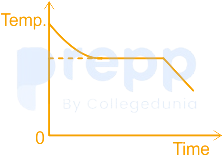
The part of the curve that is practically horizontal is due to
Perspiration cools the body because
In which of the following phenomena do heat waves travel along a straight line with the speed of light?
Which one of the following statement is NOT correct?
Important Questions from Temperature and heat
A Kelvin thermometer and a Fahrenheit thermometer both give the same reading for a certain sample. What would be the corresponding reading in a Celsius thermometer?
Which of the following gases has highest value of critical temperature ?
- For carbon dioxide ($CO_2$), which is commonly used in industrial processes as a supercritical fluid, what is its critical temperature? Above this temperature, $CO_2$ cannot be liquefied regardless of how much pressure is applied, existing only as a supercritical fluid.
- Where does the heat energy go when the solid melts but its temperature remains the same?
A pressure cooker cooks food faster by



