
Ramesh cannot see distinctly objects kept beyond 2 m. This defect can be corrected by using a lens of power
0.5 D
Understanding Ramesh's Eye Defect: Myopia Correction
Ramesh cannot see objects distinctly beyond 2 meters. This means his far point is 2 meters instead of at infinity, which is the normal far point for a healthy eye. This condition is known as myopia, or nearsightedness.
In myopia, the eye focuses light in front of the retina instead of directly on it, especially for distant objects. To correct this defect and enable Ramesh to see distant objects clearly, a corrective lens is needed.
Choosing the Corrective Lens for Myopia
A concave lens (also known as a diverging lens) is used to correct myopia. A concave lens diverges the incoming light rays before they enter the eye, causing them to focus further back on the retina.
The purpose of the corrective lens is to form a virtual image of a distant object (an object at infinity) at the person's far point. In Ramesh's case, the far point is 2 meters from his eye.
Calculating the Focal Length of the Corrective Lens
We can use the lens formula to determine the focal length ($f$) of the required lens:
The lens formula is given by: $\$ \frac{1}{f} = \frac{1}{v} - \frac{1}{u} \$$
Where:
- $u$ is the object distance
- $v$ is the image distance
- $f$ is the focal length of the lens
For a person with myopia, the corrective lens needs to create a virtual image of an object at infinity ($\$ u = -\infty \$$) at the person's far point. Since the image is formed at the far point on the same side as the object (in front of the eye), the image distance ($v$) is negative. Ramesh's far point is 2 m, so $\$ v = -2 \text{ m} \$.
Substituting these values into the lens formula:
$\$ \frac{1}{f} = \frac{1}{-2} - \frac{1}{-\infty} \$$
Since $\$ \frac{1}{-\infty} \approx 0 \$, the equation simplifies to:
$\$ \frac{1}{f} = \frac{1}{-2} - 0 \$$
$\$ \frac{1}{f} = -\frac{1}{2} \text{ m}^{-1} \$$
So, the focal length is: $\$ f = -2 \text{ m} \$.
The negative focal length confirms that a concave lens is required, which is consistent with the correction for myopia.
Calculating the Power of the Corrective Lens
The power ($P$) of a lens is defined as the reciprocal of its focal length in meters:
$\$ P = \frac{1}{f \text{ (in meters)}} \$$
Using the calculated focal length $\$ f = -2 \text{ m} \$,$
$\$ P = \frac{1}{-2} \text{ D} \$$
$\$ P = -0.5 \text{ D} \$$
The power of the required lens is -0.5 Diopters (D). The negative sign indicates a concave lens.
Analyzing the Options
We calculated the required power to be -0.5 D. Let's look at the given options:
- + 0.5 D (Positive power)
- 0.5 D (No sign specified)
- + 0.2 D (Positive power)
- 0.2 D (No sign specified)
Options 1 and 3 are for convex lenses (positive power), which are used to correct hypermetropia (farsightedness), not myopia. Therefore, these are incorrect.
We are left with options 2 (0.5 D) and 4 (0.2 D). Our calculated power magnitude is 0.5 D. Although the sign is crucial for identifying the lens type (concave requires negative power), option 2 provides the correct magnitude (0.5 D).
In some contexts, particularly in introductory questions or options lists, the negative sign for power of a concave lens might be omitted or understood from the context of correcting myopia. Based on the options provided and the calculated magnitude, the power is 0.5 D, corresponding to a concave lens of power -0.5 D.
Revision Table: Common Eye Defects and Corrections
| Eye Defect | Description | Far Point | Near Point | Corrective Lens |
|---|---|---|---|---|
| Myopia (Nearsightedness) | Eye focuses light in front of retina | Less than infinity | Closer than normal (25 cm) | Concave (Diverging) Lens |
| Hypermetropia (Farsightedness) | Eye focuses light behind retina | Normal (infinity) | Further than normal (25 cm) | Convex (Converging) Lens |
| Presbyopia | Loss of accommodation due to age | Normal (infinity) | Further than normal (25 cm) | Bifocal or Convex Lens |
| Astigmatism | Unequal curvature of cornea/lens | Variable | Variable | Cylindrical Lens |
Additional Information on Lens Power and Eye Correction
The power of a lens is a measure of how much it converges or diverges light. A higher power means stronger convergence (positive power, convex lens) or divergence (negative power, concave lens).
The unit of lens power is the Diopter (D), which is equal to one reciprocal meter ($1 \text{ m}^{-1}$). A lens with a focal length of 1 meter has a power of 1 Diopter.
When correcting vision defects:
- For myopia, a concave lens with negative power is used to shift the image formed by the eye backward onto the retina. The required power is determined by the extent of the myopia, specifically the far point distance.
- For hypermetropia, a convex lens with positive power is used to shift the image formed by the eye forward onto the retina. The required power is determined by the near point distance.
- For presbyopia, which is age-related loss of focusing ability, often a convex lens is needed for reading (near vision). Bifocal or progressive lenses can correct both near and distant vision simultaneously.
Understanding the relationship between focal length, power, and the specific eye defect is crucial for selecting the correct type and strength of the corrective lens.
Similar Questions
Myopia is a defect in human vision where an image of a
Human eye can see objects at different distances with contrasting illuminations. This is due to
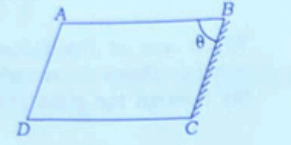
A glass slab of refractive index \(1\cdot5\) is cut in the shape of a parallelepiped \(ABCD\) as shown in the figure. Surface \(BC\) is polished to form a perfect reflector. Light is incident at surface \(AB\) from inside at an angle \(\pi/3\). Which one of the following is the correct angle \(ABC\) (\(\theta\)) such that the reflected light retraces its path?
- A periscope uses two plane mirrors inclined at \(45^\circ\). If the tube of the periscope is filled with a complete transparent liquid of refractive index \(1\cdot5\), then which one of the following is correct in respect of the image seen?
- Bottom of a tank containing water appears to be raised. It is due to
Statement I: Due to diffused or irregular reflection of light, a closed room gets light even if no direct sunlight falls inside the room.
Statement II: Irregular reflection, where the reflected rays are not parallel, does not follow the laws of reflection.Light enters the eye through a thin membrane called
Colour vision in human eyes is the function of photoreceptor cells named
Cornea in human eye
The part of the human eye on which the image is formed is
Important Questions from Reflection and Refraction
Myopia is also known as ______.
Part of the eye which controls the light entering, is called as
Which defect of vision is corrected using cylindrical lenses in spectacles ?
Which of the following defects can be corrected by using a convex lens of appropriate power?
A person standing on the bank of a river observes a fish inside the water. He sees the fish_____.



