
Human eye can see objects at different distances with contrasting illuminations. This is due to
accommodation of eye
Understanding How the Human Eye Sees Clearly
The human eye is an incredible organ capable of seeing objects clearly whether they are close up or far away, and also under different lighting conditions, from bright sunshine to dim rooms. This ability to adjust focus for distance and adapt to varying light levels is crucial for our vision.
What is Eye Accommodation?
The main mechanism that allows the eye to focus on objects at different distances is called accommodation. This process involves changing the shape of the eye's natural lens.
- When you look at a distant object, the ciliary muscles around the lens relax, causing the suspensory ligaments to pull the lens and make it thinner and flatter. This reduces the refractive power, allowing light from far objects to focus correctly on the retina.
- When you look at a near object, the ciliary muscles contract. This releases the tension on the suspensory ligaments, allowing the elastic lens to become thicker and more rounded. This increases the refractive power, ensuring light from near objects is focused on the retina.
This dynamic change in lens shape is the core of accommodation, enabling us to shift our focus smoothly from reading a book to looking at a distant building.
Eye's Response to Different Illuminations
Besides focusing at different distances, the eye also adapts to varying light levels. This is managed by the iris and the pupil.
- The iris is the colored part of the eye, acting like the diaphragm of a camera.
- The pupil is the opening in the center of the iris that lets light enter the eye.
- In bright light, the iris muscles contract, making the pupil smaller. This reduces the amount of light entering the eye, preventing the retina from being overwhelmed.
- In dim light, the iris muscles relax, making the pupil larger. This increases the amount of light entering the eye, allowing us to see better in low light conditions.
So, the eye uses both accommodation (for distance focusing) and pupil size adjustment (for light control) to see clearly under various conditions.
Why Accommodation of Eye is the Key Reason
The question asks why the eye can see objects at different distances with contrasting illuminations. While both accommodation and pupil adjustment contribute, accommodation is the process specifically mentioned in the options that describes the eye's ability to change focus for varying distances. The options provided relate either to vision defects or to this adaptive mechanism.
Why Other Options Are Not Correct
Let's look at the other options:
- Far-sightedness (Hyperopia): This is a vision defect where distant objects are seen clearly, but near objects appear blurry. It occurs when light focuses behind the retina. This is a problem with focus, not the eye's ability to dynamically adjust focus for different distances.
- Near-sightedness (Myopia): This is another vision defect where near objects are seen clearly, but distant objects appear blurry. It occurs when light focuses in front of the retina. Like far-sightedness, it's a fixed refractive error, not an adaptive mechanism for seeing at various distances.
- Far-sightedness and near-sightedness: Since both of these are vision defects that impair the eye's ability to focus correctly, they are not the reason the eye *can* see objects at different distances; they are reasons why it *might struggle* to do so.
Therefore, among the given choices, "accommodation of eye" is the correct explanation for the eye's ability to focus on objects at different distances, which is a primary part of seeing under different conditions.
| Mechanism | Primary Function | Parts Involved | Affected By |
|---|---|---|---|
| Accommodation | Focusing on objects at different distances | Lens, Ciliary Muscles, Suspensory Ligaments | Age (Presbyopia) |
| Pupil Adjustment | Regulating amount of light entering the eye | Iris, Pupil | Light Intensity |
| Far-sightedness (Hyperopia) | Vision Defect (Blurry near vision) | Eyeball shape, Lens/Cornea power | Genetics, Age |
| Near-sightedness (Myopia) | Vision Defect (Blurry distant vision) | Eyeball shape, Lens/Cornea power | Genetics, Environmental factors |
Revision Table: Key Eye Terms
| Term | Definition |
|---|---|
| Accommodation | The process by which the eye changes optical power to maintain a clear image or focus on objects at different distances. |
| Lens | A transparent structure behind the iris that focuses light onto the retina. Changes shape during accommodation. |
| Ciliary Muscles | Muscles in the eye that contract and relax to change the shape of the lens, controlling accommodation. |
| Suspensory Ligaments | Fibers that connect the ciliary muscles to the lens. |
| Retina | Light-sensitive tissue at the back of the eye where images are focused. |
| Iris | The colored part of the eye that controls the size of the pupil. |
| Pupil | The opening in the center of the iris that regulates the amount of light entering the eye. |
Additional Information on Eye Focus and Vision
Over time, the eye's ability to accommodate can decrease. This condition is called presbyopia, an age-related loss of the lens's elasticity, making it difficult to focus on near objects. This is why many older adults need reading glasses.
Vision defects like far-sightedness and near-sightedness can often be corrected using external lenses (glasses or contact lenses) or refractive surgery. These corrections work by altering the path of light entering the eye so that it focuses correctly on the retina, compensating for the eye's natural focusing error.
Understanding these different aspects of eye function helps explain the complexity and efficiency of human vision.
Similar Questions
Myopia is a defect in human vision where an image of a
A glass slab of refractive index \(1\cdot5\) is cut in the shape of a parallelepiped \(ABCD\) as shown in the figure. Surface \(BC\) is polished to form a perfect reflector. Light is incident at surface \(AB\) from inside at an angle \(\pi/3\). Which one of the following is the correct angle \(ABC\) (\(\theta\)) such that the reflected light retraces its path?
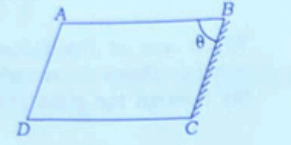
- A periscope uses two plane mirrors inclined at \(45^\circ\). If the tube of the periscope is filled with a complete transparent liquid of refractive index \(1\cdot5\), then which one of the following is correct in respect of the image seen?
- Bottom of a tank containing water appears to be raised. It is due to
Statement I: Due to diffused or irregular reflection of light, a closed room gets light even if no direct sunlight falls inside the room.
Statement II: Irregular reflection, where the reflected rays are not parallel, does not follow the laws of reflection.Ramesh cannot see distinctly objects kept beyond 2 m. This defect can be corrected by using a lens of power
Light enters the eye through a thin membrane called
Colour vision in human eyes is the function of photoreceptor cells named
Cornea in human eye
The part of the human eye on which the image is formed is
Important Questions from Reflection and Refraction
Myopia is also known as ______.
Part of the eye which controls the light entering, is called as
Which defect of vision is corrected using cylindrical lenses in spectacles ?
Which of the following defects can be corrected by using a convex lens of appropriate power?
A person standing on the bank of a river observes a fish inside the water. He sees the fish_____.



