
Refraction Explains Tank Bottom Appearance
The phenomenon where the bottom of a tank containing water appears to be raised is a classic example of refraction of light. Light travels at different speeds in different mediums (like water and air). When light passes from one medium to another, its path bends. This bending is called refraction.
Understanding Light Refraction
Here's a step-by-step explanation:
- Light Path: Imagine looking at the bottom of a water tank. Light rays travel from the bottom of the tank upwards towards your eyes. These rays first travel through the water and then pass into the air before reaching you.
- Bending of Light: Water is optically denser than air. When light rays move from a denser medium (water) to a rarer medium (air), they bend away from the normal (an imaginary line perpendicular to the surface).
- Apparent Depth: Your brain assumes that light travels in straight lines. When these refracted rays reach your eyes, your brain traces them back in straight lines. Because the rays bend away from the normal, these traced-back lines intersect at a point shallower than the actual bottom of the tank.
- Result: This makes the bottom of the tank appear shallower or "raised" compared to its actual depth.
Why Other Options Are Incorrect
Let's look at why the other options don't explain this specific observation:
- Reflection of light: Reflection is when light bounces off a surface. While reflection occurs at the water surface, it doesn't explain why the bottom itself appears shifted upwards.
- Interference of light: Interference occurs when two or more light waves overlap, resulting in patterns of constructive and destructive interference. This is not the cause of the apparent raised bottom.
- Diffraction of light: Diffraction is the bending of light waves around obstacles or through narrow openings. This phenomenon is typically observed in specific conditions and doesn't explain the general appearance of a raised tank bottom.
Mathematical Representation (Optional)
The relationship between the real depth (\(d_{real}\)) and the apparent depth (\(d_{app}\)) is given by the formula:
\( d_{app} = \frac{d_{real}}{\mu} \)
where \(\mu\) (mu) is the refractive index of the medium (water in this case). Since the refractive index of water (\(\mu \approx 1.33\)) is greater than 1, the apparent depth is always less than the real depth, confirming that the bottom appears raised.
Therefore, the primary reason the bottom of a water tank appears raised is the refraction of light as it passes from water to air.
Similar Questions
Myopia is a defect in human vision where an image of a
Human eye can see objects at different distances with contrasting illuminations. This is due to
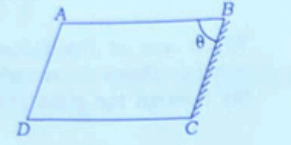
A glass slab of refractive index \(1\cdot5\) is cut in the shape of a parallelepiped \(ABCD\) as shown in the figure. Surface \(BC\) is polished to form a perfect reflector. Light is incident at surface \(AB\) from inside at an angle \(\pi/3\). Which one of the following is the correct angle \(ABC\) (\(\theta\)) such that the reflected light retraces its path?
- A periscope uses two plane mirrors inclined at \(45^\circ\). If the tube of the periscope is filled with a complete transparent liquid of refractive index \(1\cdot5\), then which one of the following is correct in respect of the image seen?
Statement I: Due to diffused or irregular reflection of light, a closed room gets light even if no direct sunlight falls inside the room.
Statement II: Irregular reflection, where the reflected rays are not parallel, does not follow the laws of reflection.Ramesh cannot see distinctly objects kept beyond 2 m. This defect can be corrected by using a lens of power
Light enters the eye through a thin membrane called
Colour vision in human eyes is the function of photoreceptor cells named
Cornea in human eye
The part of the human eye on which the image is formed is
Important Questions from Reflection and Refraction
Myopia is also known as ______.
Part of the eye which controls the light entering, is called as
Which defect of vision is corrected using cylindrical lenses in spectacles ?
Which of the following defects can be corrected by using a convex lens of appropriate power?
A person standing on the bank of a river observes a fish inside the water. He sees the fish_____.



