
The image will remain unchanged.
The question relates to the concept of light reflection and optics, specifically about how light behaves when passing through media of different refractive indices.
- The periscope utilizes two plane mirrors to redirect light, allowing the observer to see over obstacles. Normally, mirrors in a periscope are set at an angle of \(45^{\circ}\).
- In this scenario, the tube of the periscope is filled with a transparent liquid with a refractive index of \(1.5\). This means light traveling through the liquid will experience refraction but will not change its path when it reflects off the mirrors.
- The refractive index has no effect on the brightness or lateral position of the image as perceived through the periscope. The properties of the reflected light (such as intensity and direction) depend only on the reflective surfaces of the mirrors, not on the medium between them.
- Let's evaluate the options:
- The image will appear \(1.5\) times darker: This option is incorrect because the refractive index does not directly affect the brightness or intensity of the reflected light from the mirrors.
- The image will appear laterally shifted: This is incorrect because a lateral shift would imply the image has moved sideways, which is not affected by a change in the medium.
- The image will appear \(1.5\) times brighter: Again, this is incorrect because the medium’s refractive index does not change the brightness of the mirror-reflected image.
- The image will remain unchanged: This is correct. In terms of appearance, the image will be unaffected by the refractive index change since reflection on plane mirrors does not depend on the medium but rather on the mirrors themselves.
- Therefore, the correct interpretation is that the image will remain unchanged.
Similar Questions
Myopia is a defect in human vision where an image of a
Statement I: Due to diffused or irregular reflection of light, a closed room gets light even if no direct sunlight falls inside the room.
Statement II: Irregular reflection, where the reflected rays are not parallel, does not follow the laws of reflection.Ramesh cannot see distinctly objects kept beyond 2 m. This defect can be corrected by using a lens of power
Colour vision in human eyes is the function of photoreceptor cells named
Light enters the eye through a thin membrane called
Human eye can see objects at different distances with contrasting illuminations. This is due to
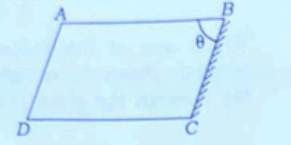
A glass slab of refractive index \(1\cdot5\) is cut in the shape of a parallelepiped \(ABCD\) as shown in the figure. Surface \(BC\) is polished to form a perfect reflector. Light is incident at surface \(AB\) from inside at an angle \(\pi/3\). Which one of the following is the correct angle \(ABC\) (\(\theta\)) such that the reflected light retraces its path?
The part of the human eye on which the image is formed is
- Bottom of a tank containing water appears to be raised. It is due to
Cornea in human eye
Important Questions from Reflection and Refraction
- If '\(c\)' is the velocity of light in free space, the time taken by light to travel a distance \(x\) in medium of refractive index \(\mu\) is given by
What is the average diameter of the eyeball of a human?
Myopia is a defect in human vision where an image of a
______ is a condition in which tissues in the body fail to receive an adequate supply of oxygen.
Which of the following statements is CORRECT about a black surface?



