
Colour vision in human eyes is the function of photoreceptor cells named
Cones
The correct answer is Cones.
Cones are retinal photoreceptors that work in bright light and provide colour vision and sharp (photopic) vision; three types respond to red, green and blue light.
Rods work in dim light and give black-and-white (scotopic) vision. The blind spot (optic disc) has no photoreceptors at all, and the fovea is a small pit packed with cones — a region of the retina, not a type of cell.
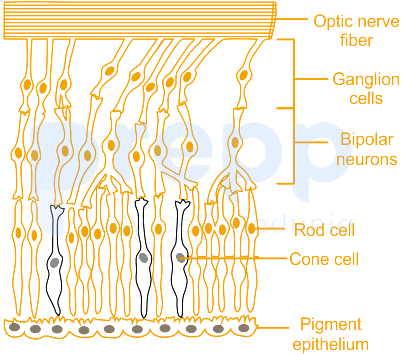
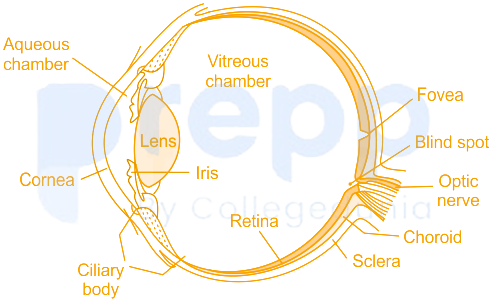
Short trick: Cones = Colour; Rods = dim light (night vision).
Similar Questions
Myopia is a defect in human vision where an image of a
Human eye can see objects at different distances with contrasting illuminations. This is due to
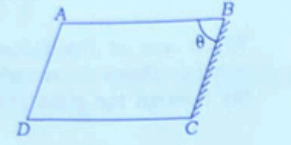
A glass slab of refractive index \(1\cdot5\) is cut in the shape of a parallelepiped \(ABCD\) as shown in the figure. Surface \(BC\) is polished to form a perfect reflector. Light is incident at surface \(AB\) from inside at an angle \(\pi/3\). Which one of the following is the correct angle \(ABC\) (\(\theta\)) such that the reflected light retraces its path?
- A periscope uses two plane mirrors inclined at \(45^\circ\). If the tube of the periscope is filled with a complete transparent liquid of refractive index \(1\cdot5\), then which one of the following is correct in respect of the image seen?
- Bottom of a tank containing water appears to be raised. It is due to
Statement I: Due to diffused or irregular reflection of light, a closed room gets light even if no direct sunlight falls inside the room.
Statement II: Irregular reflection, where the reflected rays are not parallel, does not follow the laws of reflection.Ramesh cannot see distinctly objects kept beyond 2 m. This defect can be corrected by using a lens of power
Light enters the eye through a thin membrane called
Cornea in human eye
The part of the human eye on which the image is formed is
Important Questions from Reflection and Refraction
Myopia is also known as ______.
Part of the eye which controls the light entering, is called as
Which defect of vision is corrected using cylindrical lenses in spectacles ?
Which of the following defects can be corrected by using a convex lens of appropriate power?
A person standing on the bank of a river observes a fish inside the water. He sees the fish_____.



