
Statement I: Due to diffused or irregular reflection of light, a closed room gets light even if no direct sunlight falls inside the room.
Statement I is true but Statement II is false
Understanding Light Reflection and Room Illumination
Let's analyze the two statements provided about the reflection of light and how it affects illumination inside a room.
Analysis of Statement I: Diffused Reflection and Room Lighting
Statement I says: "Due to diffused or irregular reflection of light, a closed room gets light even if no direct sunlight falls inside the room."
- What is Diffused or Irregular Reflection? When light strikes a rough surface, it reflects in many different directions. This is called diffused reflection or irregular reflection. Think about the surface of a wall or a piece of paper – they are rough on a microscopic level.
- How does it illuminate a room? Sunlight coming from outside hits various objects and surfaces like buildings, trees, the ground, and even clouds. These surfaces are often rough. The light undergoes diffused reflection from these surfaces, scattering in all directions. Some of this scattered light enters the room through windows or openings, even if direct sunlight isn't shining in. Inside the room, light hitting the walls, ceiling, floor, and furniture also undergoes diffused reflection, further spreading the light throughout the space.
- Conclusion for Statement I: This statement accurately describes how diffused reflection helps illuminate areas that are not in direct line of sight of a light source. Therefore, Statement I is true.
Analysis of Statement II: Laws of Reflection and Irregular Reflection
Statement II says: "Irregular reflection, where the reflected rays are not parallel, does not follow the laws of reflection."
- What are the Laws of Reflection? The fundamental laws of reflection state:
- The angle of incidence is equal to the angle of reflection ($\angle i = \angle r$).
- The incident ray, the reflected ray, and the normal to the surface at the point of incidence all lie in the same plane.
- Do Laws Apply to Irregular Reflection? Yes, the laws of reflection apply to every single ray of light reflecting from a surface, whether the surface is smooth or rough. In irregular reflection, the surface is rough, meaning the normal to the surface is different at different points. When parallel rays of light hit this rough surface, each ray obeys the laws of reflection at its specific point of incidence, reflecting at an angle equal to its angle of incidence *relative to the local normal* at that point. Because the normal changes from point to point on a rough surface, parallel incident rays reflect in different directions, resulting in scattered or diffused light. The individual rays still follow the laws.
- Conclusion for Statement II: This statement incorrectly claims that irregular reflection does not follow the laws of reflection. The laws of reflection are always followed by individual rays. Therefore, Statement II is false.
Conclusion on the Statements
Based on the analysis:
- Statement I is true.
- Statement II is false.
This matches the scenario where Statement I is true but Statement II is false.
| Statement | Content | Truthfulness |
|---|---|---|
| Statement I | Diffused reflection provides light in a room without direct sunlight. | True |
| Statement II | Irregular reflection does not follow the laws of reflection. | False |
Revision Table: Key Concepts in Light Reflection
| Feature | Regular Reflection | Irregular (Diffused) Reflection |
|---|---|---|
| Surface Type | Smooth, polished (e.g., mirror) | Rough, uneven (e.g., wall, paper) |
| Incident Parallel Rays | Remain parallel after reflection | Scatter in different directions after reflection |
| Image Formation | Forms clear, sharp images | Does not form clear images (surfaces appear visible) |
| Adherence to Laws of Reflection | Laws of reflection followed by all rays | Laws of reflection followed by each individual ray |
| Example | Image seen in a mirror | Seeing the page of a book, illumination of a room |
Additional Information: The Importance of Diffused Reflection
Diffused reflection is crucial for how we see most objects around us and for everyday illumination.
- Seeing Objects: We see non-luminous objects (like furniture, walls, books) because they reflect light that falls on them. Since most surfaces are rough, this is primarily diffused reflection. If all surfaces were perfectly smooth mirrors, we would only see reflections of light sources (like the sun or bulbs) and nothing else directly.
- Uniform Illumination: Diffused reflection helps spread light more evenly throughout a space, reducing harsh shadows compared to direct light or light reflected from smooth surfaces. This is why indirect lighting techniques often use diffused reflection from walls or ceilings.
- Laws are Universal: It's a key principle in physics that the laws governing a phenomenon (like reflection) are valid regardless of the specific conditions (like the smoothness of a surface) under which the phenomenon occurs. The apparent difference between regular and irregular reflection arises from the macroscopic nature of the surface, not from a change in the fundamental laws of reflection obeyed by individual light rays.
Similar Questions
Myopia is a defect in human vision where an image of a
Human eye can see objects at different distances with contrasting illuminations. This is due to
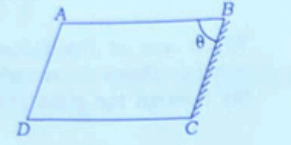
A glass slab of refractive index \(1\cdot5\) is cut in the shape of a parallelepiped \(ABCD\) as shown in the figure. Surface \(BC\) is polished to form a perfect reflector. Light is incident at surface \(AB\) from inside at an angle \(\pi/3\). Which one of the following is the correct angle \(ABC\) (\(\theta\)) such that the reflected light retraces its path?
- A periscope uses two plane mirrors inclined at \(45^\circ\). If the tube of the periscope is filled with a complete transparent liquid of refractive index \(1\cdot5\), then which one of the following is correct in respect of the image seen?
- Bottom of a tank containing water appears to be raised. It is due to
Ramesh cannot see distinctly objects kept beyond 2 m. This defect can be corrected by using a lens of power
Light enters the eye through a thin membrane called
Colour vision in human eyes is the function of photoreceptor cells named
Cornea in human eye
The part of the human eye on which the image is formed is
Important Questions from Reflection and Refraction
Myopia is also known as ______.
Part of the eye which controls the light entering, is called as
Which defect of vision is corrected using cylindrical lenses in spectacles ?
Which of the following defects can be corrected by using a convex lens of appropriate power?
A person standing on the bank of a river observes a fish inside the water. He sees the fish_____.



