
Light enters the eye through a thin membrane called
cornea
Understanding How Light Enters the Eye
The question asks about the thin membrane through which light first enters the eye. Understanding the path of light through the eye is key to answering this question correctly.
The Eye's Entry Point for Light
When light from the outside world reaches your eye, it has to pass through several structures to reach the light-sensitive cells. The very first part of the eye that light encounters is a transparent, thin outer layer.
- This outer layer acts like a window at the front of the eye.
- It is responsible for a significant amount of the eye's focusing power.
Let's look at the options provided:
| Part of the Eye | Function Related to Light | Is it the First Entry Point? |
|---|---|---|
| Retina | Contains photoreceptor cells (rods and cones) that detect light and convert it into electrical signals. Located at the back of the eye. | No, light must pass through other structures to reach the retina. |
| Cornea | A transparent outer layer at the front of the eye. Refracts (bends) light as it enters the eye. | Yes, this is the very first structure light passes through. |
| Pupil | The opening in the center of the iris that controls the amount of light entering the eye. It is not a membrane, but a space. | No, light passes through the cornea before reaching the pupil. The pupil is an aperture, not a membrane. |
| Iris | The colored part of the eye that controls the size of the pupil, regulating the amount of light. It is an muscular diaphragm, not the initial entry membrane. | No, light passes through the cornea before reaching the iris (and then passing through the pupil). |
Based on the analysis, the cornea is the transparent, thin membrane located at the very front of the eye through which light initially enters. It performs the crucial first step of bending light rays.
Conclusion on Light Entry into the Eye
The journey of light into the eye begins at the cornea. This initial interaction with the cornea is vital for clear vision, as it provides a significant portion of the eye's focusing power. Following the cornea, light passes through the pupil, lens, and finally reaches the retina.
Therefore, the thin membrane through which light enters the eye is the cornea.
Revision Table: Key Eye Structures and Light Path
| Eye Structure | Location | Primary Function (Light Path) |
|---|---|---|
| Cornea | Front of the eye, transparent outer layer | First structure light passes through; significant light refraction |
| Pupil | Center of the iris (an opening) | Controls amount of light entering |
| Lens | Behind the iris and pupil | Focuses light onto the retina |
| Retina | Back of the eye | Detects light (photoreceptors) and converts it to signals |
Additional Information on Eye Anatomy and Light
Understanding the different parts of the eye helps explain how we see. Each component plays a specific role in capturing and processing light:
- Cornea: As mentioned, this is the transparent outer layer. It has no blood vessels and gets its nutrients from tears and the aqueous humor. Its curvature is fixed.
- Aqueous Humor: A clear fluid filling the space between the cornea and the lens. It provides nutrients and maintains pressure.
- Iris: The colored part that functions like the diaphragm of a camera, controlling the size of the pupil.
- Pupil: The adjustable opening in the iris that allows light to pass through to the lens. It appears black because light entering it is absorbed by the tissues inside the eye.
- Lens: A transparent structure behind the iris and pupil. It changes shape (accommodation) to fine-tune the focus of light onto the retina.
- Vitreous Humor: A gel-like substance filling the large space behind the lens. It helps maintain the eye's shape.
- Retina: The light-sensitive tissue lining the back of the eye. Contains rods (for low light vision) and cones (for color vision).
- Optic Nerve: Transmits the electrical signals generated by the retina to the brain for interpretation.
The intricate design of the eye allows for the complex process of vision to occur, starting with light entering through the cornea.
Similar Questions
Myopia is a defect in human vision where an image of a
Human eye can see objects at different distances with contrasting illuminations. This is due to
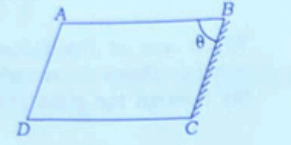
A glass slab of refractive index \(1\cdot5\) is cut in the shape of a parallelepiped \(ABCD\) as shown in the figure. Surface \(BC\) is polished to form a perfect reflector. Light is incident at surface \(AB\) from inside at an angle \(\pi/3\). Which one of the following is the correct angle \(ABC\) (\(\theta\)) such that the reflected light retraces its path?
- A periscope uses two plane mirrors inclined at \(45^\circ\). If the tube of the periscope is filled with a complete transparent liquid of refractive index \(1\cdot5\), then which one of the following is correct in respect of the image seen?
- Bottom of a tank containing water appears to be raised. It is due to
Statement I: Due to diffused or irregular reflection of light, a closed room gets light even if no direct sunlight falls inside the room.
Statement II: Irregular reflection, where the reflected rays are not parallel, does not follow the laws of reflection.Ramesh cannot see distinctly objects kept beyond 2 m. This defect can be corrected by using a lens of power
Colour vision in human eyes is the function of photoreceptor cells named
Cornea in human eye
The part of the human eye on which the image is formed is
Important Questions from Reflection and Refraction
Myopia is also known as ______.
Part of the eye which controls the light entering, is called as
Which defect of vision is corrected using cylindrical lenses in spectacles ?
Which of the following defects can be corrected by using a convex lens of appropriate power?
A person standing on the bank of a river observes a fish inside the water. He sees the fish_____.



