
Myopia is a defect in human vision where an image of a
distant object is focused before the retina.
Understanding Myopia: The Vision Defect
Myopia, commonly known as nearsightedness, is a refractive error of the eye. It's a condition where light from distant objects focuses in front of the retina instead of directly on it.
How Myopia Affects Vision
In a healthy eye, light rays from objects are refracted by the cornea and the lens, converging precisely on the retina, where the image is formed. The retina then sends signals to the brain, allowing us to see clearly.
However, in a myopic eye, the light rays from distant objects converge too strongly. This can happen because:
- The eyeball is too long from front to back.
- The cornea or the lens has too much refractive power.
Because the light converges early, the image of a distant object is formed before the retina. By the time the light rays reach the retina, they have already crossed and started to diverge, resulting in a blurred image of distant objects.
For nearby objects, the light rays are more divergent when they enter the eye. A myopic eye can often focus these divergent rays correctly on the retina, which is why near vision is usually clear for people with myopia.
Analyzing the Options
Let's evaluate the given options based on our understanding of Myopia:
| Option | Description | Analysis |
|---|---|---|
| 1 | A nearby object is focused beyond the retina. | Incorrect. Myopia primarily affects distant vision, and focusing beyond the retina describes hyperopia (farsightedness). |
| 2 | A nearby object is focused before the retina. | Incorrect. Myopia primarily affects distant vision, and while near vision is clearer, this option describes a scenario that doesn't define myopia itself. |
| 3 | A distant object is focused before the retina. | Correct. This accurately describes how light from distant objects is focused in a myopic eye, leading to blurred vision for far-away things. |
| 4 | A distant object is focused beyond the retina. | Incorrect. Focusing beyond the retina describes hyperopia (farsightedness), not myopia. |
Therefore, the correct description of Myopia concerning image focusing is that a distant object is focused before the retina.
Correction of Myopia
Myopia can be corrected using concave (diverging) lenses in eyeglasses or contact lenses. These lenses help to slightly diverge the incoming light rays before they enter the eye, effectively shifting the focal point back onto the retina.
Revision Table: Vision Defects Summary
| Defect | Common Name | Issue with Distant Objects | Issue with Nearby Objects | Image Focus | Correction |
|---|---|---|---|---|---|
| Myopia | Nearsightedness | Blurred | Clear | Before the retina (for distant objects) | Concave Lens |
| Hyperopia | Farsightedness | Usually Clear (can be blurry with age/severity) | Blurred | Beyond the retina (for nearby objects) | Convex Lens |
| Presbyopia | Age-related Farsightedness | Usually Clear | Blurred (difficulty focusing up close) | Beyond the retina (for nearby objects, due to lens stiffness) | Convex Lens (often bifocals/progressives) |
| Astigmatism | Distorted Vision | Blurred/Distorted at all distances | Blurred/Distorted at all distances | Multiple focal points (due to irregular cornea shape) | Cylindrical Lens |
Additional Information on Eye Refraction
Refraction is the bending of light as it passes through different mediums. In the eye, light is refracted primarily by the cornea and the lens. These structures work together to focus light precisely on the retina.
Emmetropia is the term for normal vision, where light is correctly focused on the retina without the need for corrective lenses. Refractive errors like myopia, hyperopia, and astigmatism occur when the eye's shape or the refractive power of the cornea/lens prevents light from focusing properly on the retina.
Understanding these refractive errors is crucial for diagnosing and correcting vision problems.
Similar Questions
Human eye can see objects at different distances with contrasting illuminations. This is due to
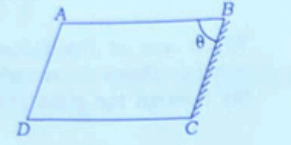
A glass slab of refractive index \(1\cdot5\) is cut in the shape of a parallelepiped \(ABCD\) as shown in the figure. Surface \(BC\) is polished to form a perfect reflector. Light is incident at surface \(AB\) from inside at an angle \(\pi/3\). Which one of the following is the correct angle \(ABC\) (\(\theta\)) such that the reflected light retraces its path?
- A periscope uses two plane mirrors inclined at \(45^\circ\). If the tube of the periscope is filled with a complete transparent liquid of refractive index \(1\cdot5\), then which one of the following is correct in respect of the image seen?
- Bottom of a tank containing water appears to be raised. It is due to
Statement I: Due to diffused or irregular reflection of light, a closed room gets light even if no direct sunlight falls inside the room.
Statement II: Irregular reflection, where the reflected rays are not parallel, does not follow the laws of reflection.Ramesh cannot see distinctly objects kept beyond 2 m. This defect can be corrected by using a lens of power
Light enters the eye through a thin membrane called
Colour vision in human eyes is the function of photoreceptor cells named
Cornea in human eye
The part of the human eye on which the image is formed is
Important Questions from Reflection and Refraction
Myopia is also known as ______.
Part of the eye which controls the light entering, is called as
Which defect of vision is corrected using cylindrical lenses in spectacles ?
Which of the following defects can be corrected by using a convex lens of appropriate power?
A person standing on the bank of a river observes a fish inside the water. He sees the fish_____.



