
Which one of the following laws is enacted by the Central Government and enforced by the State Governments?
Factories Act, 1948
The question asks which of the four labour laws is enacted by the Centre but enforced by the States, so the key is to separate central administration from state administration.
The Factories Act, 1948 is a central enactment, yet the Act itself hands its day-to-day administration and enforcement to the State Governments: the states appoint the Chief Inspector and factory inspectors, grant registration and licences to factories, and frame rules on many working-condition matters within the framework of the central Act.
By contrast, the Employees' State Insurance Act, 1948 and the Employees' Provident Fund and Miscellaneous Provisions Act, 1952 are run by central statutory bodies - the ESIC and the EPFO - and the Mines Act, 1952 is enforced centrally by the Directorate General of Mines Safety, because mine safety is kept under central control.
So among the four, only the Factories Act is centrally enacted yet state-enforced.
Hence the answer is the Factories Act, 1948.
Similar Questions
Under which method of performance appraisal many evaluators join together to judge employee’s performance in several situations with the use of a variety of criteria ?
Which one of the following is not a form of Government intervention in industrial relations ?
According to ‘The Hot Stove Rule’ propounded by Douglas McGregor, a sound disciplinary system in an organisation does not includes :
What is not required for termination of employees under the Industrial Disputes Act, 1947 ?
The disillusionment that occurs when high job expectations confront the reality of a boring, unchallenging job. This may rightly be attributed to which one of the following?
In case of a domestic enquiry, which one of the following is not correct about enquiry officer?
Read the passage carefully and answer the Question that follow:
Organizational culture refers to qualities of the workplace itself that influence its employees, whereas Organizational behavior refers to the resulting behavior of the people within it. Organizational culture includes factors such as core values, the company’s mission statement and expectations of the employees. It defines the identity and how it wants to be perceived.
For the instance, if a company has a mission statement focused on providing the highest quality of customer service, then the core values may be centered around communication, professionalism and customer satisfaction. This will shape the employees expectations, such as expecting them to be willing and courteous to go the extra mile to serve the customer.
Organizational behavior is the resulting behavior of the people within the organization based on the culture they’re immersed in. if the company culture is one that promotes customer service, then the employees are likely to display behavior such as friendliness and helpfulness when dealing with customers.
The opposite may be true if the company’s culture revolves around a competitive environment and employees are expected to go above and beyond to be the most successful. In this case, employees may display behavior such as aggressiveness and competitiveness in order to achieve the highest results.
Organizational culture works as the foundation for the employee’s behavioral exhibit, and the two are closely intertwined. If a company wishes to create a positive working environment, it is essential to establish an organizational culture that promotes a healthy behavioral environment among its employees.
Arrange the Five Stages of Conflict Process in proper sequence from beginning to end
A. Potential opposition or incompatibility
B. Intentions
C. Cognition and personalisation
D. Outcomes
E. Behaviour
Choose the correct answer from the options given below:
Arrange the Model of Organisation Development Process of H.M.F Rush in proper sequence from beginning to end.
A. Problem Recognition
B. Organization diagnosis
C. Feed back for change strategy
D. Interventions
E. Measurement and Evaluation
Choose the correct answer from the options given below:
Match the List-I with List-II
LIST I
ConflictLIST II
Appropriate viewA. The Traditional view I. The belief that conflict is a natural and inevitable outcome in any group B. The Human Relations view II. The belief that all conflict is harmful and must be avoided C. The Interactionist View III. Conflict that supports the goals of the group and improves its performance D. Functional conflict IV. The belief that conflict is not a positive force in a group but that it is absolutely necessary for a group to perform effectively Choose the correct answer from the options given below:
Important Questions from Miscellaneous
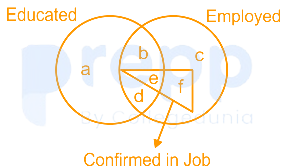
Read the given figure and find the region representing persons who are educated and employed but not confirmed in job.
The magazine in which Mahatma Gandhi mentioned what he wanted the Constitution to do is:
Which gas shields the surface of the earth from ultraviolet radiation from the sun?
Which event is marked as an Intangible Cultural Heritage of Humanity by UNESCO?
Who has been conferred with the rank of the Commander of the Order of the British Empire in 2018?



