
Statement-I : Oxidation of p-nitrotoluene with acidic $KMnO_4$ gives an acid that is stronger than benzoic acid.
Statement-II : Reduction of p-nitrotoluene with Sn/HCl followed by neutralization gives an amine that is more basic than aniline.
In light of the above statements, choose the most appropriate answer from the options given below.
This question requires evaluating two statements concerning the chemical reactivity of p-nitrotoluene.
Statement I: Oxidation Product Acidity
Statement-I discusses the oxidation of p-nitrotoluene using acidic potassium permanganate ($KMnO_4$).
- The starting material is p-nitrotoluene, which has the structure $CH_3C_6H_4NO_2$.
- Oxidation with a strong oxidizing agent like acidic $KMnO_4$ converts the methyl group ($-CH_3$) attached to the benzene ring into a carboxylic acid group ($-COOH$). The nitro group ($NO_2$) remains unchanged.
- The resulting product is p-nitrobenzoic acid ($NO_2C_6H_4COOH$).
- Acidity of benzoic acid derivatives is influenced by substituents. Electron-withdrawing groups increase acidity, while electron-donating groups decrease it.
- The nitro group ($-NO_2$) is a strong electron-withdrawing group.
- Compared to benzoic acid ($C_6H_5COOH$), p-nitrobenzoic acid has a strongly electron-withdrawing $-NO_2$ group, which stabilizes the carboxylate anion more effectively.
- Therefore, p-nitrobenzoic acid is a stronger acid than benzoic acid.
- Conclusion: Statement-I is correct.
Statement II: Reduction Product Basicity
Statement-II concerns the reduction of p-nitrotoluene using tin (Sn) and hydrochloric acid (HCl), followed by neutralization.
- The reaction involves the reduction of the nitro group ($-NO_2$) in p-nitrotoluene ($CH_3C_6H_4NO_2$) to an amino group ($-NH_2$).
- The reagents $Sn/HCl$ are standard for reducing nitro groups to amines. The subsequent neutralization step yields the free amine.
- The product formed is p-toluidine ($CH_3C_6H_4NH_2$).
- The basicity of anilines is affected by substituents on the benzene ring. Electron-donating groups enhance basicity by increasing electron density on the nitrogen atom.
- The methyl group ($-CH_3$) in p-toluidine is an electron-donating group (via hyperconjugation and inductive effect).
- Aniline ($C_6H_5NH_2$) serves as the reference base.
- Because the $-CH_3$ group donates electron density to the ring and the amino group, the lone pair on the nitrogen in p-toluidine is more available for protonation than in aniline.
- Therefore, p-toluidine is more basic than aniline.
- Conclusion: Statement-II is correct.
Final Answer Determination
Since both Statement-I and Statement-II have been determined to be correct, the most appropriate option is the one stating that both statements are correct.
Final Answer: The final answer is $\boxed{D}$
Similar Questions
Select the reagents that reduce nitriles to primary amines :
A. (i) $LiAlH_4$ ; (ii) $H_2O$
B. $Sn + HCl$
C. $H_2 / Ni$
D. $Na(Hg) / C_2H_5OH$
E. $Br_2 / \text{aq. } NaOH$
Choose the correct answer from the options given below :The major product Z formed in the following sequence of reactions is :
$$C_2H_6 \xrightarrow{Cl_2, \text{UV light}} X \text{ (monochlorinated product)} \xrightarrow{NH_3} Y \xrightarrow{(i) NaNO_2, HCl, (ii) H_2O} Z$$- The pair of molecules that are metamers among the following is :
- Compound P ($C_8H_8O$) gives a red orange precipitate with 2,4-DNP reagent and it does not reduce Fehling's reagent. On drastic oxidation with chromic acid, P gives an aromatic product Q that produces effervescence on treating with aq. $NaHCO_3$. Compounds P and Q, respectively, are :
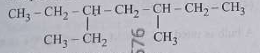
The correct IUPAC name of the following compound is :
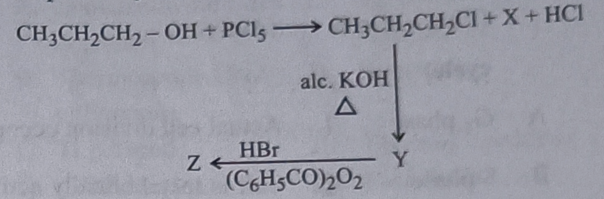
In the following reaction sequence, X and Z respectively are :
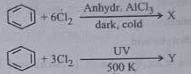
The number of chlorine atoms present in the organic products X and Y of the following reactions, respectively, are :
Two products X and Y are formed in the following reaction sequence.

The suitable method that can be used for the separation of products X and Y is :List I (Reactions) List II (Reagents) A. 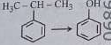
I. (i) oleum, (ii) $NaOH, \Delta$, (iii) $H^+$ B. $CH_3COOH \rightarrow CH_3CH_2OH$ II. (i) $O_3$, (ii) $H_2O/H^+$ C. $CH_3CH_2CH_2OH \rightarrow $ 
III. (i) $CH_3OH, H^+$, (ii) $H_2$, catalyst D. 
IV. (i) conc. $H_2SO_4, \Delta$, (ii) $H_2O$ Match List I with List II.
The following two reactions give the same foul smelling product Z.
$$C_2H_5Cl \xrightarrow{X} Z$$

X and Z, respectively, are :
Important Questions from Organic Chemistry
- In Dumas method for estimation of nitrogen, 0.50 g of an organic compound gave 70 mL of nitrogen collected at 300 K and 715 mm pressure. The percentage of nitrogen in the organic compound is ______ %.
(Aqueous tension at 300 K is 15 mm). Given below are two statements:
Statement I: The dipole moment of R-CN is greater than R-NC and R-NC can undergo hydrolysis under acidic medium to produce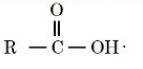
Statement II: R-CN hydrolyses under acidic medium to produce a compound which on treatment with $\text{SOCl}_2$, followed by the addition of $\text{NH}_3$ gives another compound(x). This compound (x) on treatment with $\text{NaOCl/NaOH}$ gives a product, that on treatment with $\text{CHCl}_3\text{/KOH/}\Delta$ produces R-NC
In the light of the above statements, choose the correct answer from the options given below- Given below are two statements:
Statement I: Cross aldol condensation between two different aldehydes will always produce four different products.
Statement II: When semicarbazide reacts with a mixture of benzaldehyde and acetophenone under optimum pH, it forms a condensation product with acetophenone only.
In the light of the above statements, choose the correct answer from the options given below - $0.25 \text{ g}$ of an organic compound "A" containing carbon, hydrogen and oxygen was analysed using the combustion method. There was an increase in mass of $\text{CaCl}_2$ tube and potash tube at the end of the experiment. The amount was found to be $0.15 \text{ g}$ and $0.1837 \text{ g}$, respectively. The percentage of oxygen in compound A is ______ %. (Nearest integer)
(Given: molar mass in $\text{g mol}^{-1}$ $\text{H} : 1, \text{C} : 12, \text{O} : 16$) - Grignard reagent $\text{RMgBr (P)}$ reacts with water and forms a gas $\text{(Q)}$. One gram of Q occupies $1.4 \text{ dm}^3$ at STP. (P) on reaction with dry ice in dry ether followed by $\text{H}_3\text{O}^+$ forms a compound $\text{(Z)}$. 0.1 mole of $\text{(Z)}$ will weigh _________ g. (Nearest integer)


