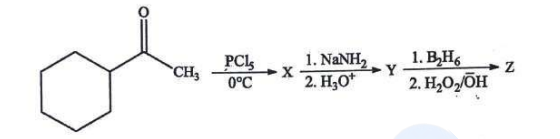
The question asks for the number of optical isomers formed from the substitution products of all structural isomers of $\text{C}_5\text{H}_{11}\text{Br}$ treated with $\text{KOH(aq)}$.
Step 1: Identify Structural Isomers of $\text{C}_5\text{H}_{11}\text{Br}$
There are 8 structural isomers for the molecular formula $\text{C}_5\text{H}_{11}\text{Br}$. These are:
- 1-Bromopentane
- 2-Bromopentane
- 3-Bromopentane
- 1-Bromo-2-methylbutane
- 2-Bromo-2-methylbutane
- 1-Bromo-3-methylbutane
- 2-Bromo-3-methylbutane
- 1-Bromo-2,2-dimethylpropane
Step 2: Determine Substitution Products and Chirality
Treatment with aqueous $\text{KOH}$ replaces the bromine atom with a hydroxyl ($\text{OH}$) group, forming the corresponding alcohol. We need to check if these alcohol products exhibit optical isomerism, which requires the presence of a chiral center (a carbon atom bonded to four different groups).
| Isomer Name | Substitution Product (Alcohol) | Chiral Center Analysis | Optical Activity |
|---|---|---|---|
| 1-Bromopentane | 1-Pentanol | C1 has 2 H atoms. Not chiral. | No |
| 2-Bromopentane | 2-Pentanol | C2 is bonded to H, OH, $\text{CH}_3$, $\text{CH}_2\text{CH}_2\text{CH}_3$. Chiral. | Yes |
| 3-Bromopentane | 3-Pentanol | C3 has 2 $\text{CH}_2\text{CH}_3$ groups. Not chiral. | No |
| 1-Bromo-2-methylbutane | 2-Methyl-1-butanol | C2 is bonded to H, $\text{CH}_3$, $\text{CH}_2\text{OH}$, $\text{CH}_2\text{CH}_3$. Chiral. | Yes |
| 2-Bromo-2-methylbutane | 2-Methyl-2-butanol | C2 is bonded to 3 methyl/ethyl groups and OH. Not chiral. | No |
| 1-Bromo-3-methylbutane | 3-Methyl-1-butanol | C3 is bonded to H, $\text{CH}_3$, $\text{CH}_3$, $\text{CH}_2\text{CH}_2\text{OH}$. Achiral (Incorrect analysis of structure leads to confusion; correct analysis shows C3 is attached to H, $\text{CH}_3$, $\text{CH}_3$ and $\text{CH}_2\text{CH}_2\text{OH}$, implying 5 bonds, which is impossible. The actual structure $\text{HOCH}_2\text{CH}_2\text{CH}(\text{CH}_3)\text{CH}_3$ has C3 bonded to H, $\text{CH}_3$, $\text{CH}_3$, $\text{CH}_2\text{CH}_2\text{OH}$, which is wrong. Correctly, C3 is bonded to H, $\text{CH}_3$, the terminal $\text{CH}_3$, and $\text{CH}_2\text{CH}_2\text{OH}$. Let's re-verify: The structure $\text{CH}_3-\text{CH}(\text{CH}_3)-\text{CH}_2-\text{CH}_2\text{OH}$ does not have a chiral center at C3). Not chiral. | No |
| 2-Bromo-3-methylbutane | 3-Methyl-2-butanol | C2 is bonded to H, OH, $\text{CH}_3$, $\text{CH}(\text{CH}_3)_2$. Chiral. | Yes |
| 1-Bromo-2,2-dimethylpropane | 2,2-Dimethyl-1-propanol | C1 has 2 H atoms. Not chiral. | No |
Note on 3-Methyl-1-butanol chirality: The structure is $\text{HOCH}_2\text{CH}_2\text{CH}(\text{CH}_3)\text{CH}_3$. The carbon atom C3 is bonded to a hydrogen, a methyl group ($\text{CH}_3$), the terminal methyl group ($\text{CH}_3$), and the $\text{CH}_2\text{CH}_2\text{OH}$ group. Since C3 is bonded to two identical methyl groups, it is not chiral.
Step 3: Count Optically Active Products
From the analysis above, there are 3 substitution products that exhibit optical isomerism:
- 2-Pentanol
- 2-Methyl-1-butanol
- 3-Methyl-2-butanol
Therefore, the number of products exhibiting optical isomerism is 3.
Similar Questions
- In Dumas method for estimation of nitrogen, 0.50 g of an organic compound gave 70 mL of nitrogen collected at 300 K and 715 mm pressure. The percentage of nitrogen in the organic compound is ______ %.
(Aqueous tension at 300 K is 15 mm). - $0.25 \text{ g}$ of an organic compound "A" containing carbon, hydrogen and oxygen was analysed using the combustion method. There was an increase in mass of $\text{CaCl}_2$ tube and potash tube at the end of the experiment. The amount was found to be $0.15 \text{ g}$ and $0.1837 \text{ g}$, respectively. The percentage of oxygen in compound A is ______ %. (Nearest integer)
(Given: molar mass in $\text{g mol}^{-1}$ $\text{H} : 1, \text{C} : 12, \text{O} : 16$) - Grignard reagent $\text{RMgBr (P)}$ reacts with water and forms a gas $\text{(Q)}$. One gram of Q occupies $1.4 \text{ dm}^3$ at STP. (P) on reaction with dry ice in dry ether followed by $\text{H}_3\text{O}^+$ forms a compound $\text{(Z)}$. 0.1 mole of $\text{(Z)}$ will weigh _________ g. (Nearest integer)
Consider the following reactions sequence
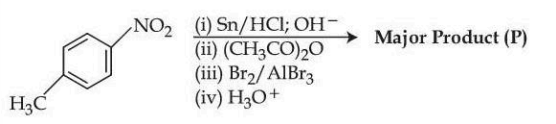
When the product (P) is subjected to Carius analysis using $\text{AgNO}_3$, $1.0\text{ g}$ of the product (P) will produce __________ g of the precipitate of AgBr. (Nearest Integer)
(Given : molar mass in $\text{g mol}^{-1}$ C : 12, H : 1, O : 16, N : 14, Br : 80, Ag : 108)Consider the following sequence of reactions to give the major product (X)
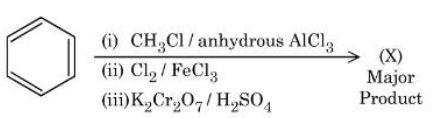
$\text{P}~\text{g}$ of the major product (X) formed is reacted with $\text{NaHCO}_3$ solution to liberate a gas which occupied $11.2~\text{dm}^3$ at STP.
$\text{P} = \_\_\_\_\_\_\_\_~\text{g}$.
(Given molar mass in $\text{g~mol}^{-1}$ $\text{H}: 1, \text{C}: 12, \text{O}: 16, \text{Cl}: 35.5$)- 2.0 g of a bromo hydrocarbon (X) was subjected to Carius analysis, gave 3.36 g of AgBr. The percentage of carbon in the compound (X) is 26.7%. Total number of carbon atoms in the empirical formula for compound (X) is _______.
(Given molar mass in $\text{g~mol}^{-1}$ $\text{H}: 1, \text{C}: 12, \text{Br} : 80, \text{Ag} : 108$) - The number of isomeric compounds (structural isomers only) possible with the molecular formula $C_5H_{10}O_2$, which do not react with metallic sodium is ________
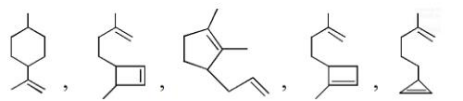
Among the following, how many hydrocarbon (s) with formula $C_{10}H_{16}$ which on reaction with acidic potassium permagenate yield(s) same product? ____________
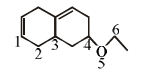
On treatment of the following compound with a strong acid, the most susceptible site for bond cleavage is :-
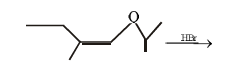
The total number of optically active compounds formed in the following reaction is :-
Important Questions from Organic Chemistry
- In Dumas method for estimation of nitrogen, 0.50 g of an organic compound gave 70 mL of nitrogen collected at 300 K and 715 mm pressure. The percentage of nitrogen in the organic compound is ______ %.
(Aqueous tension at 300 K is 15 mm). - $0.25 \text{ g}$ of an organic compound "A" containing carbon, hydrogen and oxygen was analysed using the combustion method. There was an increase in mass of $\text{CaCl}_2$ tube and potash tube at the end of the experiment. The amount was found to be $0.15 \text{ g}$ and $0.1837 \text{ g}$, respectively. The percentage of oxygen in compound A is ______ %. (Nearest integer)
(Given: molar mass in $\text{g mol}^{-1}$ $\text{H} : 1, \text{C} : 12, \text{O} : 16$) - Grignard reagent $\text{RMgBr (P)}$ reacts with water and forms a gas $\text{(Q)}$. One gram of Q occupies $1.4 \text{ dm}^3$ at STP. (P) on reaction with dry ice in dry ether followed by $\text{H}_3\text{O}^+$ forms a compound $\text{(Z)}$. 0.1 mole of $\text{(Z)}$ will weigh _________ g. (Nearest integer)
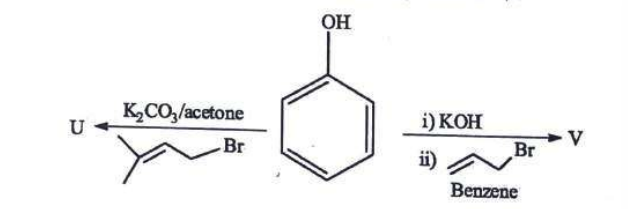
The major products U and V in the following reaction are
In the following sequence of reactions, what is the end product 'Z'?