Among the following, how many hydrocarbon (s) with formula $C_{10}H_{16}$ which on reaction with acidic potassium permagenate yield(s) same product? ____________ 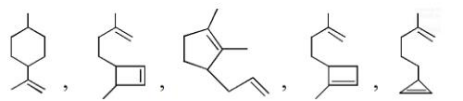
To find the number of hydrocarbons that yield the same product upon reaction with acidic potassium permanganate, follow these steps:
1. Understand the chemical reaction:
Reaction with acidic potassium permanganate ($KMnO_4/H^+$) leads to the oxidative cleavage of carbon-carbon double bonds ($C=C$). In this process:
- Terminal alkenes ($=CH_2$) are oxidized to $CO_2$ and water.
- Internal alkenes with one hydrogen ($=CH-$) are oxidized to carboxylic acids ($-COOH$).
- Internal alkenes with no hydrogens ($=C<$) are oxidized to ketones ($>C=O$).
Cyclic alkenes undergo ring-opening to form dicarbonyl compounds (keto-acids or diacids).
2. Analyze the given structures:
We are looking for structures that, after the cleavage of all their double bonds, result in the same carbon skeleton and functional group arrangement. Focus on the two cyclobutene derivatives (the 2nd and 4th structures from the left):
- Structure 2: Has a methyl group at position 1 of the cyclobutene ring and a side chain at position 3. Upon cleavage of the ring double bond, C1 becomes a methyl ketone ($CH_3-CO-$) and C2 becomes a carboxylic acid ($-COOH$).
- Structure 4: Has a methyl group at position 2 of the cyclobutene ring and the same side chain at position 4. Upon cleavage, C2 becomes a methyl ketone ($CH_3-CO-$) and C1 becomes a carboxylic acid ($-COOH$).
3. Identify the identical product:
Because of the connectivity of the 4-membered ring, opening the ring in Structure 2 (between C1 and C2) and Structure 4 (between C1 and C2) results in an identical acyclic chain. In both cases, the side chain (which also contains a double bond that gets oxidized to a ketone) is positioned such that the resulting molecule is the same keto-diacid.
4. Conclusion:
Structures 2 and 4 are the only ones in the set that produce the exact same organic product after complete oxidation.
The number of hydrocarbons that yield the same product is 2.
Similar Questions
- In Dumas method for estimation of nitrogen, 0.50 g of an organic compound gave 70 mL of nitrogen collected at 300 K and 715 mm pressure. The percentage of nitrogen in the organic compound is ______ %.
(Aqueous tension at 300 K is 15 mm). - $0.25 \text{ g}$ of an organic compound "A" containing carbon, hydrogen and oxygen was analysed using the combustion method. There was an increase in mass of $\text{CaCl}_2$ tube and potash tube at the end of the experiment. The amount was found to be $0.15 \text{ g}$ and $0.1837 \text{ g}$, respectively. The percentage of oxygen in compound A is ______ %. (Nearest integer)
(Given: molar mass in $\text{g mol}^{-1}$ $\text{H} : 1, \text{C} : 12, \text{O} : 16$) - Grignard reagent $\text{RMgBr (P)}$ reacts with water and forms a gas $\text{(Q)}$. One gram of Q occupies $1.4 \text{ dm}^3$ at STP. (P) on reaction with dry ice in dry ether followed by $\text{H}_3\text{O}^+$ forms a compound $\text{(Z)}$. 0.1 mole of $\text{(Z)}$ will weigh _________ g. (Nearest integer)
- Consider all the structural isomers with molecular formula $\text{C}_5\text{H}_{11}\text{Br}$ are separately treated with $\text{KOH(aq)}$ to give respective substitution products, without any rearrangement. The number of products which can exhibit optical isomerism from these is ___________.
Consider the following reactions sequence
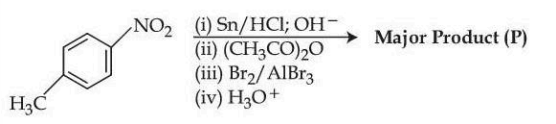
When the product (P) is subjected to Carius analysis using $\text{AgNO}_3$, $1.0\text{ g}$ of the product (P) will produce __________ g of the precipitate of AgBr. (Nearest Integer)
(Given : molar mass in $\text{g mol}^{-1}$ C : 12, H : 1, O : 16, N : 14, Br : 80, Ag : 108)Consider the following sequence of reactions to give the major product (X)
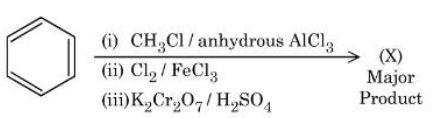
$\text{P}~\text{g}$ of the major product (X) formed is reacted with $\text{NaHCO}_3$ solution to liberate a gas which occupied $11.2~\text{dm}^3$ at STP.
$\text{P} = \_\_\_\_\_\_\_\_~\text{g}$.
(Given molar mass in $\text{g~mol}^{-1}$ $\text{H}: 1, \text{C}: 12, \text{O}: 16, \text{Cl}: 35.5$)- 2.0 g of a bromo hydrocarbon (X) was subjected to Carius analysis, gave 3.36 g of AgBr. The percentage of carbon in the compound (X) is 26.7%. Total number of carbon atoms in the empirical formula for compound (X) is _______.
(Given molar mass in $\text{g~mol}^{-1}$ $\text{H}: 1, \text{C}: 12, \text{Br} : 80, \text{Ag} : 108$) - The number of isomeric compounds (structural isomers only) possible with the molecular formula $C_5H_{10}O_2$, which do not react with metallic sodium is ________
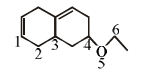
On treatment of the following compound with a strong acid, the most susceptible site for bond cleavage is :-
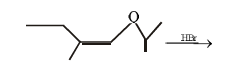
The total number of optically active compounds formed in the following reaction is :-
Important Questions from Organic Chemistry
- In Dumas method for estimation of nitrogen, 0.50 g of an organic compound gave 70 mL of nitrogen collected at 300 K and 715 mm pressure. The percentage of nitrogen in the organic compound is ______ %.
(Aqueous tension at 300 K is 15 mm). - $0.25 \text{ g}$ of an organic compound "A" containing carbon, hydrogen and oxygen was analysed using the combustion method. There was an increase in mass of $\text{CaCl}_2$ tube and potash tube at the end of the experiment. The amount was found to be $0.15 \text{ g}$ and $0.1837 \text{ g}$, respectively. The percentage of oxygen in compound A is ______ %. (Nearest integer)
(Given: molar mass in $\text{g mol}^{-1}$ $\text{H} : 1, \text{C} : 12, \text{O} : 16$) - Grignard reagent $\text{RMgBr (P)}$ reacts with water and forms a gas $\text{(Q)}$. One gram of Q occupies $1.4 \text{ dm}^3$ at STP. (P) on reaction with dry ice in dry ether followed by $\text{H}_3\text{O}^+$ forms a compound $\text{(Z)}$. 0.1 mole of $\text{(Z)}$ will weigh _________ g. (Nearest integer)
- Consider all the structural isomers with molecular formula $\text{C}_5\text{H}_{11}\text{Br}$ are separately treated with $\text{KOH(aq)}$ to give respective substitution products, without any rearrangement. The number of products which can exhibit optical isomerism from these is ___________.
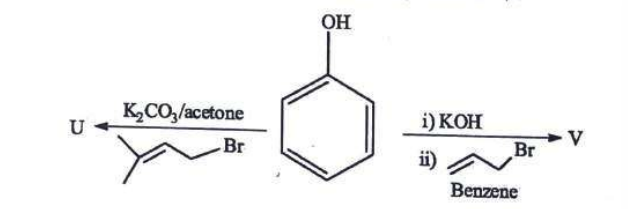
The major products U and V in the following reaction are