
(Given: molar mass in $\text{g mol}^{-1}$ $\text{H} : 1, \text{C} : 12, \text{O} : 16$)
Combustion Analysis: Determining Oxygen Percentage
This solution explains how to find the percentage of oxygen in an organic compound using data from combustion analysis.
Step 1: Calculate Mass of Hydrogen (H)
The increase in the mass of the $\text{CaCl}_2$ tube corresponds to the mass of water ($\text{H}_2\text{O}$) produced.
- Mass of $\text{H}_2\text{O}$ = $0.15 \text{ g}$
- Molar mass of $\text{H}_2\text{O}$ = $(2 \times 1) + 16 = 18 \text{ g mol}^{-1}$
- The mass fraction of H in $\text{H}_2\text{O}$ is $\frac{2 \times 1}{18} = \frac{2}{18}$.
- Mass of H = $\left( \frac{\text{Mass of H}}{\text{Molar mass of } \text{H}_2\text{O}} \right) \times \text{Mass of } \text{H}_2\text{O}$
- Mass of H = $\frac{2}{18} \times 0.15 \text{ g} = \frac{1}{9} \times 0.15 \text{ g} \approx 0.01667 \text{ g}$
Step 2: Calculate Mass of Carbon (C)
The increase in the mass of the potash tube corresponds to the mass of carbon dioxide ($\text{CO}_2$) produced.
- Mass of $\text{CO}_2$ = $0.1837 \text{ g}$
- Molar mass of $\text{CO}_2$ = $12 + (2 \times 16) = 44 \text{ g mol}^{-1}$
- The mass fraction of C in $\text{CO}_2$ is $\frac{12}{44}$.
- Mass of C = $\left( \frac{\text{Mass of C}}{\text{Molar mass of } \text{CO}_2} \right) \times \text{Mass of } \text{CO}_2$
- Mass of C = $\frac{12}{44} \times 0.1837 \text{ g} = \frac{3}{11} \times 0.1837 \text{ g} \approx 0.05009 \text{ g}$
Step 3: Calculate Mass of Oxygen (O)
The organic compound contains Carbon, Hydrogen, and Oxygen. The mass of Oxygen is the difference between the total mass of the compound and the masses of Carbon and Hydrogen.
- Mass of compound "A" = $0.25 \text{ g}$
- Mass of O = Mass of compound - Mass of C - Mass of H
- Mass of O = $0.25 \text{ g} - 0.05009 \text{ g} - 0.01667 \text{ g}$
- Mass of O $\approx 0.18324 \text{ g}$
Step 4: Calculate Percentage of Oxygen
The percentage of oxygen is calculated by dividing the mass of oxygen by the total mass of the compound and multiplying by 100.
- Percentage of O = $\left( \frac{\text{Mass of O}}{\text{Mass of compound}} \right) \times 100\%$
- Percentage of O = $\left( \frac{0.18324 \text{ g}}{0.25 \text{ g}} \right) \times 100\%$
- Percentage of O $\approx 0.73296 \times 100\% \approx 73.30\%$
Rounding to the nearest integer, the percentage of oxygen is 73%.
Similar Questions
- In Dumas method for estimation of nitrogen, 0.50 g of an organic compound gave 70 mL of nitrogen collected at 300 K and 715 mm pressure. The percentage of nitrogen in the organic compound is ______ %.
(Aqueous tension at 300 K is 15 mm). Given below are two statements:
Statement I: The dipole moment of R-CN is greater than R-NC and R-NC can undergo hydrolysis under acidic medium to produce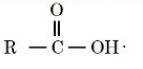
Statement II: R-CN hydrolyses under acidic medium to produce a compound which on treatment with $\text{SOCl}_2$, followed by the addition of $\text{NH}_3$ gives another compound(x). This compound (x) on treatment with $\text{NaOCl/NaOH}$ gives a product, that on treatment with $\text{CHCl}_3\text{/KOH/}\Delta$ produces R-NC
In the light of the above statements, choose the correct answer from the options given below- Given below are two statements:
Statement I: Cross aldol condensation between two different aldehydes will always produce four different products.
Statement II: When semicarbazide reacts with a mixture of benzaldehyde and acetophenone under optimum pH, it forms a condensation product with acetophenone only.
In the light of the above statements, choose the correct answer from the options given below - Grignard reagent $\text{RMgBr (P)}$ reacts with water and forms a gas $\text{(Q)}$. One gram of Q occupies $1.4 \text{ dm}^3$ at STP. (P) on reaction with dry ice in dry ether followed by $\text{H}_3\text{O}^+$ forms a compound $\text{(Z)}$. 0.1 mole of $\text{(Z)}$ will weigh _________ g. (Nearest integer)
- Given below are four compounds :
(a) n-propyl choride
(b) iso-propyl chloride
(c) sec-butyl chloride
(d) neo-pentyl chloride
Percentage of carbon in the one which exhibits optical isomerism is : - The correct statements are :
A. Activation energy for enzyme catalysed hydrolysis of sucrose is lower than that of acid catalysed hydrolysis.
B. During denaturation, secondary and tertiary structures of a protein are destroyed but primary structure remains intact.
C. Nucleotides are joined together by glycosidic linkage between $\text{C}_1$ and $\text{C}_4$ carbons of the pentose sugar.
D. Quaternary structure of proteins represents overall folding of the polypeptide chain.
Choose the correct answer from the options given below : - By usual analysis, $1.00\text{ g}$ of compound (X) gave $1.79\text{ g}$ of magnesium pyrophosphate. The percentage of phosphorus in compound (X) is : __________ (nearest integer)
(Given, molar mass in $\text{g\ mol}^{-1}$ : $\text{O} = 16, \text{Mg} = 24, \text{P} = 31$) - The correct order of the rate of the reaction for the following reaction with respect to nucleophiles is :
$\text{CH}_3\text{Br} + \text{Nu}^\ominus \longrightarrow \text{CH}_3\text{Nu} + \text{Br}^\ominus$ Given below are two statements :
Statement I : Compound (X), shown below, dissolves in $\text{NaHCO}_3$ solution and has two chiral carbon atoms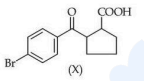
Statement II : Compound (Y), shown below, has two carbons with $\text{sp}^3$ hybridization, one carbon with $\text{sp}^2$ and one carbon with $\text{sp}$ hybridization
In the light of the above statements, choose the correct answer from the options given below :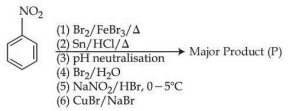
Consider the above sequence of reactions. The number of bromine atom(s) in the final product (P) will be :
Important Questions from Organic Chemistry
- In Dumas method for estimation of nitrogen, 0.50 g of an organic compound gave 70 mL of nitrogen collected at 300 K and 715 mm pressure. The percentage of nitrogen in the organic compound is ______ %.
(Aqueous tension at 300 K is 15 mm). Given below are two statements:
Statement I: The dipole moment of R-CN is greater than R-NC and R-NC can undergo hydrolysis under acidic medium to produce
Statement II: R-CN hydrolyses under acidic medium to produce a compound which on treatment with $\text{SOCl}_2$, followed by the addition of $\text{NH}_3$ gives another compound(x). This compound (x) on treatment with $\text{NaOCl/NaOH}$ gives a product, that on treatment with $\text{CHCl}_3\text{/KOH/}\Delta$ produces R-NC
In the light of the above statements, choose the correct answer from the options given below- Given below are two statements:
Statement I: Cross aldol condensation between two different aldehydes will always produce four different products.
Statement II: When semicarbazide reacts with a mixture of benzaldehyde and acetophenone under optimum pH, it forms a condensation product with acetophenone only.
In the light of the above statements, choose the correct answer from the options given below - Grignard reagent $\text{RMgBr (P)}$ reacts with water and forms a gas $\text{(Q)}$. One gram of Q occupies $1.4 \text{ dm}^3$ at STP. (P) on reaction with dry ice in dry ether followed by $\text{H}_3\text{O}^+$ forms a compound $\text{(Z)}$. 0.1 mole of $\text{(Z)}$ will weigh _________ g. (Nearest integer)
- Given below are four compounds :
(a) n-propyl choride
(b) iso-propyl chloride
(c) sec-butyl chloride
(d) neo-pentyl chloride
Percentage of carbon in the one which exhibits optical isomerism is :



