(Given molar mass in $\text{g~mol}^{-1}$ $\text{H}: 1, \text{C}: 12, \text{Br} : 80, \text{Ag} : 108$)
Bromo Hydrocarbon Empirical Formula Calculation using Carius Analysis
This solution details the steps to determine the empirical formula of a bromo hydrocarbon (X) using Carius analysis data and the given percentage of carbon.
Calculating Bromine Content
First, we calculate the amount of Bromine (Br) present in the sample.
- Molar mass of Silver Bromide (AgBr) = Molar mass of Ag + Molar mass of Br = $108 \text{ g~mol}^{-1} + 80 \text{ g~mol}^{-1} = 188 \text{ g~mol}^{-1}$.
- Moles of AgBr formed = $\frac{\text{Mass of AgBr}}{\text{Molar mass of AgBr}} = \frac{3.36 \text{ g}}{188 \text{ g~mol}^{-1}}$.
- From Carius analysis, moles of Br in the compound = moles of AgBr. Moles of Br = $\frac{3.36}{188}$ mol.
- Mass of Br in the compound = Moles of Br $\times$ Molar mass of Br = $\left( \frac{3.36}{188} \text{ mol} \right) \times (80 \text{ g~mol}^{-1}) = \frac{268.8}{188} \text{ g}$.
- Percentage of Br in compound (X) = $\frac{\text{Mass of Br}}{\text{Mass of compound (X)}} \times 100 = \frac{\frac{268.8}{188} \text{ g}}{2.0 \text{ g}} \times 100$.
- Percentage of Br = $\frac{268.8 \times 100}{188 \times 2.0} \% = \frac{26880}{376} \% \approx 71.49\%$.
Determining Atomic Ratios
We use the percentages of Carbon (C) and Bromine (Br) to find the simplest molar ratio. Since it's a hydrocarbon, Hydrogen (H) is also present.
Given:
- Percentage of Carbon (C) = 26.7%
- Calculated Percentage of Bromine (Br) $\approx$ 71.49%
The percentage of Hydrogen (H) is:
Percentage of H = $100\% - (\% \text{C} + \% \text{Br}) = 100\% - (26.7\% + 71.49\%) = 100\% - 98.19\% = 1.81\%$.
To find the empirical formula, consider a 100 g sample:
| Element | Percentage (%) | Mass (g) | Moles (Mass/Molar Mass) | Ratio (Moles / Smallest Moles) | Final Simplest Ratio |
|---|---|---|---|---|---|
| C | 26.7 | 26.7 | $\frac{26.7}{12} \approx 2.225$ | $\frac{2.225}{0.8936} \approx 2.49$ | 5 |
| H | 1.81 | 1.81 | $\frac{1.81}{1} \approx 1.811$ | $\frac{1.811}{0.8936} \approx 2.02$ | 4 |
| Br | 71.49 | 71.49 | $\frac{71.49}{80} \approx 0.8936$ | $\frac{0.8936}{0.8936} = 1$ | 2 |
The smallest molar amount is approximately 0.8936 (for Br). Dividing all molar amounts by this value gives the ratio C : H : Br $\approx 2.49 : 2.02 : 1$.
Empirical Formula Derivation
To obtain whole numbers, we multiply the ratio by 2:
C : H : Br $\approx (2.49 \times 2) : (2.02 \times 2) : (1 \times 2) \approx 4.98 : 4.04 : 2$.
This simplifies to the whole number ratio $5 : 4 : 2$.
Therefore, the empirical formula for compound (X) is $C_5H_4Br_2$.
The total number of carbon atoms in the empirical formula is 5.
Similar Questions
- In Dumas method for estimation of nitrogen, 0.50 g of an organic compound gave 70 mL of nitrogen collected at 300 K and 715 mm pressure. The percentage of nitrogen in the organic compound is ______ %.
(Aqueous tension at 300 K is 15 mm). - $0.25 \text{ g}$ of an organic compound "A" containing carbon, hydrogen and oxygen was analysed using the combustion method. There was an increase in mass of $\text{CaCl}_2$ tube and potash tube at the end of the experiment. The amount was found to be $0.15 \text{ g}$ and $0.1837 \text{ g}$, respectively. The percentage of oxygen in compound A is ______ %. (Nearest integer)
(Given: molar mass in $\text{g mol}^{-1}$ $\text{H} : 1, \text{C} : 12, \text{O} : 16$) - Grignard reagent $\text{RMgBr (P)}$ reacts with water and forms a gas $\text{(Q)}$. One gram of Q occupies $1.4 \text{ dm}^3$ at STP. (P) on reaction with dry ice in dry ether followed by $\text{H}_3\text{O}^+$ forms a compound $\text{(Z)}$. 0.1 mole of $\text{(Z)}$ will weigh _________ g. (Nearest integer)
- Consider all the structural isomers with molecular formula $\text{C}_5\text{H}_{11}\text{Br}$ are separately treated with $\text{KOH(aq)}$ to give respective substitution products, without any rearrangement. The number of products which can exhibit optical isomerism from these is ___________.
Consider the following reactions sequence
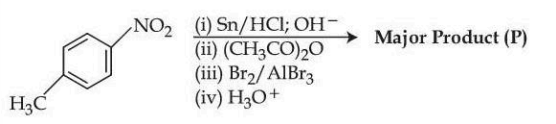
When the product (P) is subjected to Carius analysis using $\text{AgNO}_3$, $1.0\text{ g}$ of the product (P) will produce __________ g of the precipitate of AgBr. (Nearest Integer)
(Given : molar mass in $\text{g mol}^{-1}$ C : 12, H : 1, O : 16, N : 14, Br : 80, Ag : 108)Consider the following sequence of reactions to give the major product (X)
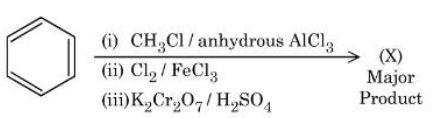
$\text{P}~\text{g}$ of the major product (X) formed is reacted with $\text{NaHCO}_3$ solution to liberate a gas which occupied $11.2~\text{dm}^3$ at STP.
$\text{P} = \_\_\_\_\_\_\_\_~\text{g}$.
(Given molar mass in $\text{g~mol}^{-1}$ $\text{H}: 1, \text{C}: 12, \text{O}: 16, \text{Cl}: 35.5$)- The number of isomeric compounds (structural isomers only) possible with the molecular formula $C_5H_{10}O_2$, which do not react with metallic sodium is ________
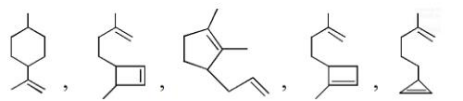
Among the following, how many hydrocarbon (s) with formula $C_{10}H_{16}$ which on reaction with acidic potassium permagenate yield(s) same product? ____________
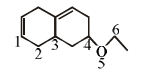
On treatment of the following compound with a strong acid, the most susceptible site for bond cleavage is :-
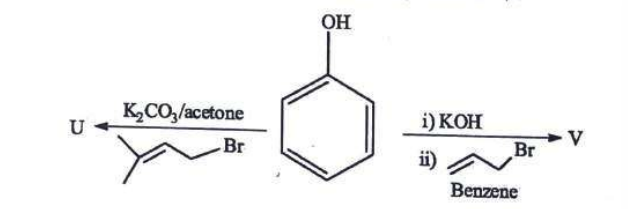
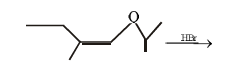
The total number of optically active compounds formed in the following reaction is :-
Important Questions from Organic Chemistry
- In Dumas method for estimation of nitrogen, 0.50 g of an organic compound gave 70 mL of nitrogen collected at 300 K and 715 mm pressure. The percentage of nitrogen in the organic compound is ______ %.
(Aqueous tension at 300 K is 15 mm). - $0.25 \text{ g}$ of an organic compound "A" containing carbon, hydrogen and oxygen was analysed using the combustion method. There was an increase in mass of $\text{CaCl}_2$ tube and potash tube at the end of the experiment. The amount was found to be $0.15 \text{ g}$ and $0.1837 \text{ g}$, respectively. The percentage of oxygen in compound A is ______ %. (Nearest integer)
(Given: molar mass in $\text{g mol}^{-1}$ $\text{H} : 1, \text{C} : 12, \text{O} : 16$) - Grignard reagent $\text{RMgBr (P)}$ reacts with water and forms a gas $\text{(Q)}$. One gram of Q occupies $1.4 \text{ dm}^3$ at STP. (P) on reaction with dry ice in dry ether followed by $\text{H}_3\text{O}^+$ forms a compound $\text{(Z)}$. 0.1 mole of $\text{(Z)}$ will weigh _________ g. (Nearest integer)
- Consider all the structural isomers with molecular formula $\text{C}_5\text{H}_{11}\text{Br}$ are separately treated with $\text{KOH(aq)}$ to give respective substitution products, without any rearrangement. The number of products which can exhibit optical isomerism from these is ___________.
The major products U and V in the following reaction are