The major products U and V in the following reaction are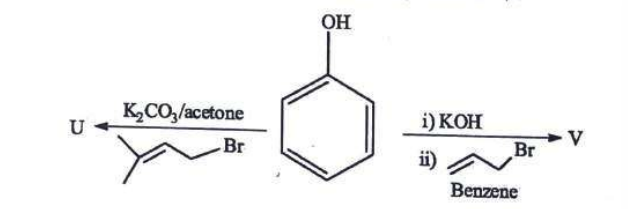
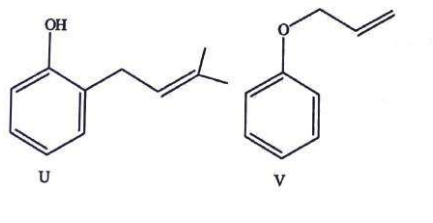
To identify the major products U and V in the given reaction sequence, we need to analyze both steps of the reaction.
Step 1: The reaction of phenol with isobutyl bromide in the presence of K2CO3 and acetone.
The role of K2CO3 is to deprotonate the phenol, thereby forming phenoxide ion. This ion acts as a nucleophile in an SN2 reaction with isobutyl bromide, resulting in the substitution of the bromide with an isobutyl group on the phenoxide. Thus, compound U is isobutyl phenyl ether.
Step 2: The reaction of phenoxide formed with another alkyl bromide in basic conditions (KOH in benzene).
In the presence of KOH and heat in benzene, the phenoxide ion can undergo another SN2 reaction but this time with the ethylene bromide given. This substitution results in the formation of an ether linkage with ethyl group. The correct product, compound V, would therefore be ethyl isobutyl phenyl ether.
Based on the explanation above, the major products U and V are as shown in the correct image option:
Similar Questions
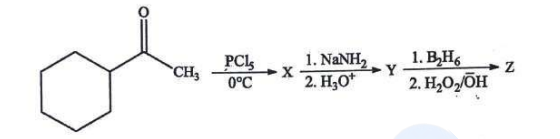
In the following sequence of reactions, what is the end product 'Z'?
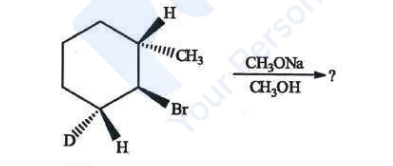
Indicate the major product of the following reaction:
- How many isomers can a compound with molecular formula $\text{C}_{3}\text{H}_{5}\text{Br}$ have?
The increasing order of basicity of the following compounds is

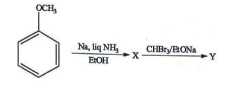
The products X and Y in the following reaction sequence are
Which one of the following does not lose water even in conc. $H_2SO_4$?
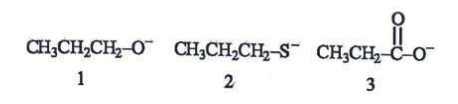
Rank the following anions in order of decreasing nucleophilicity in a polar protic solvent (most $\rightarrow$ least nucleophilic).
- In the following reaction sequence, the product Y is
$Br(CH_2)_{12}-C\equiv CH \xrightarrow{NaNH_2} X \xrightarrow[\text{catalyst}]{H_2, \text{ Lindler}} Y$ The major product in the following reaction is
$RO-CH_2-C\equiv CH \xrightarrow{X} \xrightarrow{Y} RO-CH_2-C\equiv C-CH_2CH_2-Br$
To carry out the above conversion X and Y are respectively
Important Questions from Organic Chemistry
- In Dumas method for estimation of nitrogen, 0.50 g of an organic compound gave 70 mL of nitrogen collected at 300 K and 715 mm pressure. The percentage of nitrogen in the organic compound is ______ %.
(Aqueous tension at 300 K is 15 mm). - $0.25 \text{ g}$ of an organic compound "A" containing carbon, hydrogen and oxygen was analysed using the combustion method. There was an increase in mass of $\text{CaCl}_2$ tube and potash tube at the end of the experiment. The amount was found to be $0.15 \text{ g}$ and $0.1837 \text{ g}$, respectively. The percentage of oxygen in compound A is ______ %. (Nearest integer)
(Given: molar mass in $\text{g mol}^{-1}$ $\text{H} : 1, \text{C} : 12, \text{O} : 16$) - Grignard reagent $\text{RMgBr (P)}$ reacts with water and forms a gas $\text{(Q)}$. One gram of Q occupies $1.4 \text{ dm}^3$ at STP. (P) on reaction with dry ice in dry ether followed by $\text{H}_3\text{O}^+$ forms a compound $\text{(Z)}$. 0.1 mole of $\text{(Z)}$ will weigh _________ g. (Nearest integer)
- Consider all the structural isomers with molecular formula $\text{C}_5\text{H}_{11}\text{Br}$ are separately treated with $\text{KOH(aq)}$ to give respective substitution products, without any rearrangement. The number of products which can exhibit optical isomerism from these is ___________.
In the following sequence of reactions, what is the end product 'Z'?