
The question asks for the distance beyond which ray optics is a valid approximation for light passing through an aperture.
Determining Ray Optics Validity
Ray optics is a limit of wave optics where diffraction effects are negligible. This occurs when the wavelength ($\lambda$) is much smaller than the dimensions of the aperture ($a$) and the distance ($d$) to the observation point. A common criterion involves the Fresnel number ($N_F$).
Fresnel Number Criterion
The Fresnel number is defined as $N_F = \frac{a^2}{\lambda d}$.
- When $N_F \gg 1$, Fresnel diffraction is significant, and ray optics is not valid.
- When $N_F \ll 1$, diffraction effects are small, and ray optics provides a good approximation.
We need to find the distance $d_0$ such that for distances $d > d_0$, $N_F < 1$. We can find this threshold distance by setting $N_F = 1$.
Calculating Threshold Distance
Setting the Fresnel number to 1:
$ N_F = \frac{a^2}{\lambda d_0} = 1 $Solving for the threshold distance $d_0$:
$ d_0 = \frac{a^2}{\lambda} $Substituting Values and Finding the Distance
Given:
- Aperture width, $a = 6 \text{ mm} = 6 \times 10^{-3} \text{ m} $
- Wavelength, $\lambda = 6000 \text{ \AA} = 6000 \times 10^{-10} \text{ m} = 6 \times 10^{-7} \text{ m} $
Substitute these values into the formula for $d_0$:
$ d_0 = \frac{(6 \times 10^{-3} \text{ m})^2}{6 \times 10^{-7} \text{ m}} $ $ d_0 = \frac{36 \times 10^{-6} \text{ m}^2}{6 \times 10^{-7} \text{ m}} $ $ d_0 = 6 \times 10^1 \text{ m} $ $ d_0 = 60 \text{ m} $Conclusion
Ray optics is sufficiently valid beyond the distance $d_0 = 60 \text{ m}$.
Similar Questions
- A plano-convex lens fits exactly into a plano-concave lens. Their plane surfaces are parallel to each other. If lenses are made of different materials of refractive indices $\mu_1$ and $\mu_2$ and $R$ is the radius of curvature of the curved surface of the lenses, then the focal length of the combination is
- A person has a minimum distance of distinct vision of 50 cm. The power of lenses required to read a book at a distance of 25 cm is
- A ray of light travelling in air is incident on one face of a parallel glass slab of thickness $t$ and refractive index $\mu$ at an angle of incidence $i$. Total time spent by the ray inside the slab is
- An electromagnetic wave, whose wave normal makes an angle of $45^{\circ}$ with the vertical, is travelling in air and strikes a horizontal liquid surface. While travelling through the liquid, it gets deviated by $15^{\circ}$. If the speed of electromagnetic wave in air is $3 \times 10^{8}\text{ m/s}$, then the speed of electromagnetic wave in the liquid will be
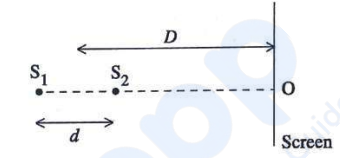
Two points of monochromatic and coherent sources of light of wavelength $\lambda$ each, are placed as shown in figure. The initial phase difference between the sources is zero, ($D \gg d$). Mark the correct statement(s).
Important Questions from Optics
- Distance between an object and three times magnified real image is $40 \text{ cm}$. The focal length of the mirror used is _______ cm.
- A point source is kept at the center of a spherically enclosed detector. If the volume of the detector increased by 8 times, the intensity will
- Five persons $\text{P}_1, \text{P}_2, \text{P}_3, \text{P}_4 \text{ and } \text{P}_5$ recorded object distance ($u$) and image distance ($v$) using same convex lens having power $+5\text{D}$ as $(25, 96), (30, 62), (35, 37), (45, 35)$ and $(50, 32)$ respectively. Identify correct statement
- In the Young's double slit experiment the intensity produced by each one of the individual slits is $I_o$. The distance between two slits is $2 \text{ mm}$. The distance of screen from slits is $10 \text{ m}$. The wavelength of light is $6000 \text{ \AA}$. The intensity of light on the screen in front of one of the slits is _______.
- In a microscope the objective is having focal length $f_o = 2 \text{ cm}$ and eye-piece is having focal length $f_e = 4 \text{ cm}$. The tube length is $32 \text{ cm}$. The magnification produced by this microscope for normal adjustment is ____________.


