
Calculating Electromagnetic Wave Speed in Liquid
This problem involves calculating the speed of an electromagnetic wave as it passes from air into a liquid, using the principles of refraction and Snell's Law.
Determining Angles of Incidence and Refraction
The wave normal makes an angle of $45^{\circ}$ with the vertical. Since the liquid surface is horizontal, the vertical direction is normal to the surface. Therefore, the angle of incidence ($\theta_1$) is:
$\theta_1 = 45^{\circ}$
The wave deviates by $15^{\circ}$. Deviation is the difference between the angle of incidence and the angle of refraction ($\theta_2$). Assuming the wave bends towards the normal (as it enters a potentially denser medium), the angle of refraction is:
$\theta_2 = \theta_1 - \text{deviation} = 45^{\circ} - 15^{\circ} = 30^{\circ}$
Applying Snell's Law
Snell's Law relates the angles of incidence and refraction to the refractive indices of the two media:
$n_{air} \sin(\theta_1) = n_{liquid} \sin(\theta_2)$
The refractive index of air ($n_{air}$) is approximately 1. Substituting the known values:
$1 \times \sin(45^{\circ}) = n_{liquid} \times \sin(30^{\circ})$
$n_{liquid} = \frac{\sin(45^{\circ})}{\sin(30^{\circ})} = \frac{1/\sqrt{2}}{1/2} = \frac{2}{\sqrt{2}} = \sqrt{2}$
Calculating Speed in Liquid
The refractive index ($n$) of a medium is defined as the ratio of the speed of light in vacuum ($c$) to the speed of light in the medium ($v$): $n = c/v$. Since the speed of light in air ($v_{air}$) is given as $3 \times 10^8 \text{ m/s}$, and $n_{air} \approx 1$, we can consider $c \approx v_{air}$.
Therefore, the speed in the liquid ($v_{liquid}$) can be found using:
$n_{liquid} = \frac{v_{air}}{v_{liquid}}$
$v_{liquid} = \frac{v_{air}}{n_{liquid}}$
Substituting the values:
$v_{liquid} = \frac{3 \times 10^8 \text{ m/s}}{\sqrt{2}}$
$v_{liquid} = \frac{3}{\sqrt{2}} \times 10^8 \text{ m/s} \approx 2.1213 \times 10^8 \text{ m/s}$
Rounding to one decimal place, the speed of the electromagnetic wave in the liquid is approximately $2.1 \times 10^8 \text{ m/s}$.
Similar Questions
- Beyond what distance, the ray optics is sufficiently valid when the aperture is $6\text{ mm}$ wide and the wavelength is $6000\text{ \AA}$?
- A plano-convex lens fits exactly into a plano-concave lens. Their plane surfaces are parallel to each other. If lenses are made of different materials of refractive indices $\mu_1$ and $\mu_2$ and $R$ is the radius of curvature of the curved surface of the lenses, then the focal length of the combination is
- A person has a minimum distance of distinct vision of 50 cm. The power of lenses required to read a book at a distance of 25 cm is
- A ray of light travelling in air is incident on one face of a parallel glass slab of thickness $t$ and refractive index $\mu$ at an angle of incidence $i$. Total time spent by the ray inside the slab is
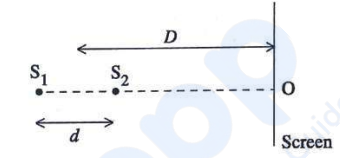
Two points of monochromatic and coherent sources of light of wavelength $\lambda$ each, are placed as shown in figure. The initial phase difference between the sources is zero, ($D \gg d$). Mark the correct statement(s).
Important Questions from Optics
- A point source is kept at the center of a spherically enclosed detector. If the volume of the detector increased by 8 times, the intensity will
- Five persons $\text{P}_1, \text{P}_2, \text{P}_3, \text{P}_4 \text{ and } \text{P}_5$ recorded object distance ($u$) and image distance ($v$) using same convex lens having power $+5\text{D}$ as $(25, 96), (30, 62), (35, 37), (45, 35)$ and $(50, 32)$ respectively. Identify correct statement
- In the Young's double slit experiment the intensity produced by each one of the individual slits is $I_o$. The distance between two slits is $2 \text{ mm}$. The distance of screen from slits is $10 \text{ m}$. The wavelength of light is $6000 \text{ \AA}$. The intensity of light on the screen in front of one of the slits is _______.
- In a microscope the objective is having focal length $f_o = 2 \text{ cm}$ and eye-piece is having focal length $f_e = 4 \text{ cm}$. The tube length is $32 \text{ cm}$. The magnification produced by this microscope for normal adjustment is ____________.
- A collimated beam of light of diameter $2 \text{ mm}$ is propagating along x-axis. The beam is required to be expanded in a collimated beam of diameter $14 \text{ mm}$ using a system of two convex lenses. If first lens has focal length $40 \text{ mm}$, then the focal length of second lens is ____________ $\text{mm}$.


